
Article: Large Capacity Jewelry Organizer Cabinet with Hidden Compartments: The Commissioned Standard
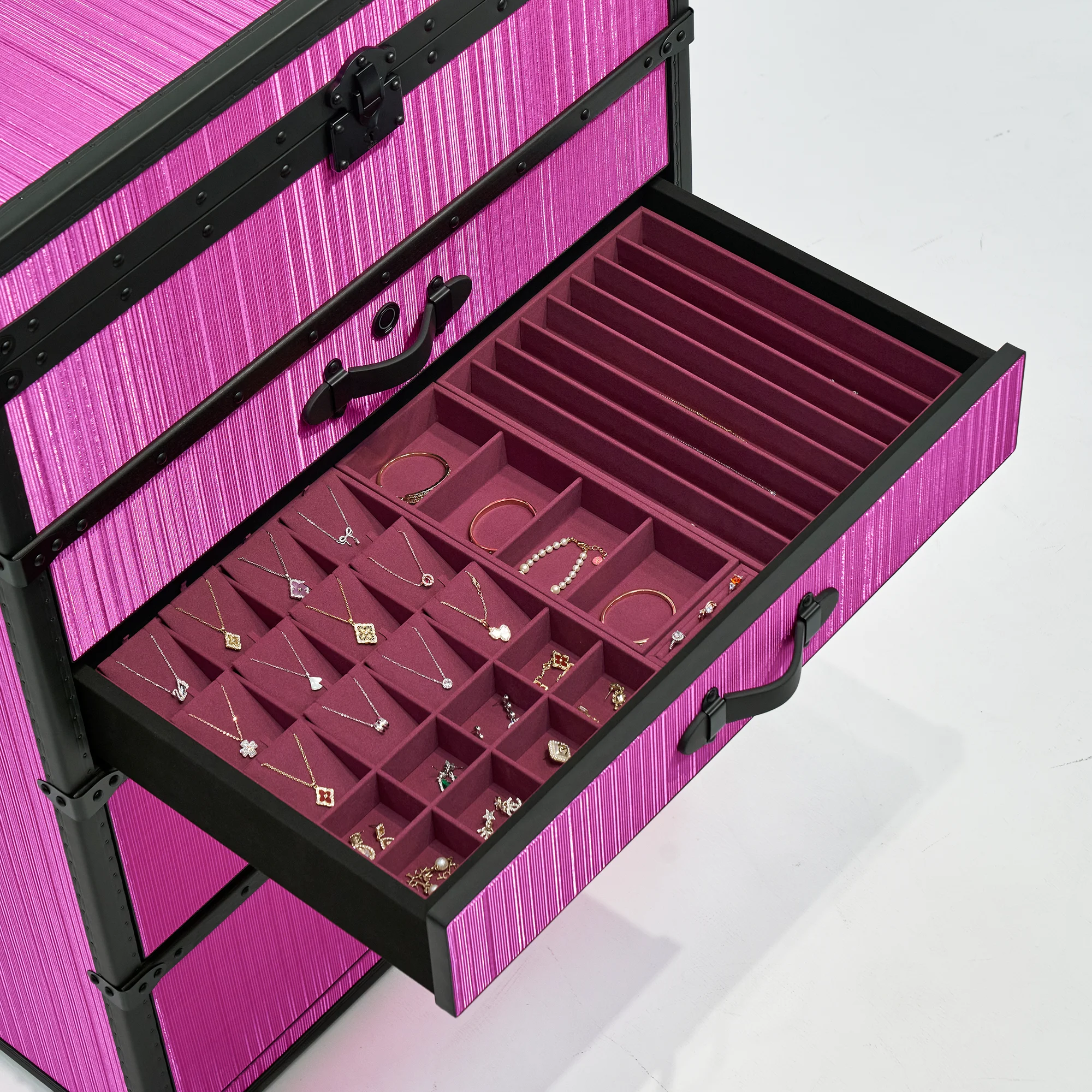
Large Capacity Jewelry Organizer Cabinet with Hidden Compartments: The Commissioned Standard
A jewelry cabinet that conceals nothing is, in truth, protecting nothing. For a collection spanning signed parures, loose stones, and pieces inherited across generations, the standard wardrobe drawer represents a fundamental failure of custodianship — not merely an inconvenience. The real challenge is threefold: capacity that maps to a living collection, hidden compartments engineered against both opportunistic theft and ambient climate damage, and a material envelope that resists the humidity swings and dry heat characteristic of Gulf interiors. Hidden compartments in a genuinely commissioned cabinet are not a styling detail; they are a calibrated anti-oxidation and anti-theft architecture, and the specifications behind them determine whether your collection emerges from storage in the same condition it entered.
Guide to This Commission
- The SIRAE Standard — key parameters, proof terms, and the climate blind spot
- Hidden Compartment Design: Tiered Storage and Private Security Architecture
- Materials and Craft Standards: Solid Oak Frames, Velvet Lining, and UV-Resistant Glass
- Selecting a Large Capacity Jewelry Cabinet: Dimensions, Lock Grades, and Brand Positioning
The SIRAE Standard
Core specification parameters — SIRAE large capacity jewelry organizer cabinet with hidden compartments:
| Parameter | Specification |
|---|---|
| Cabinet dimensions | 1420 mm (W) × 460 mm (D) × 820 mm (H) |
| Frame construction | Solid oak carcass |
| Interior lining | Velvet lining (scratch-zero contact surface) |
| Compartment tiers | Minimum 3 concealed sub-levels; discrete drawer-within-drawer architecture |
| Hardware | Soft-close hinge (silent closure, zero-impact on stored pieces) |
| Lock standard | ANSI/BHMA lock grade certification — Grade 1 or Grade 2 per application |
| Glazing | UV-resistant tempered glass door panels (UVA/UVB filtration) |
| Closure mechanism | Combination cabinet format (visible display + concealed storage) |
| Climate context | Dubai interior: 23–27 °C stable ambient target; RH management via sealed compartment gaskets |
Competitor blind spot — hidden compartment anti-humidity and anti-oxidation specification gap:
- Symptom: Tarnishing, micro-oxidation, and surface patina degradation on silver, gold alloys, and bare stones stored inside nominally "sealed" hidden drawers — observable within 6–18 months in Gulf-climate interiors where ambient RH can spike to 70–85% during transitional seasons.
- Spec/Mechanism: Sealed hidden compartment gaskets combined with anti-tarnish microfibre or silver-thread velvet lining; compartment-level vapour barrier rather than cabinet-level only; solid oak carcass (naturally hygroscopic buffering, absorbs and releases moisture slowly) rather than MDF or particleboard substrates that off-gas and accelerate oxidation.
- Verification: RH delta measurement between ambient interior and sealed compartment interior after a 72-hour closed-door period — target ≤ 5% RH differential; tarnish-strip test on sterling silver coupon placed in compartment for 30 days (zero visible discolouration = pass).
Front-loaded proof terms: solid oak frame · ANSI/BHMA lock grade · UV-resistant tempered glass · soft-close hinge · sealed-compartment vapour management · velvet lining · 1420 × 460 × 820 mm · anti-oxidation gasket architecture.
Hidden Compartment Design: Tiered Storage and Private Security Architecture
The Logic of Concealment as Structural Function
There is a meaningful distinction between a cabinet that has a hidden drawer and one whose hidden compartments are load-bearing elements of a security architecture. In the SIRAE commission format, concealment is not cosmetic. The combination cabinet structure integrates visible display volumes — for curated daily pieces — with at least three discrete sub-levels that are invisible from the exterior and inaccessible without deliberate knowledge of the release sequence.
This tiered approach addresses a specific collector reality: not every piece in a 200-piece collection carries the same access frequency. Pieces worn weekly belong in a visible, easily reached zone. Investment-grade stones, signed heritage jewelry, and loose diamonds belong in a sealed, independently locked sub-level where neither a visiting housekeeper nor a distracted moment creates exposure. The logic is architectural before it is aesthetic.
Compartment Tiers and Their Practical Mapping
A well-engineered hidden compartment cabinet structures its interior across at least three conceptually distinct zones:
- Zone 1 — Display tier: Glazed, lit, accessible; daily and guest-visible rotation pieces.
- Zone 2 — Mid-level concealed drawers: Removed from sight behind a flush panel; higher-value items on a weekly-or-less access cycle; individually partitioned for rings, bracelets, and pendants.
- Zone 3 — Deep hidden compartment: Requires deliberate two-step release; reserved for loose stones, high-carat signed pieces, and items of sentimental or insurance-grade value; lined with sealed-edge velvet and gasketed for climate isolation.
This architecture answers the central question posed by collectors acquiring a cabinet for over 200 pieces: the internal zoning logic must be decided before commission, not improvised after delivery.
Lock Grades and What ANSI/BHMA Certification Actually Means
The ANSI/BHMA lock grade classification is the operative standard for evaluating a jewelry cabinet lock mechanism against verifiable performance criteria rather than marketing language.
- Grade 1 — highest cycle rating; suited to primary access locks on large commissions; tested to 250,000 operational cycles.
- Grade 2 — residential-duty specification; appropriate for secondary compartment locks within a cabinet where the first line of physical defence is a Grade 1 primary.
- Grade 3 — light-duty; not recommended for a collection of meaningful value.
For a commissioned SIRAE cabinet housing a collection of this scale, the expectation is Grade 1 on the primary enclosure, with Grade 2 secondary locks on individual hidden sub-levels. This is not the standard specification published by most catalogue competitors, whose product descriptions omit lock grade certification entirely — leaving the collector with no verifiable security benchmark whatsoever.
Materials and Craft Standards: Solid Oak Frames, Velvet Lining, and UV-Resistant Glass
Why a Solid Oak Carcass Matters in Dubai's Interior Climate
The frame material is not a decorative decision. In a Gulf interior — where central air conditioning cycles the ambient temperature between 20 °C and 27 °C across a single day, and where seasonal transitions bring brief but sharp humidity surges — the carcass material determines the long-term dimensional stability of every drawer, every hinge alignment, and every gasket seal.
Solid oak offers a naturally hygroscopic structure: it absorbs and releases atmospheric moisture slowly and evenly, buffering micro-climate swings rather than amplifying them. The grain is close, the response measured. MDF and particleboard alternatives, by contrast, expand and contract unevenly under these conditions, distorting drawer tolerances and — critically — compromising the gasket seals that protect hidden compartments from oxidation-causing humidity ingress. It is worth being precise about that distinction: the failure mode is not visual, not immediate. It accumulates over eighteen months in a closed drawer, invisible until it is not.
The SIRAE combination cabinet is built on a full oak carcass. This is a specification that separates a commissioned piece from catalogue alternatives positioned under the same luxury vocabulary.
Velvet Lining: Contact Surface as Anti-Damage Protocol
Velvet lining in a jewelry cabinet is the interface between stored metal and everything that damages it: abrasion, surface scratch, micro-vibration transfer during drawer closure. The pile is soft to the touch and quietly purposeful beneath it.
The relevant parameters for a collector-grade specification:
- Pile density: Higher pile holds rings and pendant bails in place without lateral drift; prevents stone-to-stone contact within a shared tray.
- Fibre composition: Anti-tarnish silver-thread velvet or microfibre alternatives actively buffer sulphur compounds in ambient air — a meaningful advantage in high-occupancy villa environments where cooking and cleaning chemistry permeates HVAC systems.
- Adhesion: Velvet adhered directly to a solid substrate (rather than over foam over particleboard) maintains flush contact without peeling or wrinkling at drawer edges — a common failure point in mass-market alternatives after eighteen months.
Soft-Close Hinges: Vibration as the Overlooked Risk
The soft-close hinge specification matters beyond mere silence. Jewelry — particularly pieces with pavé settings, prong-set stones, or enamel work — is vulnerable to repetitive micro-impact vibration. A standard hinge closes with an impact force measurable at the stone-setting level; the effect is cumulative and, for pavé work especially, insidious. A calibrated soft-close mechanism absorbs that kinetic energy hydraulically, delivering a zero-slam closure with each use.
This is not a feature. It is a damage-prevention protocol.
UV-Resistant Tempered Glass Panels
UV-resistant tempered glass door panels filter both UVA and UVB wavelengths that accelerate the fading of organic gem materials — pearls, coral, amber, and certain treated stones — as well as the bleaching of velvet lining over time.
In a Dubai interior with significant natural light exposure, this specification is non-negotiable for any display-facing compartment housing organic or treated gem materials.
| Material Element | Functional Role | Gulf-Climate Relevance |
|---|---|---|
| Solid oak carcass | Hygroscopic buffering, dimensional stability | Prevents drawer tolerance loss in humidity swings |
| Velvet lining | Scratch-zero contact surface, anti-tarnish buffering | Resists sulphur compounds from HVAC environments |
| Soft-close hinge | Vibration elimination at closure | Protects pavé settings and prong-set stones |
| UV-resistant tempered glass | UVA/UVB filtration on display tier | Prevents gem fading and velvet discolouration |
| Compartment gaskets | RH isolation within hidden sub-levels | Target ≤ 5% RH differential vs ambient |
Selecting a Large Capacity Jewelry Cabinet: Dimensions, Lock Grades, and Brand Positioning
Dimensional Planning for a 200-Piece Collection
The SIRAE combination cabinet at 1420 × 460 × 820 mm occupies a meaningful but considered footprint in a master dressing room or walk-in wardrobe. To calibrate that against a real collection:
- A 200-piece collection spanning rings, necklaces, earrings, bracelets, and loose stones requires a minimum of eight to twelve distinct storage zones — not eight drawers, but eight functionally differentiated zones with appropriate depth, width, and lining configuration per category.
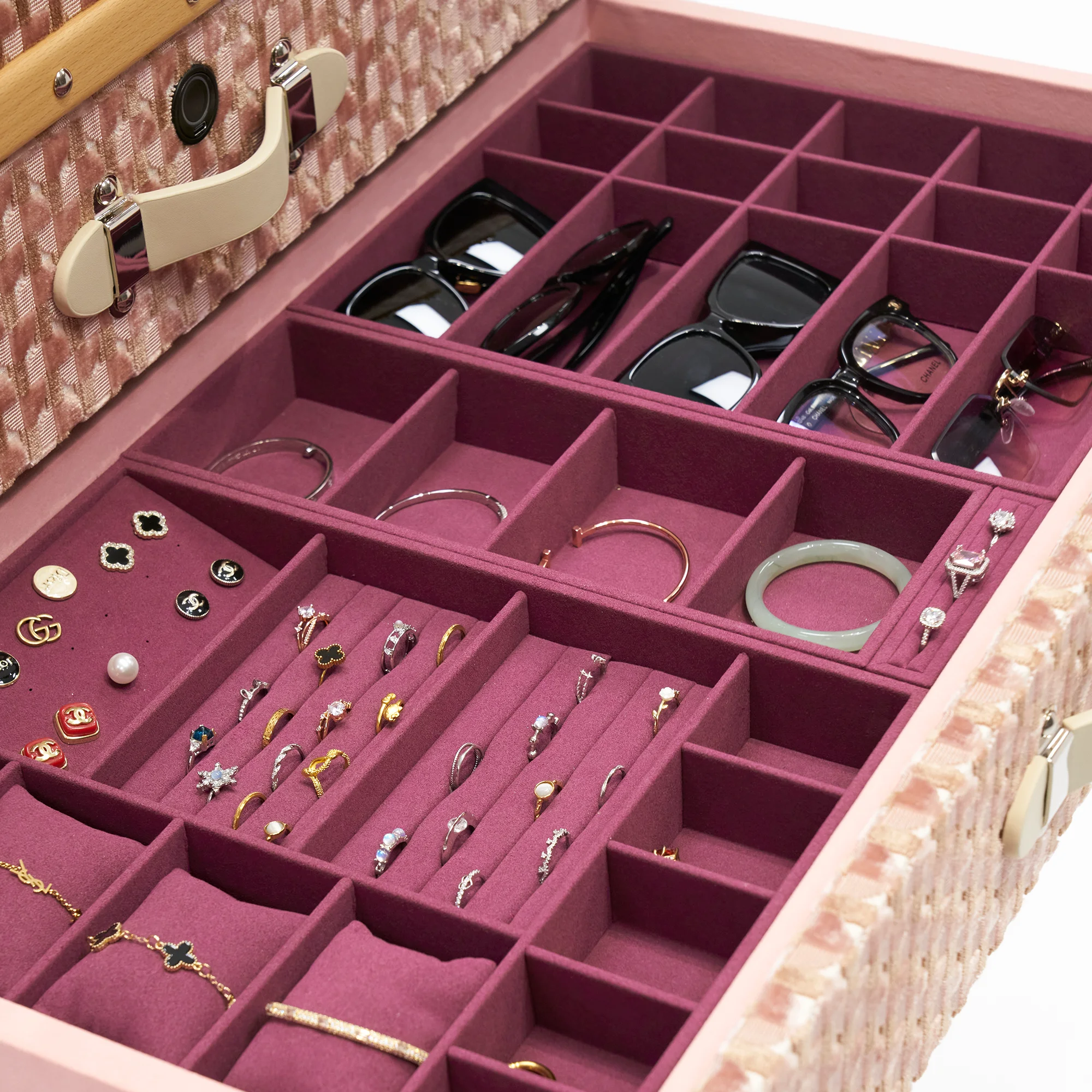
- Necklaces require vertical hang space or dedicated horizontal lay-flat trays with individual channel partitioning to prevent chain entanglement.
- Rings and earrings require shallow, high-pile velvet trays with individual recesses.
- Loose stones and high-value unset pieces require a sealed, gasketed sub-level with an independent lock.
At 1420 mm wide and 820 mm tall, the cabinet provides the footprint to accommodate this zoning — provided the internal configuration is commissioned rather than standardised.
Positioning Against Catalogue Competitors
To answer the question of how SIRAE compares to Buben & Zorweg and Agresti in the context of a Dubai or Gulf-based collection:
Buben & Zorweg operates at the intersection of watch winding and jewelry display. Their jewelry cabinet offering tends toward motorised display platforms and integrated watch-winder technology — a compelling specification for a mixed watch-and-jewelry collection, but one that introduces electronic complexity and significantly extended lead times (typically 16–24 weeks for commissioned pieces). Their published specifications rarely address gasket-level humidity management within hidden compartments — the precise gap that causes oxidation in Gulf interiors.
Agresti produces hand-crafted Italian cabinetry with a strong tradition in jewelry storage. Their hidden compartment execution is accomplished, and their velvet lining quality is among the most referenced in the category. Their work is visibly assured. However, their published climate specifications are designed around European interior conditions — notably cooler and less humidity-variable than Dubai or Riyadh — and their anti-oxidation documentation for sealed sub-levels is not published at a specification level that allows independent verification.
The SIRAE commissioned approach answers these gaps directly: the oak carcass, gasket-sealed hidden compartments, and ANSI/BHMA-verified lock hardware are designed and installed against Gulf-climate parameters from the outset. Clients commissioning from the Dubai showroom on Jumeirah Beach Road are working with a team whose reference point is the actual ambient condition of a Dubai villa interior — not a European design studio's approximation of it.
The Marriage-Gift Commission: A Technical Checklist
For a gift commission serving a collector of over 200 fine jewelry pieces, the parameters warranting scrutiny are as follows:
- Internal zoning logic: Has the configuration been mapped against the actual collection categories, or is it a generic tray layout?
- Lock grade verification: Is the ANSI/BHMA grade published and independently verifiable, or is "secure locking" the full extent of the specification?
- Timber certification: Is the solid oak certified to FSC or PEFC standards? This matters both for environmental credentials and as a proxy for timber quality control across the supply chain.
- Hidden compartment climate isolation: Is there a published RH differential specification for sealed sub-levels? If not, the compartment is concealed but not protected.
- Lead time and customisation process: European-origin commissioned pieces typically run 12–20 weeks from final specification sign-off. A bespoke commission originating from the SIRAE showroom in Dubai is managed locally, with direct installation oversight — a meaningful advantage when the delivery address is a private villa in Emirates Hills or a residence in Riyadh that requires white-glove installation rather than freight delivery.
A Note on Anti-Oxidation Architecture as Collector Discipline
The most frequently overlooked dimension in any large capacity jewelry organizer cabinet selection is not the visible specification — the lining colour, the glass, the lock finish — but the invisible one: what happens to a sealed hidden compartment over time in an environment where ambient chemistry works quietly against it.
Tarnish on a silver Art Deco bracelet is not simply an aesthetic inconvenience. It is evidence of a containment failure — a compartment that claimed to protect and did not. The solution is not a polishing cloth. It is a specification decision made before commission: solid substrate, anti-tarnish velvet, gasketed closure, and an oak carcass that mediates rather than amplifies the ambient climate.
This is the standard SIRAE applies at commission. It is verifiable, not merely claimed.
Those wishing to explore a commissioned jewelry cabinet — whether for personal collection, a significant gift, or a multi-cabinet programme across a private residence — are invited to arrange a private consultation at the SIRAE showroom on Jumeirah Beach Road: First floor, Al Shafar Complex, Jumeirah Beach Road, Umm Suqeim 1, Dubai. The conversation begins with the collection itself — its scale, its categories, its climate context — and ends with a piece built precisely for it. To schedule a private viewing or discuss a bespoke commission, please contact the team on +971 55 886 6180, write to info@siraecasa.com, or explore the full programme at https://www.siraecasa.com.

Leave a comment
This site is protected by hCaptcha and the hCaptcha Privacy Policy and Terms of Service apply.