
The Luxury Coffee Table Buyer's Guide for UAE Homes (2026)
The Luxury Coffee Table Buyer's Guide for UAE Homes (2026)
A luxury coffee table is the geometric anchor of any living room or majlis — and the piece most buyers size, shape and specify wrong. Get it right and it ties the seating zone together, handles daily handling without showing it, and survives a decade of UAE summers without warping, pitting or dulling. Get it wrong and no cushion arrangement disguises the error. This 2026 guide covers the four main coffee table formats, a material-by-material verdict for the Gulf climate, sofa and majlis proportion rules, climate-proofing strategy, and a buy-before checklist — so the piece you choose this season is still working in 2036.

Round, Rectangular, Nest or Lift-Top: Which Coffee Table Format Suits Your Space?
Quick Answer: A rectangular coffee table suits most sofa configurations and long rooms; a round table prevents corner injuries and suits smaller spaces or curved seating; a nest of tables offers maximum flexibility for entertaining; a lift-top format serves dual-purpose apartments where the coffee table also functions as a desk or dining surface.
The four formats are not interchangeable — each solves a different spatial and lifestyle problem. Knowing which one fits your room before you consider material, finish or price saves weeks of returns and restyles.
Rectangular is the default for a reason: it parallels the sofa line, clears traffic lanes on each side, and reads correctly in rooms wider than 4 m. It is the workhorse format — most seating configurations, most room proportions, most hosting rituals are built around it.
Round eliminates the hard-corner hazard that matters in households with children or in the narrow walk-arounds of a compact apartment. It also reads softer in a room full of angular furniture, and sits naturally at the centre of a curved sectional or a U-shaped majlis. The trade-off is reduced surface area at the same diameter-to-length equivalence.
Nest of tables — two or three pieces that stack when not in use — is the entertainer's choice. In a UAE villa that hosts weekly, a nest gives you an instantly expanded surface during gatherings and a compact footprint between events. Sub-tables also travel: one moves to a terrace serve point without leaving the main seating area bare.
Lift-top is the dual-purpose format: a hydraulic or hinge mechanism raises the surface to working height so the same piece functions as coffee table, casual dining table and laptop desk. In a studio or one-bedroom apartment in Dubai Marina or Business Bay, it is often the only format that justifies the floor space.
| Format | Best room proportion | Typical dimensions | Primary advantage | Watch for |
|---|---|---|---|---|
| Rectangular | Rooms 4 m+ wide, standard sofa runs | 120–160 cm L × 60–80 cm W | Maximum surface, parallels sofa line | Avoid in narrow corridors; hard corners in busy rooms |
| Round | Compact rooms, curved seating, majlis centres | 70–110 cm diameter | No hard corners, visual softness | Less surface at equivalent footprint |
| Nest of tables (2–3 pc) | Entertaining villas, flexible layouts | Largest: 60–90 cm W | Flexible scale, satellite serve points | Requires storage discipline between events |
| Lift-top | Studios, dual-purpose spaces | 100–130 cm L × 55–65 cm W | Converts to desk/dining height | Mechanical element needs annual check |
What Materials Survive the UAE Climate on a Coffee Table?
Technical Verdict: A luxury coffee table survives the Gulf when its primary structure is dimensionally stable against the 25–90% relative humidity swing between air-conditioned interiors and Dubai summer outdoors, its surface sheds fine Gulf dust without abrasive cleaning, and its hardware or edge detailing is solid brass or stainless rather than plated zinc that pits within two seasons.
The UAE's National Center of Meteorology records summer peaks above 45°C and coastal humidity routinely exceeding 80% RH outdoors (NCM), while air-conditioning pulls interiors down to roughly 25% RH. That swing — wider than almost any furniture market on earth — is what separates a piece engineered for a Milan showroom from one built for a Dubai drawing room.
Stone and marble look architectural and carry weight well, but they are cold to the touch, heavy to move, and porous grades stain from casual spills — coffee, fragrance oil, candle wax. Sealed grades perform acceptably indoors.
Solid wood and veneer move seasonally with the humidity cycle. Solid hardwood handles this better than thin veneer over MDF, which lifts at edges within two Gulf summers. Any wood piece needs regular conditioning oil and should never sit directly under a supply-air outlet.
Glass is dimensionally stable and easy to clean, but surface-scratches from keys, remotes and Gulf dust accumulate into permanent haze under raking light. Toughened 10–12 mm glass on rubber seating performs adequately; thin glass on unsupported spans does not belong in a household with children or daily entertaining.
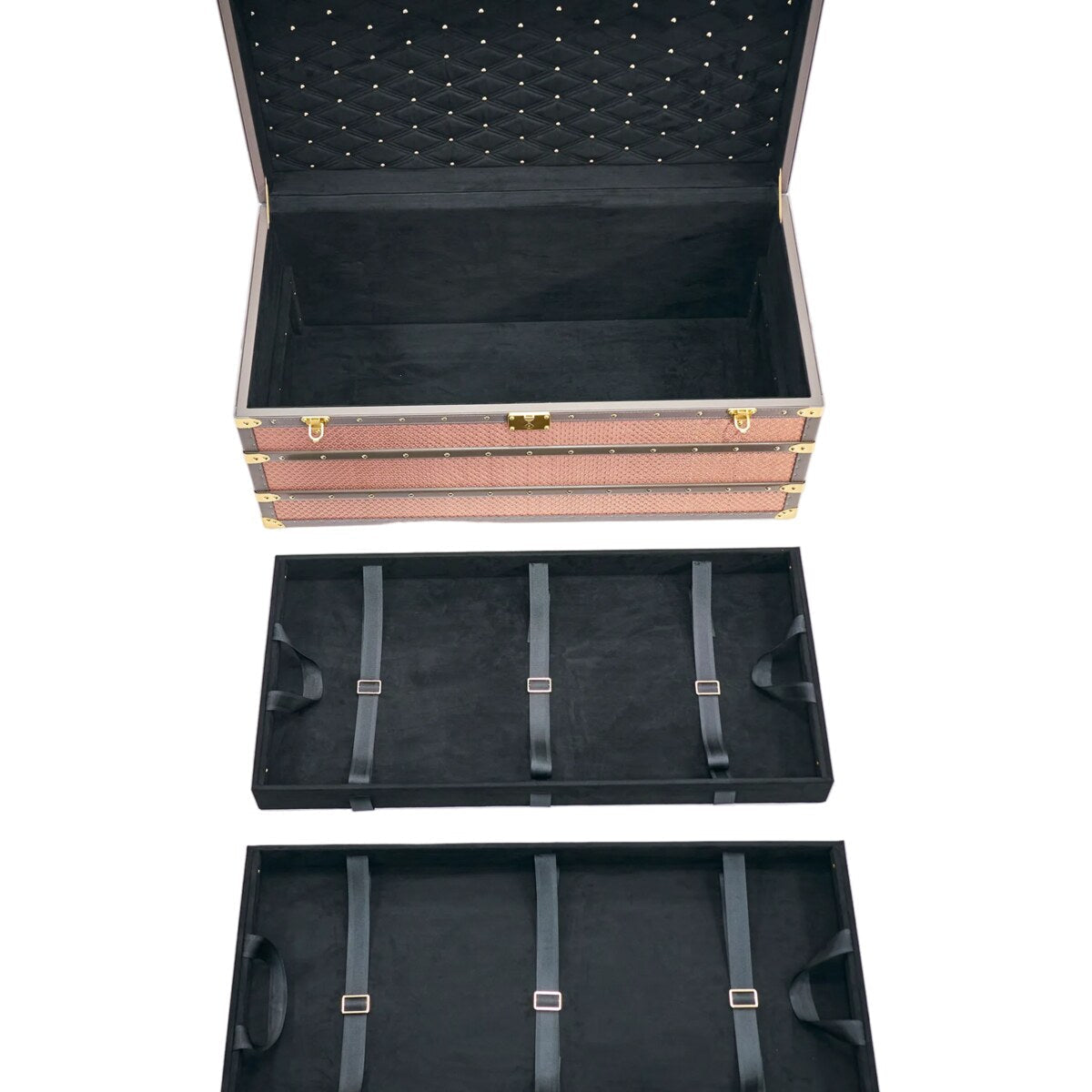
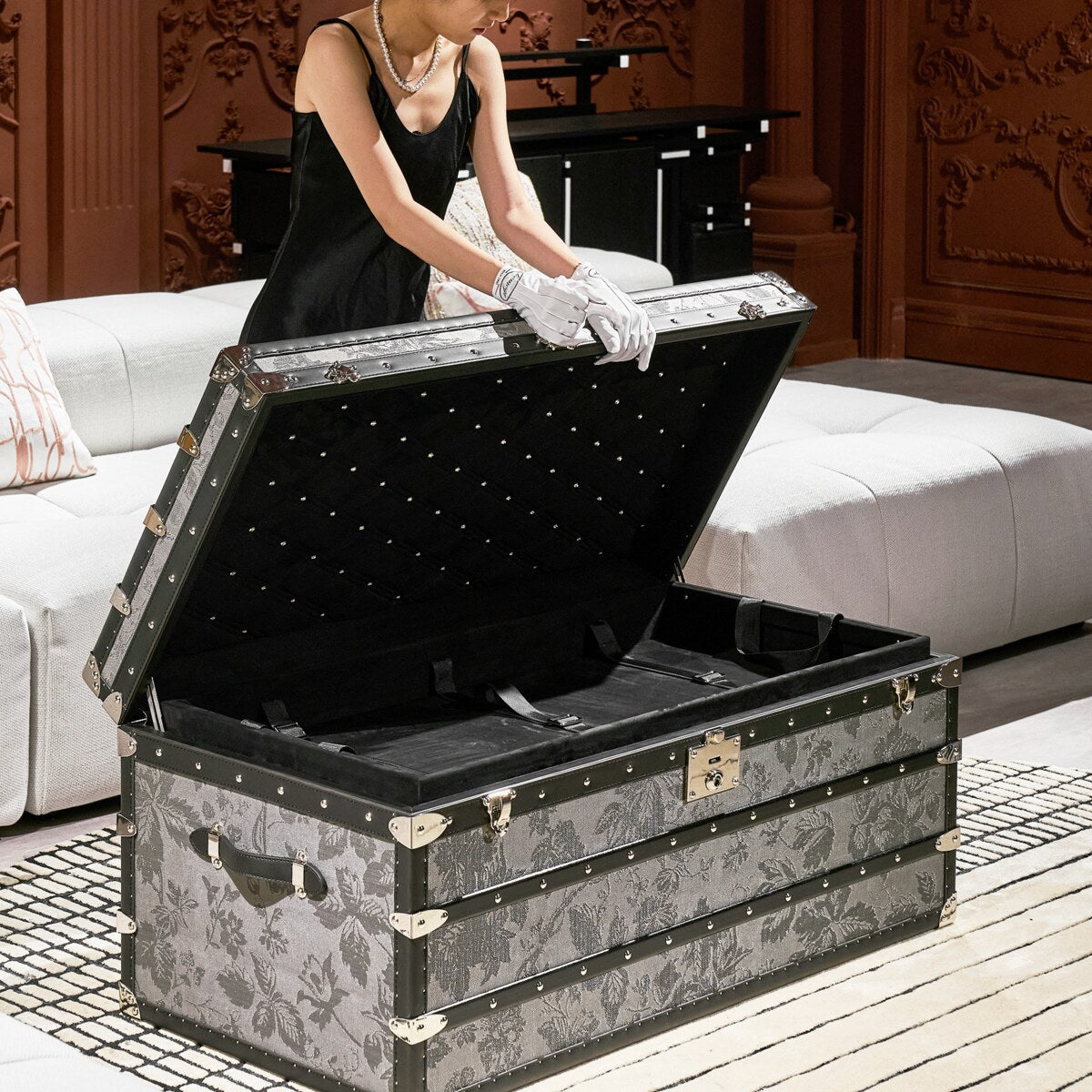
Metal frame with woven copper-wire top is where Gulf-specific engineering begins. Woven metal is dimensionally stable through the full 25–90% RH range — it does not swell, lift or blister. Copper alloy develops a surface patina rather than pitting failure, and the open weave structure allows fine dust to be brushed away rather than trapping it in a surface finish. Critically, a hard-case woven-wire surface survives the daily handling — remote controls dragged, trays slid, books stacked — that shows every micro-scratch on stone or glass within months. The Aurum Wire Coffee Table – Antique Copper is the clearest expression of this construction: woven copper wire over a rigid frame, the same hard-case logic SIRAE originally developed for jewellery storage applied at living-room scale.
Leather-wrapped is the other Gulf-appropriate surface available in the SIRAE collection. Microfiber leather handles daily contact naturally, develops a warm patina over years rather than scratches, and softens the acoustic hardness that stone or glass adds to a room. The one management point is placement: keep leather at least one metre from a direct AC supply-air outlet to prevent the rapid drying that splits or cracks the surface under sustained low-humidity airflow. The Heritage Leather Coffee Table – Royal Amethyst applies microfiber leather wrap over a structured frame with brass edge detailing — a material choice that is honest about what the Gulf demands.
| Material | Gulf climate risk | Surface durability | Maintenance | SIRAE range |
|---|---|---|---|---|
| Marble / stone (sealed) | Low — stable | Moderate — stains, scratches | Seal annually, wipe gently | Not in range |
| Solid hardwood (oiled) | Moderate — seasonal movement | Good | Condition bi-annually | Not in range |
| Thin veneer on MDF | High — edge lift, blister | Poor long-term | Avoid direct AC/sun | Not in range |
| Glass (10–12 mm toughened) | Low — stable | Poor — hazes from dust | Daily wipe, careful handling | Not in range |
| Woven copper wire (hard case) | Very low — dimensionally stable | Excellent — patina, not failure | Soft brush for dust | Aurum Wire range |
| Microfiber leather wrap | Low indoors, dry near AC | Excellent — patina, repairable | Leather conditioner, avoid AC blast | Heritage Leather range |

Sizing a Coffee Table to Your Sofa and Majlis
The Bottom Line: The coffee table should sit 35–45 cm from the sofa front edge, reach roughly two-thirds of the sofa's length (never wider), and stand within 5 cm of the sofa seat height — typically 38–48 cm tall. In a UAE majlis with low banquette seating, scale down to 30–38 cm table height and allow wider circulation lanes on all four sides for guests moving to and from the seat.
Three rules govern coffee table proportion in any living room:
Rule 1 — The two-thirds length rule. A coffee table that equals or exceeds sofa length dominates the room visually and blocks circulation. At two-thirds length, it reads as a companion rather than a rival. For a 220 cm sofa, that means a table between 130 and 150 cm long.
Rule 2 — The clearance rule. Thirty-five centimetres is the minimum comfortable knee clearance between the sofa cushion edge and the table edge. Forty to forty-five centimetres is the preferred range — close enough to set a glass down without leaning, far enough to stand without stepping over. At less than 30 cm, the table reads as an obstacle; at more than 55 cm, the visual and functional connection breaks.
Rule 3 — The height rule. A coffee table between 2 cm below and 2 cm above the sofa seat height is the functional sweet spot. Most UAE sofas sit between 40 and 48 cm. A table at 42–46 cm serves almost any standard sofa; a table at 55 cm or more belongs beside an armchair, not in front of a sofa.
For a formal majlis, where seating runs lower — banquettes at 35–40 cm seat height — scale table height to match, and prioritise round or oval formats that do not create hard-corner hazards as guests lean across a large seating circle. A round table centred in a majlis also avoids the directional implication of a rectangle, which can inadvertently point toward or away from the host seat.
If the room uses a sectional sofa, a large square or round table centred in the sectional's inner angle works better than a long rectangle that cannot be accessed from the curved far end.
Climate-Proofing Your Coffee Table Placement
Quick Answer: Keep any coffee table — regardless of material — at least one metre from a supply-air AC outlet and out of direct west-facing afternoon glazing. In Dubai, west-facing windows in summer push dark-surface temperatures above 50°C; that is enough to dry and split leather, accelerate veneer lift, and bleach coloured lacquer within a single season.
Placement is a material decision masquerading as a decor choice. The two worst positions in a UAE living room are directly under a supply-air diffuser (where cold, extremely dry air blasts the surface for eight to twelve hours a day) and flush against a west-facing window bay (where afternoon solar gain turns the table into a slow oven from May through September).
The Aurum Wire Coffee Table – Tiffany Blue and the Aurum Wire Coffee Table – Monochrome both use copper-wire construction that tolerates the indoor RH swing without dimensional response — but placement discipline still extends the life of any protective coating and prevents unnecessary patina acceleration near AC outflow.
A woven-wire surface sheds fine Gulf dust with a soft dry brush; a leather surface benefits from a monthly pass of a specialist conditioner to counteract the drying effect of air-conditioned interiors running at 25% RH for eight months of the year.

The 2026 Buying Checklist
A luxury coffee table at this price point should outlast two apartment moves and a decade of Gulf summers, so audit any candidate against seven criteria before committing: Is the primary structure dimensionally stable through the Gulf's 25–90% RH swing? Is the surface finish built for daily contact rather than showroom lighting? Is the hardware — if any — solid brass or stainless rather than plated zinc? Is the height within the 38–48 cm range that serves standard UAE sofas? Does the footprint respect the two-thirds rule relative to your sofa? Is there at least 35 cm of clear knee clearance in your floor plan? And can you place it away from direct AC outflow and west-facing afternoon glazing?
If a seller cannot state what the substrate and surface treatment are, or quotes a humidity range the piece was tested to, treat that as a materials answer in itself.
Frequently Asked Questions
What size coffee table suits a standard UAE sofa? For a typical 200–220 cm UAE sofa, a coffee table between 120 and 150 cm long covers the two-thirds-length proportion that reads correctly without dominating the room. Height should sit between 38 and 48 cm — within 2–5 cm of the sofa seat height. Allow 35–45 cm of knee clearance between the sofa front edge and the table edge.
Is a glass coffee table suitable for Dubai's climate? Glass is dimensionally stable and unaffected by humidity swings, but Gulf fine dust accumulates into surface haze under raking light and abrades the surface over time. Toughened 10–12 mm glass on rubber seating performs adequately for low-traffic rooms; woven copper wire or leather-wrapped surfaces handle the daily contact of an active household with fewer visible marks.
Can a coffee table be used in a majlis? Yes, but scale and height matter. A majlis with low banquette seating — seat height 35–40 cm — needs a coffee table at 30–38 cm height rather than the standard 40–46 cm. A round format avoids directional bias in a circular seating arrangement and eliminates hard corners in the close-seated environment of a formal majlis. Proportion the diameter to roughly half the internal seating span.
Why do some coffee tables warp or lift at the edges in UAE homes? Thin veneer over MDF expands and contracts with humidity cycling — the gap between indoor AC air at ~25% RH and outdoor air at 80–90% RH in Gulf summers. Edge lift typically appears at door corners and joins within two summers because those points see the most rapid humidity change each time the room is opened. Specifying dimensionally stable materials — solid hardwood, woven metal, toughened glass, or leather over a rigid engineered core — avoids the failure mode entirely.
See Both Collections in Dubai
Proportion rules and material tables only go so far — the weight of a woven copper-wire surface and the grain of microfiber leather have to be handled. To see the full Aurum Wire and Heritage Leather coffee table collections at scale, and to map proportions against your sofa dimensions or majlis plan, book a private viewing at the SIRAE showroom, Al Shafar Complex, Umm Suqeim 1, Dubai. Call +971 55 886 6180 or write to info@siraecasa.com, and our team will walk you through both copper-wire and leather finishes, proportion planning for your specific room, and placement guidance for the UAE climate.
%0AA%20luxury%20coffee%20table%20is%20the%20geometric%20anchor%20of%20any%20living...)
Leave a comment
This site is protected by hCaptcha and the hCaptcha Privacy Policy and Terms of Service apply.