التخطي إلى المحتوى

سلة المشتريات

سلة مشترياتك فارغة

المقال: Luxury Shoe Cabinets for Dubai Homes: Closed Storage That Beats Sand & Dust (2026)

Luxury Shoe Cabinets for Dubai Homes: Closed Storage That Beats Sand & Dust (2026)

Luxury Shoe Cabinets for Dubai Homes: Closed Storage That Beats Sand & Dust (2026)

Editorial Note: Compiled by the Sirae Editorial Team from internal custody-grade knowledge. Updated: 2026-06-16.

Luxury Shoe Cabinets for Dubai Homes: Closed Storage That Beats Sand & Dust (2026)

A shoe cabinet is the most consequential piece in a Dubai entryway, and the one most people buy as an afterthought — usually an open rack that turns into a dust trap within a month. In the Gulf, the problem is not just clutter. Fine sand carried on the shamal wind settles on every open surface, AC cycling swings indoor humidity hard against 80–90% summer coastal air, and leather soles left exposed at a villa door age faster than they should. The commodity racks sold across the UAE solve the visual problem and ignore the climate one. This 2026 guide covers the real decision: closed versus ventilated luxury shoe storage, how much capacity a Dubai household actually needs, which materials survive indoor conditions, and where the cabinet belongs in a villa entryway or walk-in closet.

closed luxury shoe cabinet in a Dubai villa entryway, marble floor, sand-light, doors partly open showing leather shoes on shelves

Closed or Ventilated: Which Shoe Cabinet Type Wins in the Gulf?

Quick Answer: In Dubai, a closed shoe cabinet with passive ventilation — solid doors that keep sand and dust out, paired with a perforated or louvered back panel and a small rear air gap — outperforms both fully open racks and fully sealed cabinets. Open racks collect airborne dust within days; fully sealed cabinets trap the moisture and odour that humidity cycling drives into leather. The Gulf-correct answer is the middle: enclosed at the front, breathing at the back.

The reasoning is climate-specific. Most "ventilated shoe cabinet" marketing means louvered front doors — fine in a temperate hallway, wrong at a Dubai villa door, because the same slats that pass air also pass the fine quartz dust that the shamal deposits across the city. What you actually want is the opposite geometry: a solid, dust-excluding front and a discreet rear breathing path. That combination keeps the visible sand out while still letting the micro-climate inside the cabinet equalise, so shoes do not sit in a sealed box of their own humidity.

Worth knowing: independent storage guidance recommends a meaningful open-back or perforated area for airflow rather than the 2–3 mm decorative slits many cabinets pass off as "breathable." For a Dubai entryway, prioritise a closed front for dust exclusion and a real rear vent path for moisture — not louvers on the door you see.

Cabinet type Sand & dust resistance Moisture control Best for
Open shoe rack Poor — collects airborne dust in days Excellent airflow Service areas, mud rooms only
Louvered-front cabinet Moderate — slats admit fine sand Good Cooler, low-dust interiors
Closed cabinet, rear-vented (Gulf-correct) Excellent — solid dust-excluding front Good — passive rear breathing Villa entryways, walk-in closets
Fully sealed cabinet Excellent Poor — traps odour and humidity Display only, not daily-worn shoes

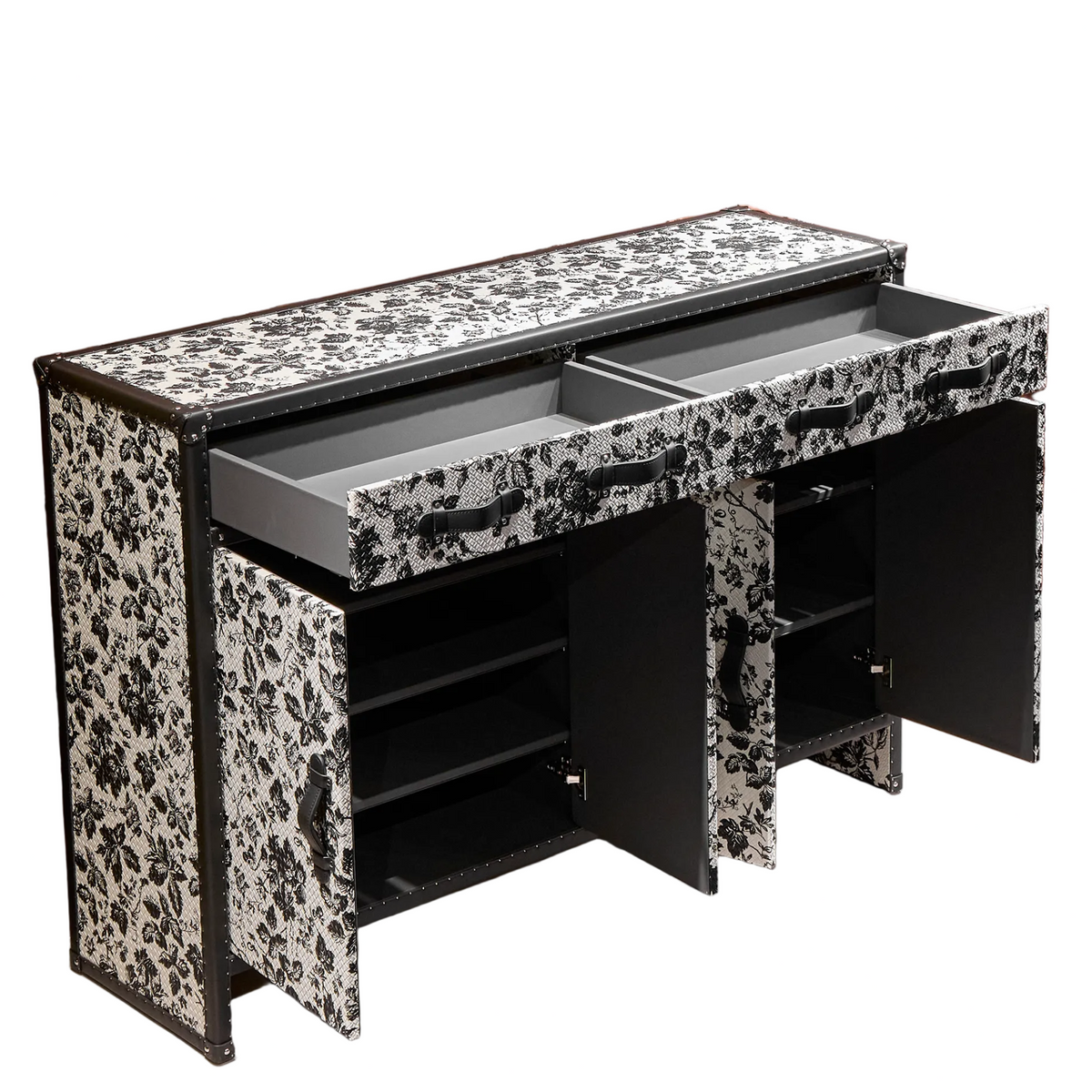
For households that rotate shoes daily at a busy door, the closed, rear-vented format is the one that holds up over years rather than months. Sirae's Heritage Print · The Avant Sideboard - Monochrome is built to this logic — a solid hand-finished front that keeps Gulf dust off the leather, with interior shelving sized for daily-worn pairs.

How Many Pairs Should a Dubai Shoe Cabinet Hold?

The Bottom Line: Size the cabinet for the shoes you wear in a season, not your whole collection. A two-person Dubai household typically keeps 8–14 actively-worn pairs near the door; a family villa entryway needs 20–30. Off-season and special-occasion footwear belongs in the walk-in closet, not the entryway cabinet. Buying one oversized cabinet to hold everything by the front door is the most common mistake — it dominates the entry and still overflows.

UAE retailers band capacity into rough tiers — up to 10 pairs (small), 11–20 (medium), 21–30 (large), 30+ (big) — which is a useful starting frame. But capacity planning in a villa is really about zoning. The entryway cabinet should hold the rotation: work shoes, the abaya-and-kandura-appropriate everyday pairs, sandals, and one or two going-out options per person. Everything else — boots worn only on European trips, the seasonal overflow, the boxed collector pairs — is stored deeper in the home where it is not exposed to door-side dust and foot traffic.

Use this as a planning check before you choose a size:

Household Active pairs near door Recommended capacity tier Cabinet format
Single professional / couple, apartment 6–10 Small–medium (up to ~12) Slim compact cabinet
Couple, villa 10–16 Medium (12–20) Single full cabinet
Family with children 18–28 Large (20–30) Wide or paired cabinets
Frequent host / large collection 30+ at door, overflow in closet Large at door + closet storage Entry cabinet + closet system

For an apartment hallway or a secondary villa door where the footprint is tight, a closed-front piece such as Sirae's Heritage Print · The Avant Sideboard - Monochrome holds the daily rotation without crowding the entry — its solid sideboard-style body keeps the contents out of sight and out of the dust, while the rear-vented construction lets the interior breathe.

interior view of an open shoe cabinet showing neatly arranged leather shoes and sandals on adjustable shelves, soft natural light

Which Materials Survive UAE Indoor Conditions?

Technical Verdict: A shoe cabinet in an air-conditioned Dubai home lives through a humidity swing of roughly 25% RH indoors against 80–90% RH summer coastal air recorded by the UAE National Center of Meteorology (ncm.gov.ae). That repeated cycling is what destroys cheap shoe storage: thin veneer on MDF lifts at the edges, particle board swells at the base where mopping water reaches it, and hollow plated hardware pits. Cabinets that last are built from dimensionally stable, sealed materials — solid or properly sealed engineered cores, hand-finished facings, and metal hardware with real corrosion resistance.

The base of a shoe cabinet matters more than any other furniture in the home, because it sits where floors are mopped and where sand-laden shoes shed grit. A raw or unsealed particle-board base will wick moisture and fail at the plinth first. Look for a sealed, lifted, or moisture-resistant base — and keep the cabinet a short distance off the floor so air moves underneath.

Material / component UAE risk level What to check
Solid wood / sealed engineered core Low — dimensionally stable when finished Sealed edges; no raw end-grain at the base
Hand-finished lacquer facing (Sirae) Low — protects the surface from dust and wiping Even seal; wipes clean without dulling
Toughened glass / mirror fronts Low Backed and edge-sealed; not adhesive-tacked
Solid metal hinges & handles Low — survive humidity cycling Solid section, corrosion-resistant finish
Full-grain leather inserts Moderate — dries under AC Condition periodically; keep 1 m from AC outflow
Thin veneer on MDF High — edge lift in humidity cycling Avoid for the body; acceptable only on backs
Raw / unsealed particle-board base High — swells where water reaches it Avoid entirely; demand a sealed or lifted base
Hollow plated zinc hardware High — pits within 12–18 months Avoid; insist on solid metal

Placement compounds the material question. A west-facing Dubai entry can push surface temperatures on dark furniture past 50°C on summer afternoons; keep a leather-faced or dark-lacquer cabinet out of direct west-window sun, and keep any leather element at least one metre from a direct AC supply outlet, which dries and cracks it over time.

How to Keep Shoes Fresh Inside the Cabinet (Gulf Climate)

Quick Answer: Inside any closed shoe cabinet in the UAE, control moisture actively: never put away damp shoes, use cedar shoe trees or silica-gel desiccant to hold humidity down, keep the rear vent path clear, and rotate worn pairs so each gets airflow between wears. A closed cabinet protects shoes from dust — but only good interior habits stop the same enclosure from trapping moisture and odour.

The single biggest cause of mould and odour in Gulf shoe storage is putting shoes away while they still hold moisture. Even when the outer leather feels dry, the insole and lining stay damp after a day's wear in the heat. Let pairs air for a few hours before they go back in the cabinet, and never seal genuinely damp shoes behind solid doors.

Beyond that, three habits do most of the work. Cedar shoe trees absorb interior moisture and hold a shoe's shape; replaceable silica-gel or rechargeable desiccant packs pull ambient humidity down inside the enclosure — useful in any closed cabinet during the humid summer months. And rotation matters: wearing the same pair on consecutive days never lets the lining dry, so a cabinet that makes every pair visible and reachable quietly encourages the rotation that keeps shoes fresh. This is one practical argument for adjustable, full-visibility shelving over deep stacked bins.

cedar shoe trees and a silica-gel desiccant pack inside a luxury shoe cabinet, detail shot, warm tone

Where Should the Shoe Cabinet Go — Entryway or Walk-In Closet?

The Bottom Line: Put a closed, dust-excluding shoe cabinet at the villa entry for the daily rotation, and reserve the walk-in closet for the wider collection and off-season pairs. The entry cabinet's job is to keep the most-worn shoes immediately to hand while excluding the sand that arrives with every opening of the front door; the closet's job is long-term, climate-buffered storage away from foot traffic. They are two roles, and one cabinet rarely does both well.

UAE entry culture shapes the brief. In many Gulf homes shoes come off near the door, which means the entry cabinet sees constant use and constant grit — exactly why a solid front beats an open rack here. Give it a clear top surface at a comfortable height for keys, sunglasses and a tray, and leave breathing room around it so the doors swing freely and air moves at the base. If the entry is narrow, a slim depth matters more than width; a compact closed unit against one wall keeps the path clear while still holding the rotation.

The walk-in closet plays the opposite role. It is climate-buffered, out of the dust path, and better suited to the collector tier — the boxed pairs, the seldom-worn formal shoes, the seasonal boots. Here, full enclosure and stacked or boxed storage make sense because the dust pressure is low. The two-cabinet split — closed and rear-vented at the door, deeper storage in the closet — is how a Dubai villa keeps both its daily shoes and its collection in good order without either competing for the same space.

Location Primary role What it stores Cabinet priority
Villa entryway Daily rotation, dust exclusion Most-worn 12–30 pairs Solid front, rear-vented, slim depth
Walk-in closet Collection & off-season storage Boxed, formal, seasonal pairs Capacity, full enclosure, low dust pressure
Apartment hallway Compact daily storage 6–12 active pairs Slim closed unit, single wall

Frequently Asked Questions

Are closed or open shoe cabinets better for a Dubai home? Closed cabinets are better for most Dubai entryways. The Gulf's fine shamal sand settles on every open surface within days, so an open rack near a villa door becomes a dust trap and the shoes on it need constant wiping. A closed cabinet with a solid, dust-excluding front keeps that grit off your leather. The one refinement for the Gulf is to choose a closed front paired with a rear vent path or perforated back, so the enclosure excludes dust without sealing in the moisture and odour that humidity cycling drives into shoes.

How do I stop shoes smelling or going mouldy in a closed cabinet in the UAE? Never put damp shoes away — even when the outer leather feels dry, the insole stays moist after a hot day, so let pairs air for a few hours first. Inside the cabinet, use cedar shoe trees to absorb moisture and hold shape, add silica-gel or rechargeable desiccant packs during the humid summer months, and keep any rear vent path clear so the enclosure can breathe. Rotating between pairs rather than wearing the same shoes on consecutive days lets each lining dry fully and is the simplest long-term fix.

What size shoe cabinet do I need for a Dubai villa? Size it for the shoes you actually wear in a season, kept near the door — not your entire collection. A couple in a villa typically keeps 10–16 active pairs at the entry, and a family with children 18–28, which puts most households in the medium-to-large capacity tier. Off-season, formal and collector pairs belong in the walk-in closet, away from the door-side dust and foot traffic. Buying one oversized cabinet to hold everything at the entry is the usual mistake: it dominates the space and still overflows.

What materials last longest for a shoe cabinet in the UAE climate? Dimensionally stable, sealed materials. A solid or properly sealed engineered core with hand-finished, wipe-clean facings survives the indoor humidity swing of roughly 25% RH against 80–90% summer coastal air. The base is the critical point — it sits where floors are mopped and sand-laden shoes shed grit, so a sealed or lifted, moisture-resistant base is essential; raw particle board swells and fails at the plinth. Insist on solid metal hinges and handles rather than hollow plated hardware, which pits within 12–18 months in Gulf humidity.

Visit the Sirae Showroom in Dubai

A luxury shoe cabinet is easy to specify on paper and harder to judge until you open the doors and feel how the front excludes dust while the interior still breathes. To see how our closed, rear-vented constructions hold up against Gulf sand and AC humidity, and to plan capacity for your specific entry or walk-in closet, book a private appointment at the Sirae showroom, Al Shafar Complex, Umm Suqeim 1, Dubai. Call +971 55 886 6180 or write to info@siraecasa.com, and our team will help you choose the right format for your villa entryway.

اترك تعليقًا

This site is protected by hCaptcha and the hCaptcha Privacy Policy and Terms of Service apply.

Read more

Dressing Table vs Vanity Cabinet: The UAE Bedroom Buyer's Guide (2026)

Dressing Table vs Vanity Cabinet: The UAE Bedroom Buyer's Guide (2026)

✍️Editorial Note: Compiled by the Sirae Editorial Team from internal custody-grade knowledge. Updated: 2026-06-16. Dressing Table vs Vanity Cabinet: The UAE Bedroom Buyer's Guide (2026) A dressin...

قراءة المزيد
Custody-grade jewellery cabinet in a luxury Dubai villa

Commissioning a New Luxury Villa in Dubai: A Room-by-Room Storage & Display Checklist (2026)

✍️Editorial Note: Compiled by the Sirae Editorial Team from internal custody-grade knowledge. Updated: 2026-06-21. Commissioning a New Luxury Villa in Dubai: A Room-by-Room Storage & Display ...

قراءة المزيد