Skip to content

Cart

Your cart is empty

Article: Beyond Winding: Climate Control for Watch Collections in the UAE

Beyond Winding: Climate Control for Watch Collections in the UAE

Beyond Winding: Climate Control for Watch Collections in the UAE

Expert Insight: This guide includes proprietary internal intelligence and has been technically reviewed by Sirae Dubai Operations Director Nidhin Sathyan to align with top-tier luxury asset custody standards.

For the discerning collector in the United Arab Emirates, a fine timepiece is more than an instrument. It is a statement of legacy, of precision, of personal history captured in miniature. Yet the very environment that defines this region—its pervasive ambient warmth and coastal humidity—presents a silent, persistent threat to the delicate, almost living mechanics of these horological treasures. A standard watch winder, while essential for maintaining a mainspring's vital tension, addresses only a fraction of what is required for true, long-term preservation.

This guide explores the critical dimension beyond mere winding: the absolute necessity of a precisely controlled micro-environment. We will detail why the unique climate of the UAE demands a far more sophisticated approach to watch care—one that safeguards not just function, but the very integrity and value of your collection for generations to come.


The Sirae Benchmark: Principles of Horological Preservation

Technical Verdict: Optimal horological preservation requires stabilising relative humidity (RH) between 45-55% and temperature between 18-22°C to prevent lubricant viscosity changes, metal oxidation, and the degradation of organic materials like leather or rubber.

The Environmental Threat of Heat and Humidity

The persistent high heat and humidity of the region create an environment that is fundamentally hostile to complex mechanical objects. High relative humidity accelerates the subtle creep of oxidation on polished hands, applied indices, and internal movement components not crafted from noble metals. Even more critically, temperature fluctuations can cause almost imperceptible beads of condensation to form inside the watch case. This is a risk that even the highest water-resistance ratings cannot entirely eliminate over the slow march of time.

The Science of Lubricant Integrity

Within every mechanical watch movement lies a constellation of jewels and pivots, each filmed with specialised oils of varying viscosities. These lubricants are miracles of chemical engineering, designed to perform flawlessly within a specific temperature range. When exposed to the elevated heat so common in the Gulf, however, their intricate chemical structures can begin to break down. This degradation alters their viscosity—the very quality that allows them to protect—impairing the movement's accuracy and leading to the grinding friction of premature wear on critical components. Over time, the result is a significant decline in performance and the certainty of costly, complex servicing.

✍️ Expert Insight: The stability of a high-grade synthetic movement oil can be compromised when consistently stored above 25°C, leading to a measurable decrease in viscosity and a significant increase in component friction within as little as 12-24 months. —— Sirae Preservation Lab.

Material Preservation Beyond the Movement

The challenge extends far beyond the movement to the very materials you see and feel. Supple leather straps are hygroscopic, meaning they naturally absorb moisture from the air. In a humid climate, this process accelerates, leading to the unwelcome bloom of mould, permanent deformation, and rapid deterioration of the hide. Similarly, certain high-performance rubber straps can lose their flexibility and become brittle when subjected to relentless cycles of heat and UV exposure. A controlled environment, therefore, preserves the entire piece in its full integrity, not just the calibre ticking silently within.


Why Standard Watch Winders are Insufficient for Your Collection in the UAE

Technical Verdict: A standard watch winder provides pre-set TPD (Turns Per Day) to energise an automatic movement but offers no active defence against ambient temperatures exceeding 30°C and relative humidity levels often surpassing 60%, which directly threaten movement lubricant stability and material integrity.

Most commercially available watch winders perform their primary function admirably. They simulate the motion of the wrist to keep an automatic watch wound, following programmed cycles of rotation and rest to ensure the mainspring retains sufficient power. Indeed, this gentle, consistent motion is crucial for both convenience and for keeping the movement's fine oils properly distributed.

These devices are, however, environmentally passive. They operate entirely within the ambient conditions of the room in which they are placed. In a Dubai villa or a penthouse overlooking the Gulf, this means the winder—and the priceless watches it holds—are subject to the very same challenging climate. One might assume this is a minor detail, but the reality is that a simple winding box does nothing to mitigate the slow, corrosive effects of humidity or the performance-altering impact of heat. It leaves a collection dangerously exposed.


Precision Climate Control: The Core Preservation Technology Beyond Winding

Technical Verdict: Commissioned preservation cabinets integrate active temperature and humidity control using solid-state Peltier cooling modules and a calibrated electronic hygrometer to create a closed-loop system that actively cools and dehumidifies, maintaining a stable micro-climate independent of external conditions.

True stewardship of a collection in this region requires a conceptual shift: moving beyond simple winding to complete environmental management. This is achieved not with passive solutions like desiccant bags, which have a finite capacity and offer no cooling capability whatsoever, but with active, intelligent systems. These systems constantly monitor and adjust the internal atmosphere of a storage cabinet, creating a perfect, sealed haven.

For a collection housed in a coastal residence, for example, an active system is the only viable solution. A Peltier-driven cabinet actively cools the air within, causing ambient water vapour to condense and be silently drained away, precisely reducing humidity to the target 45-55% RH. This meticulous process maintains absolute stability for both the movement's vital lubricants and the watch's external materials—from the fine grain of an alligator strap to the integrity of a rubber gasket. A simple safe with a desiccant module, by stark contrast, cannot cool its interior and will quickly become saturated in a humid environment, offering little more than a false sense of security.

This is the technology that ensures a Patek Philippe Calatrava and an Audemars Piguet Royal Oak Offshore are preserved under identical, perfect conditions, regardless of the season or their proximity to the sea. The silent, low-vibration nature of these thermoelectric modules is also critical, ensuring the delicate balance wheels and escapements are not subjected to the subtle but persistent vibrations produced by traditional compressor-based cooling.


Selecting the Right Cabinet for Your Collection and Environment

Technical Verdict: A collector-grade solution for a significant portfolio (e.g., 12+ watches) demands a cabinet with multi-zone climate control, allowing individual modules to be set to a stable 18-22°C and 45-55% RH, supported by on-site UAE-based installation, calibration, and aftercare.

Selecting the right preservation system is a careful matter of aligning its technical capabilities with the scale of your collection and the unique specifics of your residence. While established European makers like Buben&Zörweg offer impressive catalogue pieces, the ultimate assurance comes from a commissioned programme. A solution engineered from the ground up, with the Middle East's environmental extremes as a primary design challenge.

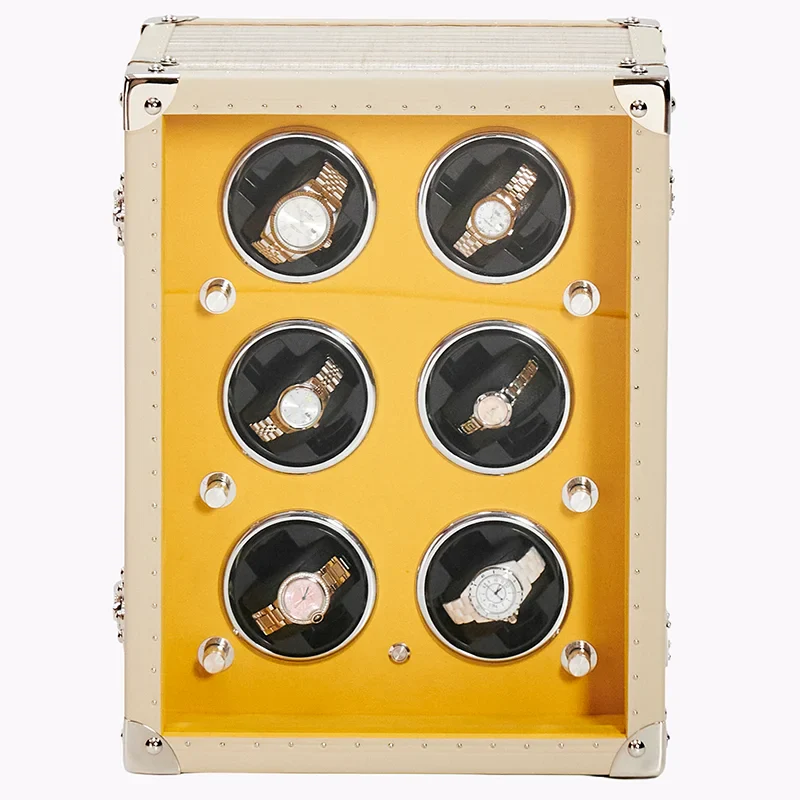
For a more significant collection, a single-zone cabinet is often insufficient. A truly commissioned solution allows for the creation of multi-watch cabinets where each winder module operates within its own independently managed micro-climate. This architecture ensures absolute, verifiable stability across the entire collection, with every parameter constantly monitored by an array of internal sensors.

Crucially, the commitment must extend beyond the technology itself. The most sophisticated system is incomplete without dedicated, localised aftercare. For an asset of this importance, a team based in the UAE—capable of providing white-glove installation, discreet servicing, and ongoing support—is non-negotiable. This presence ensures the system is calibrated perfectly for the home it resides in, and that its performance can be flawlessly maintained for decades.

This level of integration and service transforms a watch cabinet from a simple accessory into a permanent, strategic piece of preservation architecture within the home.

The long-term stewardship of a significant watch collection requires a commitment to the details of preservation that must transcend basic functionality. It demands an environment engineered for stability. A solution conceived with foresight. And the profound peace of mind that comes from knowing every single piece is perfectly, immutably maintained.

https://www.siraecasa.com


Read more

A Connoisseur’s Guide to the Watch Winder as the Ultimate Gift

A Connoisseur’s Guide to the Watch Winder as the Ultimate Gift

Searching for the perfect gift for a watch enthusiast? Discover how a luxury watch winder preserves their collection. Explore top brands and expert tips.

Read more
The Commissioned 12-Watch Winder Safe: A Guide to Unifying Collection Care and Private Security

The Commissioned 12-Watch Winder Safe: A Guide to Unifying Collection Care and Private Security

Secure your luxury watch collection. Discover how a 12-watch winder safe combines vault-grade security with precision engineering. Commission your bespoke solution.

Read more