
Cigar Storage in the Gulf Climate: A Collector's FAQ (2026)
Cigar Storage in the Gulf Climate: A Collector's FAQ (2026)
Cigar storage in the UAE is governed by a single, brutal fact that no Caribbean storage guide accounts for: the air your cigars actually live in is not the warm, humid air the leaf came from — it is fierce desert heat outdoors and bone-dry, over-conditioned air indoors. Dubai summer afternoons push 40–50°C outside, while villa air-conditioning often pulls indoor relative humidity down to 25–40% RH, far below the 65–72% a cigar needs. The most common mistake Gulf collectors make is treating a humidor as a decorative box rather than a sealed micro-climate working against the room around it. This FAQ is the central reference for storing cigars in the Gulf — the corrected numbers, the seasoning routine, the electric-versus-passive decision, and the climate-specific defences — with links out to the deep guides for each.
What Is the Ideal Humidity and Temperature for Storing Cigars in the UAE?
Quick Answer: Store cigars at 65–72% relative humidity and 16–21°C (60–70°F). For the Gulf, aim for the lower-middle of that band — roughly 65–69% RH and 18°C — because dry AC air, not damp, is the everyday enemy and a slightly drier cigar burns better than an over-humidified one.
The famous "70/70 rule" — 70% RH at 70°F — is a fine starting point and the climate premium cigars are rolled in, but most modern aficionados consider it slightly high. A cigar held at 70% RH in a hot room can burn unevenly and feel spongy, while 65–69% gives a cleaner draw and crisper burn. The two variables also interact: as temperature rises, target a lower RH, and vice versa.
Temperature carries a second, non-negotiable reason to stay disciplined in the Gulf. The tobacco beetle (Lasioderma serricorne) hatches and feeds when storage climbs above roughly 22°C (72°F) — a single warm spell can ruin a collection from the inside out. Because indoor temperatures in a UAE home can spike whenever the AC cycles off, holding 16–21°C reliably matters more here than almost anywhere else.
| Parameter | Safe range | Gulf-optimised target | Why it matters here |
|---|---|---|---|
| Relative humidity | 65–72% RH | 65–69% RH | AC dries the air; lower end resists over-humidification |
| Temperature | 16–21°C (60–70°F) | 17–19°C | Above 22°C risks tobacco-beetle hatching |
| Daily RH drift | — | ±2% RH or tighter | Door openings + dry rooms cause fast swings |
| Outdoor reference | — | 40–50°C, 80–90% RH summer | The gap your sealed cabinet must absorb |
For a deeper breakdown of why the 70/70 figure is corrected downward, see Ultimate Guide to Temperature-Controlled Humidors for Saudi Arabian Villas.
How Do I Store Cigars in Dubai Where the AC Keeps the Air So Dry?
The Bottom Line: A cigar cannot survive in open Dubai room air — at 25–40% RH indoors it will dry, crack and shed its oils within days. The only reliable method is a properly sealed humidor or humidor cabinet that holds its own climate independent of the room, kept at least one metre from any AC outflow and out of direct west-facing sun.
The scale of the challenge is the differential. Coastal UAE summer air can hit 80–90% RH outdoors per the National Center of Meteorology, while the same villa's conditioned interior sits at 25–40% RH. Your cigars need a stable 65–69% pocket between those extremes. A flimsy box with a weak seal cannot hold that line; every door opening and every AC cycle pulls the interior toward the dry room.
Placement is part of storage, not an afterthought. Keep the humidor away from direct supply-air vents, which blast dry, cold air straight onto the cabinet. West-facing Dubai glazing drives surface temperatures of dark furniture well past 50°C on summer afternoons — never position a humidor where afternoon sun lands on it. Larger cabinets have an inherent advantage: their greater internal volume and insulation slow fluctuations, so the climate drifts more gently between refills and openings.
For the three errors that cost Gulf collectors the most, see Cigar Storage in the UAE: 3 Costly Mistakes & How to Fix Them.
Electric vs Passive Humidor: Which Is Right for the Gulf Climate?
Technical Verdict: For serious collections in the UAE, an electric (active) humidor wins. A passive humidor relies on Boveda packs or a sponge and typically drifts ±5–10% RH; an electric humidor uses a fan, thermostat and automated humidity module to hold roughly ±1–2% RH at a fixed temperature, 24 hours a day — exactly the stability a hot, dry climate demands.
A passive humidor is simpler and beautiful, but it has no defence against ambient swing. In a temperate climate it copes; in a Dubai villa where the room oscillates between cold AC and warm shut-off periods, it is constantly chasing a moving target, and the collector pays in weekly maintenance and inconsistent burns. It remains a sound choice for a small desktop stash of cigars smoked within weeks.
An electric humidor — usually a cabinet with thermoelectric (solid-state, quiet) or compressor cooling — actively holds both temperature and humidity. This decouples your cigars from the room entirely, which is the single most valuable property in the Gulf, where you cannot trust the ambient air for a moment. It also caps temperature below the 22°C beetle threshold year-round, something a passive box cannot guarantee in a UAE summer.
| Factor | Passive humidor | Electric humidor |
|---|---|---|
| Humidity stability | ±5–10% RH | ±1–2% RH |
| Temperature control | None (follows room) | Actively held, caps below 22°C |
| Maintenance | Weekly checks/refills | Mostly automated; refill water reservoir |
| Best for in UAE | Small short-term stash | Mid-to-large collections, long ageing |
| Climate independence | Low | High |
For the full side-by-side built for UAE villas, see Electric vs. Passive Humidors: A Collector's Guide for UAE Villas.
How Do I Season a New Humidor Before Storing Cigars?
Quick Answer: Season the Spanish cedar lining before any cigar goes in. The lowest-risk method is a 69% or 84% Boveda pack sealed inside the empty humidor for about 14 days; the faster water-dish method takes 3–7 days at 72–75% RH. Use only distilled water — never tap water — and never wipe the cedar with a soaking sponge.
New humidor cedar is bone-dry and will otherwise rob moisture straight out of your cigars, leaving them under-humidified for weeks. Seasoning saturates the wood so it regulates moisture rather than stealing it. Skipping this step is one of the most common causes of "my new humidor won't hold humidity."
Distilled water is mandatory. Tap and mineral water leave white residue on the cedar, clog humidifier pores and can promote mould — a real hazard given Gulf summer humidity sneaking in through openings. In the Gulf, season inside an air-conditioned room so ambient heat doesn't spike the cedar's surface, and verify with a calibrated digital hygrometer before loading cigars.
For the step-by-step routine tuned to Gulf conditions, see The Ultimate Guide to Seasoning a Humidor Cabinet in the Gulf Climate.
Why Does Spanish Cedar Matter, and How Do I Defend Against Sand and Dust?
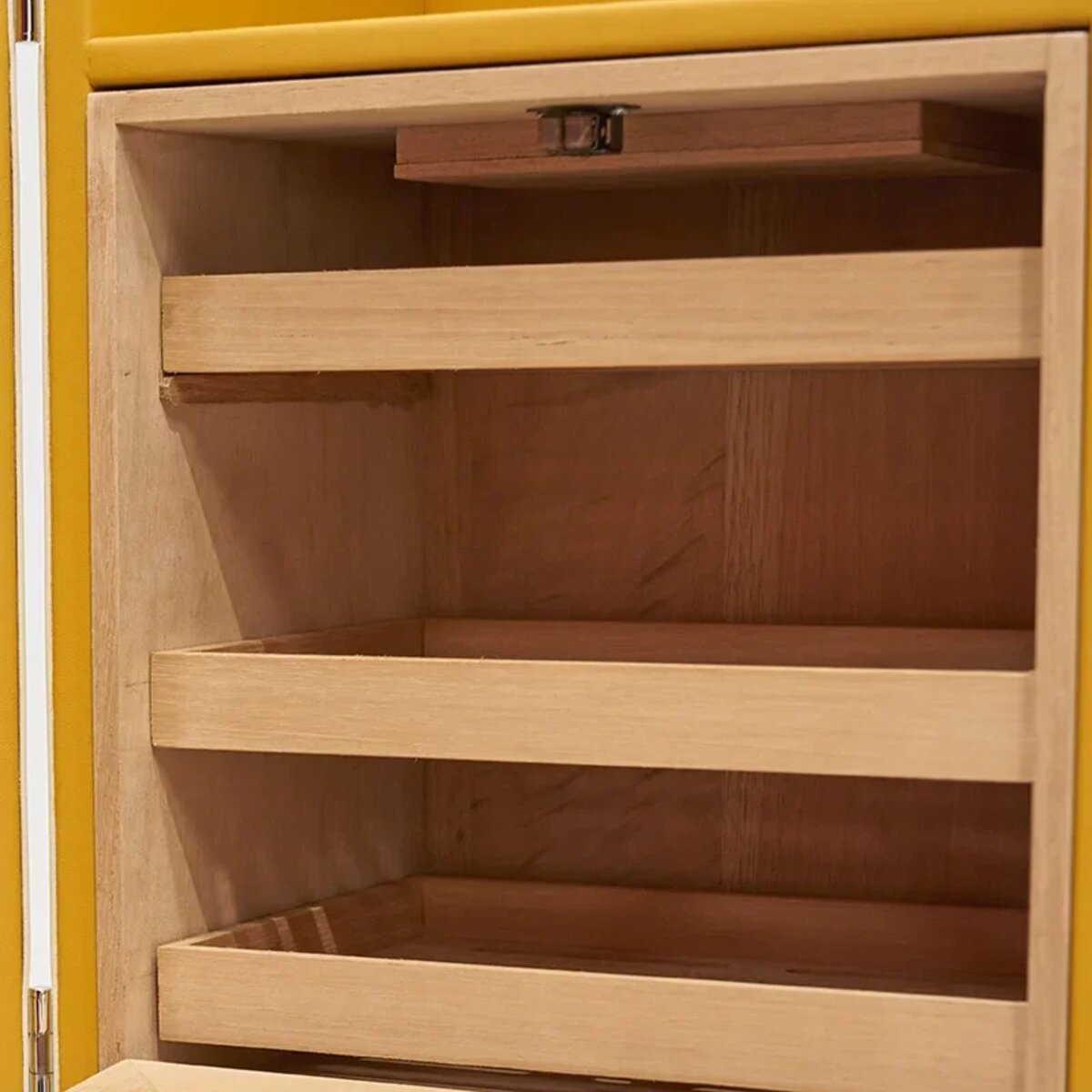
Technical Verdict: Spanish cedar (Cedrela odorata) is the standard humidor lining for three reasons — it buffers humidity, repels the tobacco beetle, and imparts a sweet maturing aroma. In the Gulf you add a fourth requirement: a sealed cabinet that blocks the fine airborne dust and sandstorm particulate that the region's air carries indoors.
Cedar is hygroscopic: it absorbs moisture when the interior is humid and releases it when dry, smoothing the swings a humidifier alone cannot. It is naturally beetle-resistant, an extra layer of insurance against the Gulf's heat-driven hatch risk. And as cigars age against it, the cedar lends the cedary backbone collectors prize in well-rested smokes.
Sand and dust are the Gulf-specific overlay. Shamal-season dust is fine enough to settle inside a loosely sealed box, dulling wrappers and contaminating the humidification system. The defence is a cabinet engineered to seal — gasketed doors, tight tolerances, glass that excludes UV. SIRAE's Aurum Wire · The Connoisseur Cigar Humidor Cabinet - Frosted Silver pairs a Spanish-cedar interior with a dimensionally stable woven copper-wire hard-case construction — metal does not swell or warp in humidity cycling the way veneered timber can — making it suited to the exact swing between dry AC interiors and damp coastal air that defeats lesser boxes.
For the desert-sealing argument in full, see Anti-Sandstorm Cigar Humidors: Sealed Cabinets for Riyadh's Climate.
How Many Cigars Should My Humidor Hold? Planning Capacity
Quick Answer: Buy for double your current count, never your current count. A humidor runs most stably when 60–80% full — the mass of cigars helps buffer humidity — but a box packed to the brim chokes airflow and a near-empty one swings wildly. Match capacity to how you collect: a desktop box (25–50) for an active smoker, a cabinet (150–250+) for an ageing collection.
Capacity is a climate-stability decision, not just a volume one. A larger, fuller cabinet holds a more stable internal climate because there is more thermal and moisture mass resisting change each time the door opens — a meaningful advantage in a region where the surrounding air is hostile. Collectors who buy a too-small box almost always upgrade within a year, having learned that a crowded humidor maintains poorly and offers no room to rotate stock.
| Collection style | Suggested capacity | Format |
|---|---|---|
| Occasional smoker | 25–50 cigars | Desktop humidor |
| Regular enthusiast | 100–150 cigars | Large desktop / small cabinet |
| Active collector | 150–250 cigars | Electric cabinet |
| Ageing / investment | 250+ cigars | Climate-controlled cabinet |
For commissioning a cabinet sized to a villa collection, see The Connoisseur's Guide to Commissioning a Luxury Cigar Humidor Cabinet in Dubai.
How Should I Display and Serve Cigars When Hosting in a Majlis?
The Bottom Line: In Gulf hosting culture the humidor is both an instrument and a centrepiece. Keep the master collection in a sealed cabinet at 65–69% RH, and bring only the evening's selection to the majlis — cigars tolerate a few hours in room air, but never store them open in a dry, AC-cooled majlis overnight.
A cabinet humidor earns its place in the modern majlis precisely because it solves storage and presentation at once: collectors can see and reach the collection through glass without breaking the climate, and the cabinet reads as a considered statement piece beside the seating. The discipline is simply not to confuse display with storage — what is on show in the cabinet is sealed; what is set out on a tray for guests is temporary.
For serving, a small desktop humidor or a Spanish-cedar tray holds the night's cigars at the seating area while the master cabinet stays closed across the room. This protects the bulk of the collection from the repeated door openings that hosting otherwise causes.
For integrating storage and hospitality into the majlis, see The Commissioned Cigar Cabinet: A Cornerstone of the Modern Majlis.
Frequently Asked Questions
What humidity should a cigar humidor be in the UAE? Hold 65–72% relative humidity, and in the Gulf aim for the lower-middle of that band — roughly 65–69% RH — paired with 16–21°C. The traditional 70/70 rule is a starting point but runs slightly high for hot climates; a marginally drier cigar burns more cleanly than an over-humidified one. Because UAE air-conditioning drives indoor air down to 25–40% RH, the real challenge is keeping humidity up, which is why a sealed, well-seasoned humidor is essential rather than optional.
Will my cigars survive in normal Dubai room air without a humidor? No. Open room air in an air-conditioned Dubai home typically sits at 25–40% RH — far below the 65–72% cigars need — so unprotected cigars dry out, crack and lose their oils within days. There is no shortcut: cigars must live inside a sealed humidor or humidor cabinet that maintains its own climate. Keep that cabinet at least one metre from any AC vent and out of direct west-facing sun, where surface temperatures can exceed 50°C on summer afternoons.
Do I really need an electric humidor in the Gulf, or is a passive one enough? For a small stash smoked within weeks, a passive humidor with Boveda packs is fine. For a collection of any size or any cigar you intend to age, an electric humidor is strongly preferable: it holds roughly ±1–2% RH and a fixed temperature versus a passive box's ±5–10% drift, and it caps temperature below the 22°C threshold at which tobacco beetles hatch — a genuine risk during a UAE summer when indoor temperatures spike whenever the AC cycles off.
How long does it take to season a new humidor? About 14 days using the sealed Boveda-pack method, or 3–7 days using the faster water-dish method at 72–75% RH. Always use distilled water — tap or mineral water leaves residue, clogs the humidifier and promotes mould. Seasoning saturates the Spanish-cedar lining so it regulates moisture instead of stealing it from your cigars. In the Gulf, season inside an air-conditioned room and confirm the climate with a calibrated digital hygrometer before loading any cigars.
Visit the SIRAE Showroom in Dubai
Custody-grade cigar storage in the Gulf climate is something you should feel before you commit to — the weight of a sealing door, the aroma of a properly seasoned Spanish-cedar interior, the steadiness of an actively held climate against the room outside. To see how SIRAE approaches cigar storage for UAE collections, book a private appointment at the SIRAE showroom, Al Shafar Complex, Umm Suqeim 1, Dubai. Call +971 55 886 6180 or write to info@siraecasa.com, and our team will walk you through seasoning, capacity and placement for your majlis or home office.
%0ACigar%20storage%20in%20the%20UAE%20is%20governed%20by%20a%20single,%20brutal%20f...)
Leave a comment
This site is protected by hCaptcha and the hCaptcha Privacy Policy and Terms of Service apply.