
Jewellery Storage & Security in the UAE: The Complete FAQ (2026)
Jewellery Storage & Security in the UAE: The Complete FAQ (2026)
Jewellery storage in the UAE is harder than the advice written for temperate climates admits, because the Gulf forces two opposite problems on the same collection: coastal summer humidity above 80% RH that drives tarnish, and the bone-dry, 24-hour air conditioning that cracks pearls and dries out leather. Most homeowners get one half right and the other wrong — a sealed box that traps moisture, or an open tray that lets AC desiccate a strand of pearls. This 2026 FAQ is the jewellery-specific answer hub: ideal humidity and temperature, anti-tarnish method, how to organise by category, when a box gives way to a cabinet or a safe, biometric security, insurance and valuation thresholds in AED, and the rules for travelling with gold. Each answer is written to stand alone.
What Is the Ideal Humidity and Temperature to Store Jewellery in the UAE?
Quick Answer: Store fine jewellery at 40–55% relative humidity and a stable 18–24°C. Silver and lower-karat gold tarnish far faster once humidity passes 60%, which UAE summer air reaches easily, so the indoor target is a controlled mid-band — not the bone-dry sub-30% that direct AC airflow produces and that cracks pearls and dries leather.
The Gulf is a two-front climate. Outdoor summer humidity along the coast routinely sits at 80–90% RH (UAE National Center of Meteorology, ncm.gov.ae), and every time a door opens that moist air enters the home. At the same time, continuous air conditioning can pull a closed bedroom down toward 25–35% RH. Jewellery sits in the crossfire: too humid and metals oxidise; too dry and organic materials fail.
The 40–55% RH window protects both halves of a typical collection. Silver and 9K–14K gold alloys oxidise when ambient humidity climbs over 60%, while pearls, opals, emeralds and coral need a stable mid-band — high humidity swells and clouds nacre, and very dry air dehydrates and cracks it. Temperature matters second: keep storage away from west-facing windows, where dark surfaces exceed 50°C on summer afternoons, and at least one metre from any AC supply vent so the airflow does not create a dry micro-climate inside the storage itself.
| Material | Risk in UAE conditions | Target RH | Note |
|---|---|---|---|
| Sterling silver | High — tarnishes above 60% RH | 40–50% | Anti-tarnish strips essential |
| 9K–18K gold | Moderate — alloy metals oxidise | 40–55% | Higher karat = lower risk |
| 24K gold (Arabic/bridal) | Low — pure gold resists tarnish | 40–55% | Risk is scratching, not oxidation |
| Pearls / opals / emeralds | High — crack when too dry | 45–55% | Keep away from AC airflow |
| Diamonds & sapphires | Low | 40–55% | Store apart to avoid scratching softer stones |
For the full anti-tarnish method, see How to Store Gold Jewellery in the UAE: Anti-Tarnish (2026).
How Do I Stop My Gold and Silver Tarnishing in Dubai's Climate?
Technical Verdict: Tarnish is a chemical reaction between metal and airborne moisture, sulphur and pollutants — so the fix is to remove the air, control the moisture and clean before storing. In Dubai that means a sealed or lined enclosure, anti-tarnish strips, a small desiccant, and the discipline of storing every piece clean and dry, never after wear.
The single most overlooked step happens before storage: skin oils, perspiration, perfume and the chlorinated or salt water common to UAE pool and beach days all accelerate corrosion. Wipe each piece with a soft dry cloth after wearing it, and store it only once fully dry. Sunscreen and hand sanitiser — used constantly in this climate — are especially aggressive on plated and lower-karat finishes.
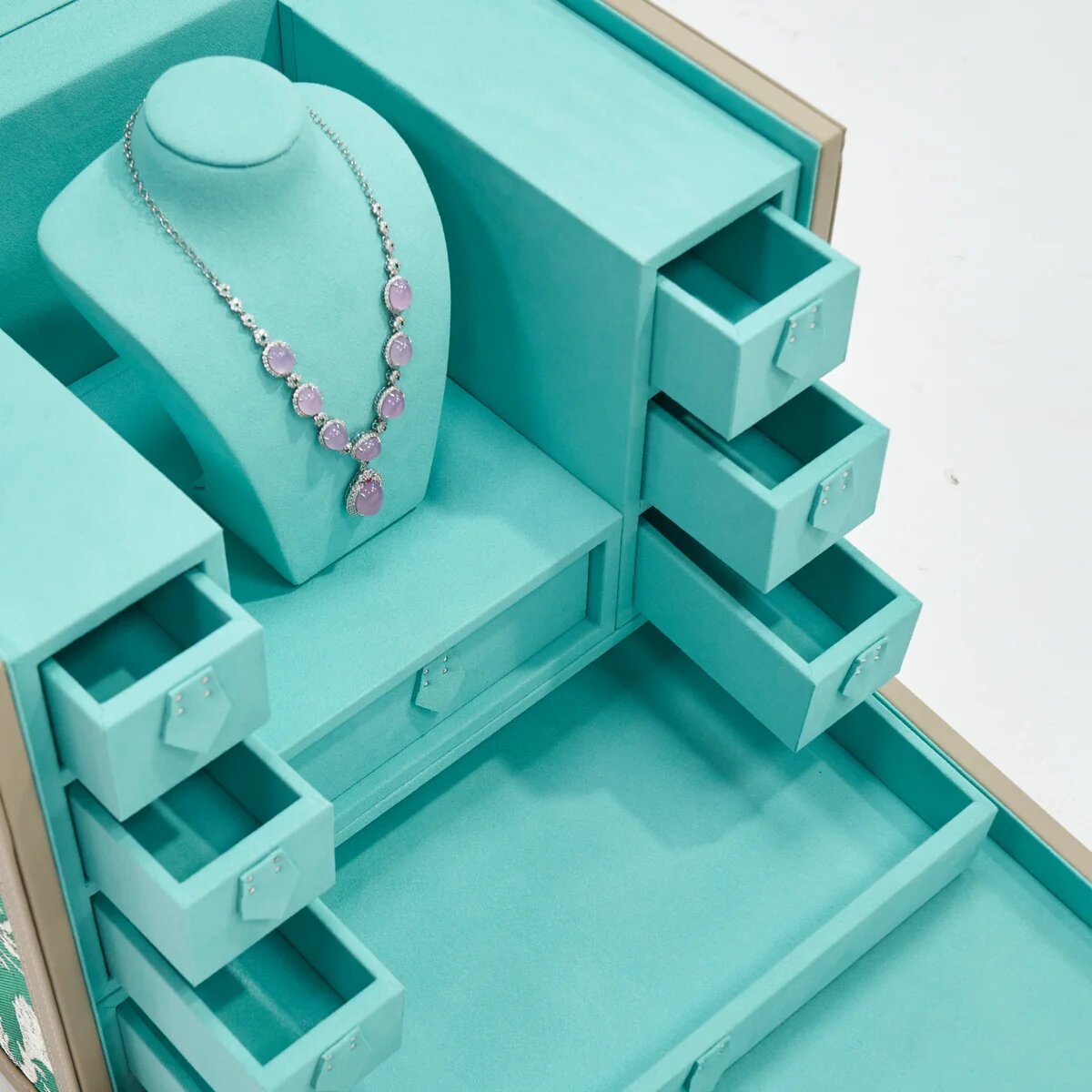
Then control the enclosure. Anti-tarnish strips (activated charcoal or zinc) neutralise the sulphur compounds that blacken silver and should be replaced every six months. A small silica-gel sachet inside a lined box buffers humidity spikes — but it must be recharged or replaced, not left saturated, or it works in reverse. Crucially, do not over-seal soft organic gems: pearls and opals want airflow, so they belong in a breathable lined compartment rather than an airtight bag. A lined, sectioned interior — like that in the Aurum Wire · The Illustrious Jewelry Box - Gilded Treasure — solves most of this passively: each piece sits separated, cushioned and shielded from open-air exposure without trapping a humid micro-climate.
| Anti-tarnish measure | What it does | UAE-specific note |
|---|---|---|
| Clean & dry before storage | Removes oils, salt, chlorine | Critical after pool/beach days |
| Anti-tarnish strips | Absorb sulphur in the air | Replace every 6 months |
| Silica-gel desiccant | Buffers humidity spikes | Recharge; never leave saturated |
| Lined, sectioned interior | Limits air contact + scratching | Breathable for pearls/opals |
| Individual soft pouches | Separates reactive metals | Anti-tarnish cloth for silver |
For the complete preservation method, see How to Store Jewellery Properly at Home: The Complete Preservation Guide.
How Should I Organise My Jewellery Collection by Type?
Quick Answer: Organise by category and by failure mode, not by aesthetics: necklaces hung or laid flat to prevent kinking, earrings paired in a foam or lined grid, rings in individual lined slots, and bracelets in a sectioned tray. The goal is one piece per compartment so nothing scratches, tangles or transfers tarnish to its neighbour.
Each category has a distinct enemy. Necklaces tangle and kink — fine chains should hang on hooks or lie flat in a long channel, never coiled in a pile. Earrings lose their pair and lose backs; a slotted foam or lined grid keeps studs upright and pairs together. Rings scratch each other when loose — a roll or row of individual lined slots is the only reliable answer, and it doubles as a quick daily inventory. Bracelets and bangles, especially heavier Arabic gold sets, need padded sectioning so rigid pieces do not dent softer ones.
Two rules sit above the categories. First, separate by hardness: diamonds (10 on the Mohs scale) will abrade gold, pearls and softer stones if they share a compartment, so hard and soft live apart. Second, keep daily-wear pieces accessible and high-value or seasonal pieces in deeper, more secure storage — the more friction there is in putting something away correctly, the less likely it is to happen. A multi-tier cabinet such as the Aurum Wire · The Pearl Jewelry Cabinet - Pearl White gives every category its own zone — necklace hooks, ring rolls, earring grids and bangle trays in one piece — which is what makes a growing collection stay organised rather than drift back into a tangle.
For category-by-category systems, see Jewelry Organizer Systems: Trays, Boxes & Cabinets (2026) and Necklace & Earring Organizer Ideas: Tangle-Free Storage (2026).
Jewellery Box vs Lockable Cabinet vs Safe — Which Do I Need?
The Bottom Line: Match the container to the value and the threat. A lined jewellery box organises and protects a working collection from tarnish and scratching but offers no security. A lockable jewellery cabinet adds capacity, display and a deterrent lock for a mid-value collection. A graded home safe is for high-value pieces where burglary, fire and insurance compliance are the real concern.
The three are a hierarchy, not alternatives. Most households need at least two: a box or cabinet for daily and weekly wear, and a safe for the pieces that would be catastrophic to lose. The decision is driven by replacement value and by what your insurer requires (see the insurance section below).
| Jewellery box | Lockable cabinet | Graded home safe | |
|---|---|---|---|
| Primary job | Organise, prevent tarnish | Organise + display + deter | Burglary/fire protection |
| Capacity | Small–medium | Large, multi-tier | Medium (security-led) |
| Security | None | Deterrent lock | Certified (EN 1143-1) |
| Best for | Working collection | Growing collection | High-value / heirloom |
| Indicative value held | Up to ~AED 30k | AED 30k–150k | AED 150k+ |
A leather or copper-wire box like the Heritage Print · The Timeless Jewelry Box - Noir is the right tool for the working layer — the rings and earrings worn weekly. The high-value layer steps up to a biometric cabinet (next section). The thresholds above are guidance, not law; your insurer's single-article limit is the real trigger to move a piece into a graded safe.
For the full comparison, see Jewellery Safe vs. Jewellery Box: A Collector's Guide to Asset Protection.
Are Biometric Jewellery Cabinets Worth It, and How Secure Are They?
Quick Answer: A biometric jewellery cabinet is worth it when you want fast, keyless daily access plus a genuine deterrent — fingerprint entry removes the lost-key and shoulder-surfed-PIN risks that defeat ordinary locks. For pure burglary resistance, the lock type matters less than the body: look for the EN 1143-1 grade, not just the fingerprint reader.
Biometric access solves a behavioural problem. A safe or cabinet that is slow or annoying to open gets left open, and an open safe is no safe. Fingerprint entry in under a second means the collection actually goes back behind the lock after every wear — the security feature people will use beats the stronger one they bypass. It also defeats two real attacks: a key copied or found by domestic staff, and a PIN observed over the shoulder.
Security itself is rated by the body, not the keypad. EN 1143-1 is the recognised European burglary-resistance standard, graded from Grade 0 upward; the higher the grade, the longer a determined attack takes and the higher the value insurers will allow inside (see the next section). Many graded units add fire protection to a separate standard (EN 1047-1 / EN 15659) and bolt-down points so the unit cannot simply be carried away — the most common failure of a freestanding box. The Aurum Wire · The Amber Jewelry Cabinet - Dune Gold pairs biometric access with custody-grade construction so daily convenience and asset protection live in the same piece, finished to sit in a dressing room rather than hide in a cupboard.
For commissioning specifics, see Commissioning the Ultimate Biometric Jewelry Safe for Dubai's Luxury Villas in 2026.
How Do Insurance and Valuation Work for Jewellery in the UAE?
Technical Verdict: Standard home-contents policies cap jewellery with a single-article limit and a category sub-limit, so high-value pieces must be individually "scheduled" against a dated valuation certificate. In the UAE, high-value home and jewellery insurance is offered by carriers such as Sukoon, and many policies rate a piece lower when it is kept in a graded safe than when worn — making your storage decision an insurance decision.
The mechanics are the same worldwide and apply in the UAE. A general contents policy might cover all jewellery up to a category limit, with each single item capped (commonly the equivalent of a four-figure sum). Anything above that cap is not fully covered unless you list it specifically — "scheduling" — supported by a valuation certificate from a certified appraiser stating the piece, its specification and its value on a stated date. Recent purchases can be evidenced by the original invoice; older or inherited pieces need a fresh appraisal.
Two UAE-relevant points. First, revalue periodically: gold prices and the carrier's replacement basis move, and a five-year-old valuation can leave a piece badly underinsured in a rising market. Second, storage affects the premium and the validity of a claim — many insurers offer a lower in-safe rate and may require a graded safe above a threshold value, so a biometric cabinet or graded safe can pay for part of itself through premium and coverage. Keep the valuation certificates, purchase invoices and dated photographs together but separate from the jewellery itself — ideally a digital copy off-site.
| Document | Purpose | When you need it |
|---|---|---|
| Valuation / appraisal certificate | Sets insured value of a scheduled item | High-value & inherited pieces |
| Original purchase invoice | Proof of value for recent buys | New purchases |
| Dated photographs | Identification for a claim | Every scheduled piece |
| Provenance / heirloom record | Establishes history & authenticity | Antique / inherited sets |
For the full local guide, see Jewellery Insurance & Valuation in the UAE: A Collector's Guide (2026).
What Are the Rules for Travelling With Jewellery Into and Out of the UAE?
Quick Answer: Travellers aged 18+ entering or leaving the UAE must declare cash and valuables — including jewellery, gold and precious metals — once the total exceeds AED 60,000, via the Federal Authority (ICP) online or the Afseh app. Personal jewellery is not subject to import duty, but you should carry it in hand luggage with invoices or a valuation as proof of ownership and value.
The declaration threshold is a combined figure across cash and valuables, so a single high-value set can cross it on its own. Declaring is straightforward and free; failing to declare above the limit risks penalties and seizure. The UAE does not impose import duty on personal gold jewellery, coins or bars, but officials may still ask you to declare and document them — which is why receipts or a valuation certificate matter at the border as much as at the insurer.
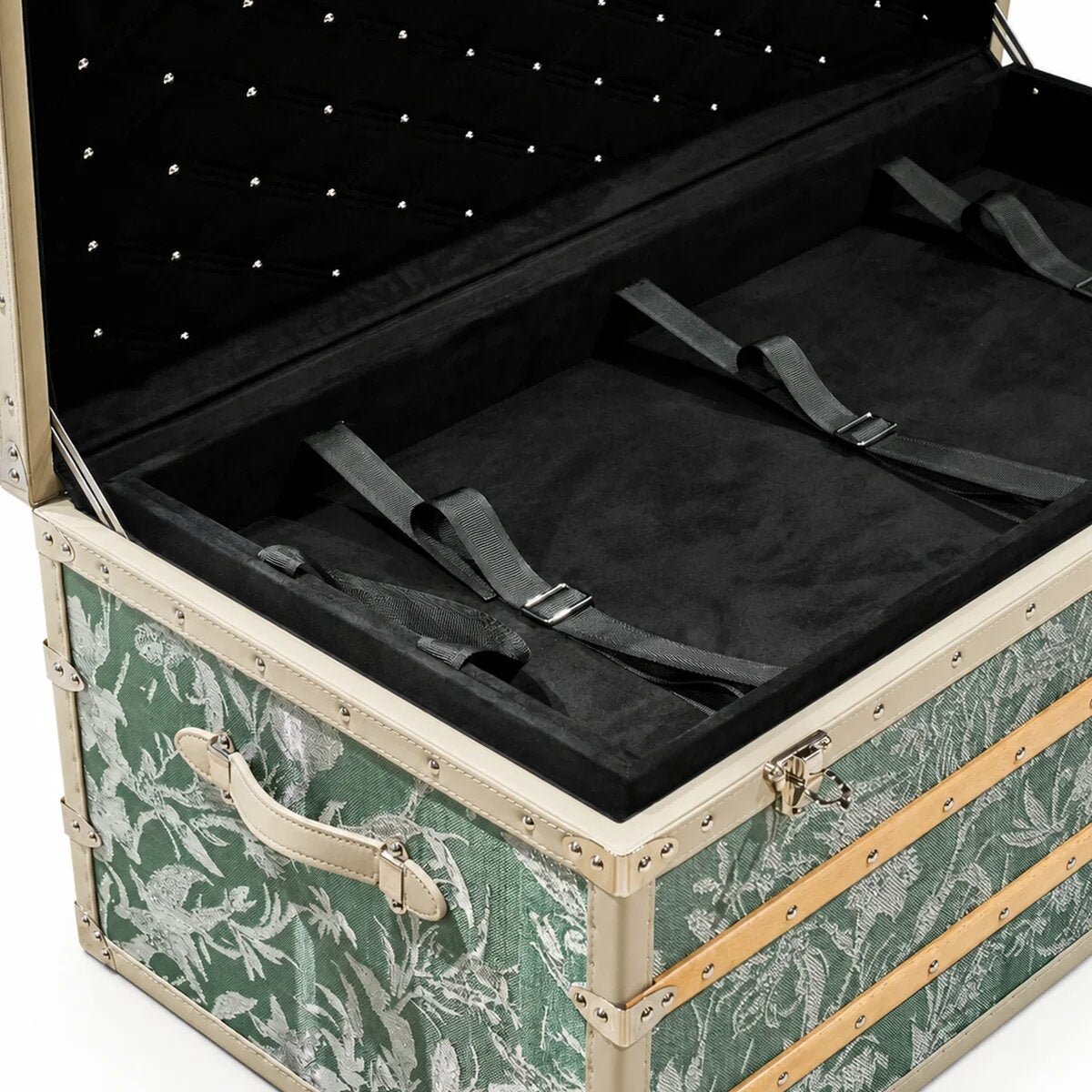
For the journey itself, never check valuable jewellery into the hold: keep it on your person or in cabin baggage, where it stays within reach and within most travel-insurance terms. A purpose-built travel case protects against the crushing and tangling of transit while keeping pieces organised and discreet. The Heritage Print · The Refined Travel Jewelry Case - Noir is sized for cabin carry, with secured rings, earring slots and a roll for chains so a week's pieces travel without tangling or rubbing.
For the customs detail, see Travelling with Valuables to UAE: Customs Declaration Rules for Jewellery, Gold & Watches; for case selection, see The Ultimate Luxury Travel Jewellery Case for GCC Travellers.
How Should I Store Heirloom and Bridal Gold for the Long Term?
The Bottom Line: Long-term and inheritance storage is about stability, separation and documentation — a controlled-humidity enclosure that holds 45–55% RH, each set individually padded and listed, with provenance and valuation records kept alongside. Heavy 24K Arabic and Indian bridal sets resist tarnish but scratch and deform easily, so cushioning matters more than airtightness.
High-purity gold worn rarely faces different risks from a daily collection. Tarnish is minimal at 22K–24K, but soft pure gold dents and bends, and elaborate Kundan, Polki and filigree work catches and breaks if pieces are stacked. Each set should sit in its own padded compartment, flat and unstacked, with the most fragile settings face-up and unweighted. Pearls and uncut stones common to bridal sets need the mid-band humidity above — keep them out of any airtight bag and away from direct AC airflow.
The second half of legacy storage is information. An heirloom you cannot identify or value is hard to insure and hard to pass on. Photograph each set, hold its appraisal and any original receipts, and record provenance — who it came from, when, and any restoration history. A multi-generation cabinet keeps the pieces and a discipline of organisation in one place; pair it with off-site digital copies of the documents so a single loss event cannot take both the gold and its record.
For inheritance planning, see How to Properly Store and Archive Family Heirloom Jewelry for the Next Generation; for display ideas, see Elegant Jewellery Display Ideas for Your Home: Stands, Holders & Organizers.
Frequently Asked Questions
What is the best humidity to store jewellery in the UAE? Aim for 40–55% relative humidity and a stable 18–24°C. Silver and lower-karat gold tarnish quickly above 60% RH, which Gulf summer air reaches outdoors, while bone-dry air conditioning below 30% RH cracks pearls and dries leather. The controlled mid-band protects both reactive metals and soft organic gems. Keep storage away from west-facing windows and at least one metre from AC vents, and add an anti-tarnish strip plus a recharged silica-gel sachet to buffer humidity spikes inside the box.
How do I stop my silver and gold tarnishing in Dubai? Clean and fully dry each piece before storing — skin oils, perfume, sunscreen, sanitiser, and pool or sea water all accelerate corrosion in this climate. Keep pieces in a lined, sectioned enclosure with activated-charcoal or zinc anti-tarnish strips replaced every six months, and a silica-gel desiccant to manage humidity. Store silver in anti-tarnish cloth pouches, but keep pearls and opals in a breathable compartment rather than an airtight bag, since they crack in over-dry, over-sealed conditions.
Do I need a safe for jewellery, or is a lockable cabinet enough? It depends on value and on your insurer. A lockable cabinet organises and deters for a mid-value collection — roughly up to the AED 100,000–150,000 range. Beyond that, or wherever a single piece exceeds your home-insurance single-article limit, you need a burglary-rated safe (EN 1143-1) that is bolted down and, ideally, fire-rated. Most homes use both: a cabinet or box for daily wear, and a graded safe for high-value and heirloom pieces that would be catastrophic to lose.
Do I have to declare jewellery when travelling to the UAE? Yes, once the combined value of cash and valuables you carry exceeds AED 60,000, travellers aged 18 and over must declare it to the Federal Authority for Identity, Citizenship, Customs & Ports Security — online or through the Afseh app. Personal jewellery is not charged import duty, but customs may ask for documentation, so carry invoices or a valuation certificate. Always keep valuable jewellery in cabin baggage, not the hold, in a secured travel case.
Visit the SIRAE Showroom in Dubai
Jewellery storage in the UAE is finally about matching the right enclosure to the right piece and the right threat. To see how custody-grade boxes, multi-tier cabinets and biometric storage handle the Gulf's humidity, AC dryness and security demands — and to plan a system that scales with your collection — book a private appointment at the SIRAE showroom, Al Shafar Complex, Umm Suqeim 1, Dubai. Call +971 55 886 6180 or write to info@siraecasa.com, and our team will walk you through the storage that suits your pieces and your home.
%0AJewellery%20storage%20in%20the%20UAE%20is%20harder%20than%20the%20a...)
Leave a comment
This site is protected by hCaptcha and the hCaptcha Privacy Policy and Terms of Service apply.