
How to Properly Store and Archive Family Heirloom Jewelry for the Next Generation
There is a particular discipline required when preserving heirloom jewelry across generations — one that sits at the intersection of materials science, climate awareness, and legal clarity. A Victorian diamond brooch sealed incorrectly in Dubai's environment will not survive another century. Natural pearls stored alongside silver will suffer. Enamel beside jade demands different conditions entirely. The answer is not a single vault, but a considered, partitioned system: one that speaks coherently to your insurer, your solicitor, and your grandchildren in equal measure.
Navigation
- The SIRAE Standard — Technical Parameters and Symptom–Spec–Verification Matrix
- Material Assessment and Professional Archiving: Metal Purity, Gemstone Certification, and the Digital Provenance Record
- Long-Term Environmental Control: Humidity, Light, Anti-Oxidation Packaging, and Safe Storage Tiers
- Legal Frameworks, Insurance, and Inheritance Protocols for Multi-Generational Jewelry Preservation
The SIRAE Standard
| Symptom (Observable Failure) | Spec / Mechanism | Verification |
|---|---|---|
| Silver tarnishes inside sealed box within months | No anti-tarnish cloth (925 silver anti-tarnish cloth) lining; residual humidity above 55% RH | Inspect lining material; measure RH with calibrated hygrometer; re-check at 90-day intervals |
| Gold or platinum pieces exhibit micro-scratches from contact | Absence of individual acid-free tissue paper wrapping; multi-piece co-storage without partitioning | Visual inspection under 10x loupe at retrieval; re-wrap each piece individually |
| Organic material (pearls, coral, tortoiseshell) desiccates or cracks | Silica gel desiccant over-buffering pushing RH below 40%; no separate humidity-moderated zone | Calibrated datalogger; target 45–55% RH for organic materials; cross-check quarterly |
| Conflicting-material failure: jade and enamel degrade alongside silver in shared compartment | Partitioned storage by material group; silver isolated with anti-tarnish barrier; jade and enamel in stable 45–55% RH zone; pearls in lightly breathable wrapping without desiccant over-saturation | Zone-by-zone hygrometer readings; no shared atmosphere between sulphur-emitting metals and porous organic materials |
| Fire or theft destroys irreplaceable pieces with no recovery pathway | Safe rated below UL 72 Class 350 fire protection; no offsite digital provenance record copy | Confirm UL 72 Class 350 fire-resistance rating on safe documentation; verify offsite backup of gemological files |
| Inert gas / nitrogen sealing loses integrity; residual oxygen causes metal oxidation | Inadequate seal on storage vessel; no scheduled re-seal protocol | Pressure or oxygen-sensor check at seal date; schedule re-seal every 12–24 months depending on vessel type |
| GIA gemstone certificate cannot be matched to physical stone at estate valuation | Certificate stored separately from piece; no cross-referenced digital archive | Unified digital jewelry archive with certificate scan, stone plot, photography, and piece identifier in single record |
| Humidity spikes during Gulf summer (Dubai seasonal swing) cause differential expansion in multi-stone settings | No climate-buffered storage vessel; ambient RH fluctuates 30–75% across seasons | Continuous datalogger; maintain storage environment within plus or minus 5% RH of 50% target year-round |
Two supplementary notes: the 45–55% RH band is the calibrated consensus for mixed collections; organic materials such as natural pearls require the upper half of that range and must never share an over-desiccated compartment with silver. Partitioned zoning — not a single unified atmosphere — is the non-negotiable design principle for multi-material heirloom collections.
Material Assessment and Professional Archiving: Metal Purity, Gemstone Certification, and the Digital Provenance Record
Beginning with a Thorough Material Inventory
Before a single piece enters long-term storage, it demands an honest reckoning. Heirloom collections assembled across generations frequently mix metals, gemstones, and organic materials whose storage requirements diverge considerably. Victorian jewelry in particular — K-gold settings, old mine-cut diamonds, platinum fittings, and perhaps a natural pearl or two — arrives with no original documentation and a history only partly legible from the metalwork itself. The chasing on a gold mount may suggest a decade; the alloy composition, quite another.
The first act of archiving is professional assessment: a qualified gemologist or accredited jewelry appraiser who can confirm metal purity, identify treatments in colored stones, and flag any condition issues that storage alone cannot resolve. What you invest in assessment now returns itself many times over in legal certainty and insurer confidence later.
GIA Certification and Third-Party Gemological Records
For any unmounted diamond, significant colored stone, or historically important piece, a GIA gemstone certificate remains the most widely recognized verification instrument internationally — accepted by insurers, estate solicitors, and auction houses without further argument.
Where original certificates are absent, commissioning new gemological reports from recognized laboratories is the appropriate step. The report should specify:
- Stone identity, weight, and cut grade
- Any treatments or enhancements (heat treatment in sapphires, fracture filling in emeralds)
- Inclusions plotted to the specific stone — the unique fingerprint that enables future identification
These physical certificates must never be stored with the jewelry in conditions that could damage them. A separate, fireproof document archive — or ideally a digital facsimile stored offsite — is the correct protocol.
Building the Digital Jewelry Archive
A digital provenance record is no longer optional for collections intended to cross generational lines. It is the document structure that makes an heirloom legible to the next owner, a probate court, and an underwriter simultaneously. Clarity here is not a convenience; it is a form of loyalty to whoever comes after you.
A thorough digital archive for each piece should contain:
- High-resolution photography in natural and raking light (to capture surface detail)
- Macro photography of hallmarks, maker's marks, and any engraving
- Scans of all certificates, receipts, appraisal reports, and insurance valuations
- A written provenance note: acquisition date, family history, any known restoration
- Unique piece identifier cross-referenced with physical storage location
Cloud storage alone is insufficient. The archive should exist on at least two physically separate media — an encrypted external drive held by the estate's solicitor and a second copy in a secure digital repository — with periodic integrity checks to confirm files remain uncorrupted.
Victorian and Mixed-Era Collections: Special Archiving Considerations
Victorian jewelry presents specific challenges that modern appraisal frameworks sometimes underestimate. Old mine-cut diamonds carry values that differ from modern brilliant equivalents; platinum fittings from the Edwardian period may be alloyed differently from contemporary platinum. Enamel work, seed pearls, and foil-backed stones each require their own notation in the archive.
For collections that include pieces of particular historical significance, a narrative provenance statement — written by a specialist rather than a generalist appraiser — adds considerable legal weight. This document becomes part of the digital archive and, ultimately, part of the estate file presented to probate.
Long-Term Environmental Control: Humidity, Light, Anti-Oxidation Packaging, and Safe Storage Tiers
Why Dubai's Climate Demands an Active Storage Strategy
Dubai's ambient environment presents a particular challenge for heirloom storage. Summer interiors, even in climate-controlled villas, can cycle between air-conditioned 19°C and brief exposures to outdoor air exceeding 45°C. Relative humidity oscillates between the extreme aridity of peak summer — sometimes below 20% outdoors — and the damp coastal air of spring and autumn. These swings, if felt inside a storage vessel even momentarily, cause differential expansion in multi-stone settings, hasten the desiccation of organic materials, and accelerate tarnish on silver alloys.
The answer is not simply "buy a good safe." It is a layered environmental system in which every tier — packaging, container, room, and vault — contributes to stability.
The Multi-Layer Packaging System
Each piece, regardless of its material, should be individually wrapped before it enters any storage container. The materials are not interchangeable:
- Acid-free tissue paper for all metal and gemstone pieces — it buffers minor humidity fluctuations and prevents surface contact between hard materials
- 925 silver anti-tarnish cloth for silver alloys, silver-gilt, and Sheffield plate — the embedded chemistry absorbs sulphur compounds that cause tarnish
- Soft, undyed natural linen or muslin pouches for organic materials (pearls, coral, ivory, tortoiseshell) — breathable containment that prevents both desiccation and condensation
- Silica gel desiccant sachets placed at container level, not in direct contact with organic materials — these are replaced or recharged on a scheduled basis, typically every three to six months
For pieces of particular sensitivity — early photographic miniatures in gold lockets, painted enamel panels, or organic inlay — inert gas / nitrogen sealing within an individual sealed vessel represents the highest available protection against oxidation. This technique, borrowed from fine art and numismatic conservation, eliminates residual oxygen from the storage atmosphere entirely. It is particularly appropriate for decade-scale or longer archiving where the piece will not be retrieved regularly.
The Partitioned Storage System: Resolving Material Conflicts
This is the point at which most generic storage guidance fails. A single, unified storage atmosphere — however well-controlled — cannot serve every material in a mixed heirloom collection without compromise. The conflict is chemical, not merely physical. And it is worth correcting a common assumption here: proximity alone, even within a beautifully lined cabinet, constitutes shared atmosphere if the compartments are not genuinely sealed from one another.
- Silver and silver-gilt emit sulphur compounds as they oxidize; these compounds attack pearls and accelerate degradation of enamel surfaces in a shared atmosphere
- Jade (nephrite and jadeite) and hardstone carvings are relatively stable but benefit from a slightly higher humidity — 50–55% RH — and are damaged by the acidic off-gassing of certain synthetic linings
- Natural pearls require a minimum of 45% RH and cannot be stored in an over-desiccated environment; they also require occasional exposure to moderate humidity to prevent dehydration cracking
- Painted enamel is acutely sensitive to thermal shock; rapid temperature changes cause the enamel layer to separate from its metal base with a finality that no subsequent restoration fully reverses
The solution is explicit zoning within the storage system:
| Material Group | Target RH | Packaging | Isolation Requirement |
|---|---|---|---|
| Gold and platinum (unmounted or diamond-set) | 40–50% RH | Acid-free tissue; individual compartment | No special isolation needed |
| Silver, silver-gilt, Sheffield plate | 40–45% RH | Anti-tarnish cloth wrap; sealed sub-compartment | Physically isolated from pearls and enamel |
| Natural pearls, coral, organic materials | 50–55% RH | Breathable linen pouch; no desiccant contact | Separate zone; no shared atmosphere with silver |
| Jade, hardstone, enamel | 50–55% RH | Acid-free tissue; soft lining | Isolated from sulphur-emitting metals |
| Miniatures, enamel portraits, foil-backed stones | 45–50% RH; nitrogen seal optional | Individual sealed vessel if decade-plus storage | Maximum isolation; consider nitrogen sealing |
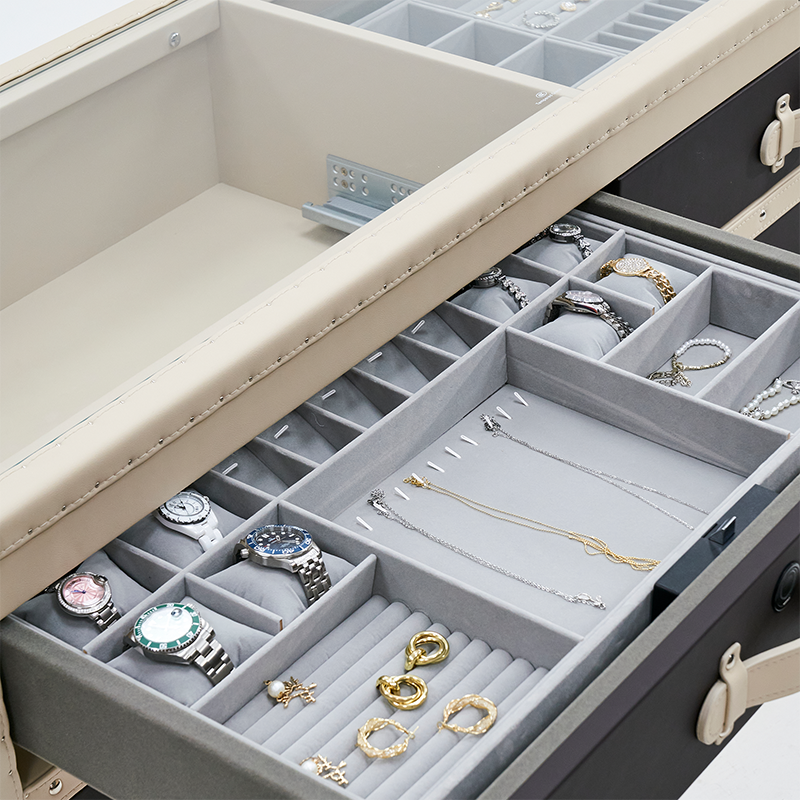
This zoning principle does not require multiple separate safes. A well-designed cabinet with discrete, individually lined and atmospherically managed compartments achieves the same result — provided those compartments do not share a common air space.
Safe and Vault Selection: UL 72 Class 350, Bank Vaults, and Professional Art Storage
Three primary tiers of physical storage are relevant to the long-term archiving scenario:
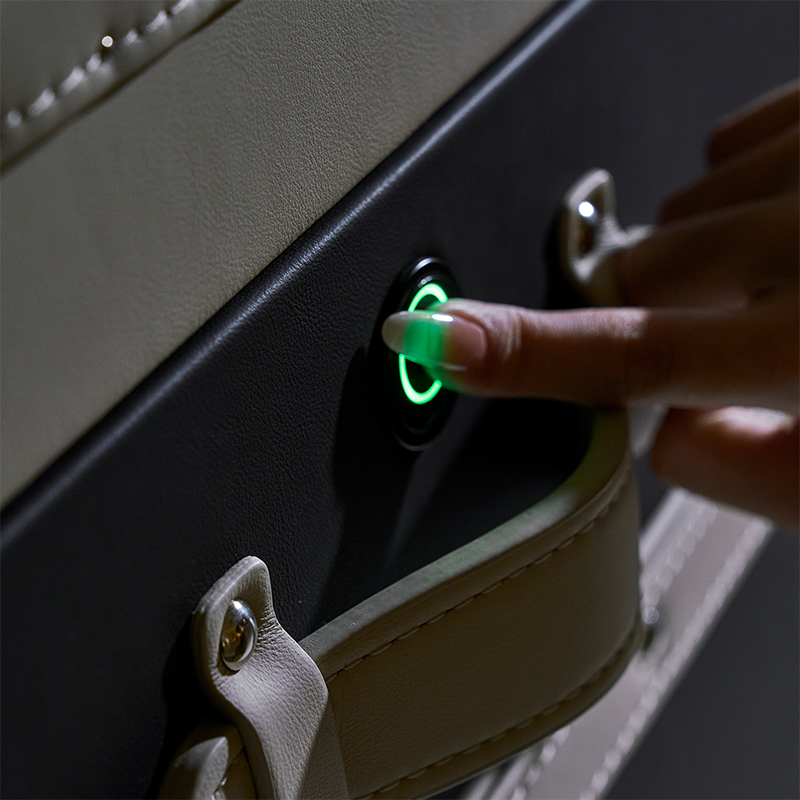
Tier 1 — Residential safe (on-site, daily access) A residential jewelry safe with a minimum UL 72 Class 350 fire resistance rating ensures that internal temperatures remain below 177°C (350°F) during a standard fire scenario — the threshold below which most precious metal pieces and gemstones survive without damage. Below this rating, a fire event is likely to destroy the collection irrecoverably. For collections of significant value, biometric or multi-factor access and concealed installation within the villa structure are the appropriate specifications.
Tier 2 — Private bank vault (off-site, periodic access) Private bank safe-deposit facilities in the UAE offer a level of institutional security that residential safes cannot replicate. The limitation is access: retrieval requires a physical visit during banking hours, and environmental conditions within individual deposit boxes are not user-controllable. For pieces not requiring regular retrieval, bank vaulting is a sensible secondary layer — particularly for duplicate certificate storage.
Tier 3 — Specialist art and valuables warehousing (multi-year, climate-controlled) For collections genuinely intended to remain undisturbed for a decade or more, specialist fine art and valuables storage facilities — such as those operated by internationally recognized logistics organizations — offer individually climate-controlled, insurance-grade environments with documented chain-of-custody and institutional-level security. The cost premium over a residential safe is substantial. The environmental consistency and insurer acceptance, however, are unmatched for high-value, long-duration archiving.
For collections planned for ten years or more without retrieval, the recommended architecture is: individual nitrogen-sealed vessels for the most sensitive pieces, within a climate-controlled specialist facility, with residential or bank vault storage reserved for pieces in active circulation within the family.
Legal Frameworks, Insurance, and Inheritance Protocols for Multi-Generational Jewelry Preservation
Why Physical Security Alone Is Insufficient
The most perfectly stored collection is still vulnerable if its legal status is ambiguous. Heirloom jewelry intersects with probate law, inheritance tax, spousal rights, and — across MENA jurisdictions — Sharia succession frameworks in ways that can override even the most carefully written will. Physical preservation without legal clarity is an incomplete act of stewardship.
This section does not constitute legal advice; it outlines the documentation architecture that estate solicitors and succession specialists consistently require.
The Valuation and Insurance Layer
Every piece intended for inter-generational transfer should carry a current professional valuation — issued within three to five years of the intended transfer date, or updated after any significant market movement in the relevant stone or metal category. The valuation should:
- Reference the GIA certificate or equivalent laboratory report by number
- Specify replacement value and market value (these diverge considerably for antique pieces)
- Be conducted by an appraiser with appropriate professional credentials recognized by the insurer
The insurance policy itself requires scrutiny. A standard home contents policy rarely provides adequate cover for jewelry collections above modest thresholds. A scheduled all-risks policy — naming each significant piece individually, with agreed value (not replacement value) for antique and irreplaceable items — is the appropriate instrument. Confirm that the policy covers storage both at the residential location and in any off-site facility used.
The GIA Certificate as a Legal Instrument
A GIA certificate is not merely a quality document; it is a traceable legal identifier. The certificate number is a permanent record held by the issuing laboratory, retrievable independently of the physical certificate. This makes it the most reliable reference point for an estate solicitor working to match physical pieces to inventory lists in a probate context.
Every significant stone in the collection should have either an original GIA or equivalent laboratory certificate, or a newly commissioned report. The certificates should be:
- Scanned in high resolution and stored as part of the digital provenance record
- Referenced by number in the will or trust document (never by description alone)
- Held physically in a location independent of the jewelry — typically with the estate solicitor or in a separate secure document archive
Drafting the Inheritance Protocol
The inheritance protocol is the document that makes the entire archive usable by the next generation. It is distinct from the will itself — it is an operational guide that explains the collection to heirs who may have had no direct involvement in its assembly. Think of it as the one document that should need no interpreter.
A thorough inheritance protocol should contain:
- A complete inventory with photographs, certificate references, and digital archive location for each piece
- The storage location architecture: which pieces are where, and how to access each storage tier
- Maintenance schedule: when desiccants are replaced, when insurance valuations are renewed, when datalogger readings are reviewed
- The identity and contact details of the estate's preferred gemologist, appraiser, and storage facility
- A statement of intent for each significant piece — whether it is to be kept, distributed to named individuals, or eventually liquidated — with the legal mechanism (specific bequest, trust, or residuary estate) clearly indicated
For families operating across multiple jurisdictions — a Dubai-based collection with beneficiaries in Saudi Arabia, the UK, or elsewhere — the protocol should explicitly address the question of which jurisdiction's succession law governs the collection and confirm that the storage and insurance arrangements comply with the relevant regulatory environment.
The Closed Legal Loop: Will, Certificate, Insurance, and Digital Archive
The four instruments work together as a single coherent system:
- The will or trust instrument names pieces by certificate reference number, not by description
- The GIA certificate (or equivalent) provides the independent, verifiable stone identifier
- The insurance policy confirms agreed value and storage compliance
- The digital provenance record ties everything together — photographs, appraisals, certificates, provenance notes, and the maintenance history of the storage system itself
No single instrument functions effectively in isolation. The legal closure — the condition in which a probate court, an insurance underwriter, and a new generation of owners can all work from the same coherent, cross-referenced documentation — is the ultimate purpose of the entire archiving exercise.
The most enduring act of heirloom stewardship is not the vault or the certificate — it is the discipline to build a system coherent enough for someone who never knew you to trust it completely. Those who do this work quietly, now, give the next generation not merely an object but a story with proof.

Leave a comment
This site is protected by hCaptcha and the hCaptcha Privacy Policy and Terms of Service apply.