
How to Upgrade from a Cluttered Jewelry Box to a Minimalist High-End Storage System
There is a particular kind of quiet frustration known only to collectors: opening a drawer and finding a tangle of chains, a ring missing its companion, a silver pendant clouded to the colour of old pewter. The problem is rarely the jewellery itself — it is the system, or rather the absence of one. Upgrading from a cluttered jewellery box to a minimalist, considered storage arrangement is less a shopping decision than an act of editorial discipline: choosing what deserves space, then designing a space worthy of it.
This guide addresses the transition methodically — diagnosing why conventional storage fails, establishing what materials and structures actually constitute a meaningful upgrade, and then walking through a calm, sequenced migration so that no piece is lost, damaged, or demoted in the process.
Navigation
- Diagnosing the Core Failures of Conventional Jewellery Storage
- Materials, Structure, and Standards for a Minimalist High-End System
- A Step-by-Step Migration to Systematic Minimalist Storage
The SIRAE Standard
High-Density Preservation Parameters for Jewellery Storage
| Parameter | Professional Benchmark | Why It Matters in Humid Climates |
|---|---|---|
| Interior lining material | Suede lining or acid-free cotton; pH-neutral, non-outgassing | Tarnish-accelerating vapours from synthetic linings are amplified above 65% RH |
| Relative humidity (RH) threshold | Target 45–55% RH for mixed-metal collections | Above 65% RH, oxidation rate on sterling silver accelerates by a measurable factor of 3–5x |
| Anti-tarnish mechanism | Acid-free, anti-oxidant cotton cloth partition layers; no adhesive backings | Adhesives off-gas acetic acid, reacting with silver and copper alloys at elevated temperature |
| Wood lining (gemstone sections) | Spanish cedar wood partition only for non-metal items; avoided for direct silver contact | Cedar's natural oils can micro-stain porous gemstones; compartmentalisation is non-negotiable |
| UV exposure limit | UV-filtering acrylic or glass cover; UV index at or below 380 nm blocked | Prolonged UV bleaches organic gemstones (coral, pearl, amber) and fades enamel |
| Modular scalability metric | Horizontal tray-stacking system; each tray independently removable | Prevents micro-abrasions caused by lifting a whole tray stack to retrieve a single piece |
| Ring channel spacing | Minimum 22 mm centre-to-centre to prevent prong-to-prong contact | Contact between set stones causes surface micro-abrasions on facets and bezel edges |
| Closure mechanism | Magnetic or recessed clasp; zero metal-on-metal latches on interior | Vibration from spring latches transmits into trays, dislodging pave and channel-set stones |
The table above is the minimum specification frame for any storage system that claims to protect a serious collection. Everything below it is sentiment; everything above it is genuine preservation engineering.
Diagnosing the Core Failures of Conventional Jewellery Storage: Oxidation, Tangling, and Loss {#diagnosing}
Why a Standard Jewellery Box Actively Harms Your Collection
The conventional jewellery box — a hinged lid, a few fixed ring rolls, a shallow tray beneath — was designed for the display of perhaps twelve to twenty pieces at most. When a collection grows beyond that threshold, the structure fails on every axis simultaneously. It does not fail gradually; it fails all at once.
The first failure is oxidation. Most mass-market boxes are lined with synthetic velvet or polyester-backed fabric. These materials trap moisture and, crucially, off-gas low-level volatile compounds that accelerate tarnishing on silver, copper alloys, and even gold-plated surfaces. In humid climates the problem compounds: relative humidity above 65% within a sealed, poorly ventilated box creates a micro-environment far more corrosive than the ambient room. What the lid conceals, the chemistry corrodes.
The second failure is mechanical entanglement. When chains share an unpartitioned drawer or tray, the result is entirely predictable — knots that require specialist intervention to resolve without stretching, and clasps that snap under tension. Fine chain links, particularly in 18-karat yellow gold or 925 silver, are susceptible to deformation at precisely the points where the metal is thinnest.
The third failure is invisible: loss through disorganisation. When pieces are not assigned fixed positions, retrieval becomes search — and search becomes the occasion for pieces being placed "temporarily" elsewhere and never returned.
The Risk Profile by Material
Not all jewellery degrades at the same rate in poor storage conditions:
- 925 silver: highest tarnish sensitivity; reacts visibly with sulphur compounds and humidity within weeks in inadequate storage.
- K-gold alloys (9k, 14k): lower tarnish risk, but copper content in lower-karat alloys remains reactive to acidic off-gassing from synthetic linings.
- Natural gemstones: organic stones — pearl, coral, amber — are hygroscopic and absorb atmospheric moisture; rigid synthetic-lined boxes offer no moisture buffering whatsoever. Porous stones including turquoise and malachite can absorb volatile compounds from adhesive-backed linings.
- Diamonds and hard stones (sapphire, ruby, emerald): chemically stable, but facet micro-abrasions from unpartitioned contact with other stones are permanent and cannot be reversed without professional re-polishing.
Diagnosing Your Own System
Before any acquisition or reorganisation, perform a brief, honest audit:
- Count the number of pieces that have tangled in the last six months.
- Identify any silver or silver-plated pieces with visible tarnish that was not there when last stored.
- Note any pieces you have been unable to find for more than two weeks.
- Observe whether your current storage allows you to see every piece without lifting or moving others.
If three or more of these are true, the system itself is the problem — not the quantity of jewellery.
Materials, Structure, and Standards for a Minimalist High-End Storage System: Suede Lining, Modular Trays, and UV Protection {#materials}
What "Minimalist" Actually Means in Storage Design
Minimalism in storage is not the absence of capacity — it is the absence of visual disorder. A genuinely minimalist high-end system presents every piece in its correct position, accessible without rearrangement, without overlap, and without the eye needing to process unnecessary information to locate what it seeks. This is an engineering condition as much as an aesthetic one.
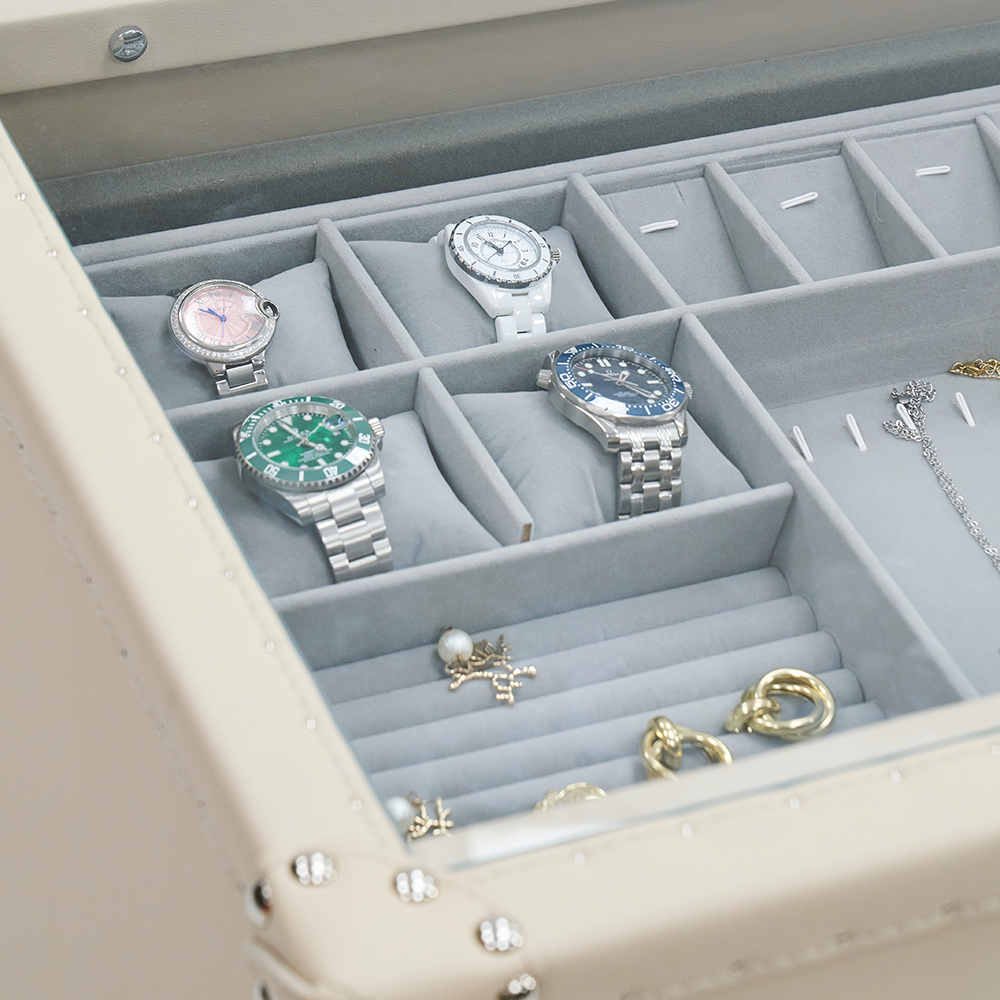
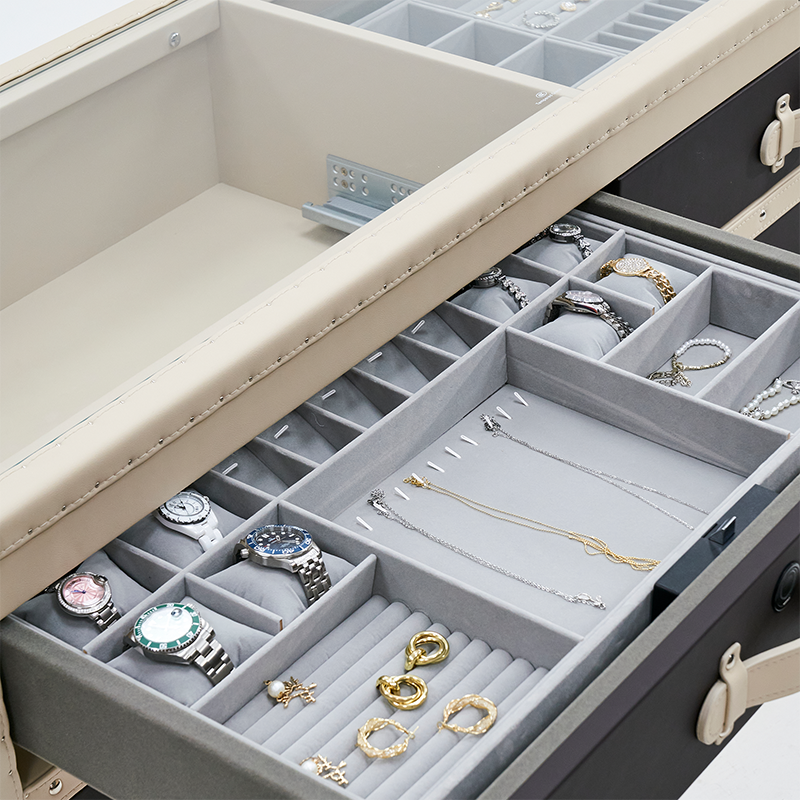
The structure that achieves this is the modular layered tray system — a modular stacking tray system of independently removable horizontal trays, each with fixed-position compartments, ring channels, and pendant hooks, scaled to the exact dimensions of the collection rather than a generic market average.
The Material Hierarchy
The interior material is not a finishing detail — it is the primary preservation instrument:
| Material | Correct Application | What to Avoid |
|---|---|---|
| Suede lining | Main tray surfaces; ring channels; earring boards | Do not use raw suede near porous coloured gemstones without pH testing |
| Acid-free anti-oxidant cotton cloth | Partition layers between trays; wrap for long-term storage pieces | Standard cotton (not acid-free) still contains residual processing chemicals |
| Spanish cedar wood partition | Structural dividers in non-metal storage; accent panelling | Direct cedar contact with silver — cedar oils can leave faint marks on polished surfaces |
| UV-filtering acrylic display cover | Open-shelf display within a wardrobe or dressing room; museum-style presentation | Standard glass or uncoated acrylic transmits UV; gemstone colour shift is cumulative and irreversible |
The Wolf Designs and Buben & Zorweg Comparison: Anti-Oxidant Linings, Scalability, and Aesthetic Register
The two names most frequently cited at the collector level for jewellery storage are Wolf Designs and Buben & Zorweg. They represent distinct philosophies — and the distinction matters practically.
Wolf Designs has built a long reputation on accessible modularity. Its tray systems are designed for incremental expansion: trays stack and interlock, finishes are consistent across the range, and the anti-tarnish lining — a proprietary LusterLoc treatment on felt — is claimed to inhibit tarnish for up to thirty-five years under controlled conditions. The aesthetic is tailored and functional, well-suited to a wardrobe context where pieces will be used daily. The limitation worth noting — and it is a meaningful one — is that the lining material, while effective under the manufacturer's stated conditions, has not been tested or rated for the elevated-humidity environments found in Hong Kong, Shanghai, or coastal Gulf climates, where ambient RH regularly exceeds 70% without supplemental climate control.
Buben & Zorweg operates at a different register entirely. The brand is associated with jewellery armoires and vault-adjacent storage that approaches archival-grade specification: hand-stitched suede interiors whose nap is perceptibly finer and denser than production alternatives, individually configured compartments, temperature and humidity management in the larger cabinet formats, and an aesthetic language drawn from fine furniture rather than accessory retail. The scalability model is not horizontal tray addition but vertical commission — each piece is configured to the collection at the point of order, which suits a collector whose holdings are largely stable but whose requirements for protection are non-negotiable.
For collections of eighty or more pieces — encompassing K-gold, 925 silver, and natural gemstones — the selection logic for a humid-climate environment follows a clear framework:
- If the dressing room or wardrobe has supplemental climate control (dehumidifier maintaining 50–55% RH): Wolf Designs' modular tray architecture provides accessible, expandable daily-use storage without over-engineering the brief.
- If climate control is absent or unreliable (common in older residential stock in Hong Kong and Shanghai): the priority shifts to a closed, humidity-buffering system with suede or acid-free cotton lining at every contact surface — placing Buben & Zorweg's enclosed cabinet formats, or a commissioned equivalent, as the appropriate category.
- For display-facing collections in open dressing rooms: a UV-filtering acrylic display cover is non-negotiable at any brand level, regardless of other material choices.
The Quantified Standard for Humid-Climate Selection
This is the question that most storage guides decline to answer with precision: what, exactly, constitutes an adequate anti-oxidant lining specification for climates where humidity is a design variable rather than a constant?
The answer requires three quantified checkpoints:
- Lining pH neutrality: Any lining material in direct or near-contact with metal jewellery must test at pH 6.5–7.5. Below pH 6.0, the material is actively acidic and will accelerate tarnish on silver and copper-bearing alloys. This is verifiable with standard pH strip testing on a dampened sample — a step that takes under two minutes and is rarely performed.
- Vapour permeability rating: Lining materials with zero vapour permeability — dense synthetic foams, rubberised backings — trap condensate against metal surfaces in a high-humidity environment. Materials with controlled permeability, natural suede and woven acid-free cotton among them, allow slow moisture exchange and prevent condensation pools from forming at the piece surface.
- Outgassing assessment: Adhesive-backed linings, common in mass-market storage, off-gas acetic acid and formaldehyde at measurable levels, particularly when warmed by ambient heat. In Dubai or Hong Kong, where interior temperatures may reach 28–32 degrees Celsius without air conditioning, this effect is pronounced. A storage system that relies on adhesive-attached lining rather than mechanically fixed or hand-stitched material is not suitable for precious-metal or porous-gemstone collections in warm climates.
No mainstream guide for jewellery storage currently provides these three parameters as selection criteria. They are, however, the precise variables that determine whether a "high-end" storage system is performing as claimed or merely presenting the appearance of care.
A Step-by-Step Migration to Systematic Minimalist Storage: KonMari Classification, Tray Architecture, and Collection Continuity {#migration}
The Philosophical Frame: Applying KonMari Principles to a Jewellery Collection
The KonMari classification method is frequently cited in the context of clothing and books, but its underlying logic applies with particular rigour to jewellery: category-first sorting, retention by clear positive criteria rather than default inertia, and the assignment of a specific home to every retained item.
Applied to a collection of eighty or more pieces, the framework operates in four phases. It is worth noting plainly that phase one is evaluative, not acquisitive. Nothing new enters the system until the existing collection has been assessed on its own terms.
Phase One: Full Inventory and Categorical Assessment
Remove every piece from existing storage simultaneously and arrange by category on a clean, neutral surface — a white linen cloth or an acid-free cotton surface works well, both for visual clarity and for preventing contact with anything reactive. The act of laying everything out together is itself instructive; collections have a habit of being larger, and stranger in composition, than memory suggests.
Categories to use:
- Daily wear (high rotation, simple clasps, robust materials)
- Occasion wear (low rotation, fine settings, fragile chains, pave)
- Archival / sentimental (rarely or never worn, high sentimental or monetary value)
- Requiring attention (tarnished, broken clasps, missing stones — set aside for restoration)
- For reconsideration (pieces that serve no clear purpose in the collection as currently understood)
The KonMari question — "does this piece have a clear, continuing role?" — is the correct filter for the fifth category. Pieces without a continuing role are candidates for gifting, resale through specialist auction, or private sale. They should not be admitted to the new system by default.
Phase Two: Assigning Protection Grades
Once retained pieces are inventoried, assign each a protection grade based on material sensitivity and rotation frequency:
| Grade | Material Profile | Storage Requirement |
|---|---|---|
| Grade A – Daily | K-gold, diamond, hard stones; worn 3 or more times per week | Top tray; accessible; suede-lined ring channel or earring board |
| Grade B – Occasion | 925 silver, coloured gemstones, delicate chains; worn monthly | Mid tray; acid-free cotton partition between layers; closed lid |
| Grade C – Archival | Antique silver, organic stones (pearl, coral, amber), enamel; rarely worn | Sealed compartment; acid-free cotton wrap; humidity-buffered enclosure |
This grading exercise determines the physical architecture of the new system before any storage is purchased. It is the single most common step that collectors skip — and the omission is precisely why many "upgrades" simply replicate the disorder of the previous system in more expensive materials.
Phase Three: Designing the Tray Architecture
A modular stacking tray system succeeds only when the tray configuration mirrors the collection's actual geometry — not a generic template.
Key design decisions:
- Ring tray: specify minimum 22 mm channel spacing to prevent prong contact; suede lining throughout; no metal hardware on the tray surface itself.
- Necklace and chain management: individual pendant hooks or silicone-tipped pegs for each chain; chains must hang vertically or lie flat in dedicated channels, never coiled together.
- Earring boards: grid format with defined spacing; pierced holes rather than clips allow both stud and drop earrings to store securely without pressure on the fitting.
- Bracelet tray: padded roll or flat-lay channel; bracelets must not touch each other — bangles are particularly prone to surface scratching when stacked loose.
- Deep compartment: one or two closed compartments per tray level for Grade C archival pieces or those currently wrapped in acid-free anti-oxidant cotton cloth.
Phase Four: The Physical Migration — Sequenced, Not Simultaneous
The migration from old storage to new should be carried out in grade order, Grade A first:
- Clean each piece before placing in the new system. For silver, use a professional-grade polishing cloth, not an impregnated dip — dips remove the controlled patina that many natural gemstone settings are calibrated to complement.
- Assign and fix each piece to its designated position. Do not place pieces "temporarily" — the discipline of fixed assignment is the operational core of the new system.
- Photograph the completed tray layout. A visual inventory serves as both an insurance record and a practical reference for pieces stored out of sight in lower or archival trays.
- Remove all previous storage. The old boxes serve no residual function, and their continued presence creates a default fallback that quietly undermines the new system's integrity.
Phase Five: Environmental Control as the Final Layer
The storage system itself is only as effective as the environment surrounding it. In Hong Kong, Shanghai, or any Gulf coastal environment, the ambient conditions are not a secondary consideration — they are the governing variable:
- Dehumidifier or climate-controlled dressing room: maintain ambient RH at 45–55%. A hygrometer within the room — not relying on a general smart-home reading — provides ground-truth data for the immediate storage zone.
- Avoid direct airflow from air conditioning vents onto open storage trays. Rapid temperature cycling at the piece surface causes condensation on metal and thermal stress on resin-set or cement-set stones.
- Silica gel packets in closed archival compartments provide passive buffering for Grade C pieces during months when ambient humidity fluctuates. Replace or regenerate every sixty to ninety days; a spent silica gel packet that has passed its absorption capacity is worse than no packet, as it holds trapped moisture directly against the stored pieces.
- UV-filtering acrylic display cover for any trays displayed openly on shelving: this is not optional for pieces with organic gemstones, enamel, or coloured lacquer.
Maintaining the System Over Time: Expansion Logic
When a collection grows, the modular horizontal architecture expands by adding trays — not by creating overflow elsewhere. The discipline that distinguishes a genuine collection from an accumulation is that expansion is deliberate: a new piece earns its position before it enters the room.
The KonMari framework applied to ongoing acquisition is simple. A new addition displaces something from the active trays — into archival storage or out of the collection entirely — or the tray architecture expands by a defined increment. The system should never accommodate a piece without first clarifying where it will live.
Every collection deserves a form of order that reflects the care with which it was assembled — and the quiet discipline of a well-designed storage system is, in the end, the most lasting form of respect a collector can offer to the objects in their keeping.

Leave a comment
This site is protected by hCaptcha and the hCaptcha Privacy Policy and Terms of Service apply.