
The Collector's Compendium: Luxury Watch Winder Cabinet Alternatives to Wolf 1834
For the collector who counts a Patek Philippe complications piece, an F.P. Journe, and perhaps two or three Rolex sport references amongst their holdings, the question of appropriate storage and conditioning is never casual. It is, in fact, a form of horological stewardship. Wolf 1834's heritage is genuine — founded by silversmith Philipp Wolf and refined over nearly two centuries — yet heritage alone does not satisfy the demands of a collection that has outgrown a single-brand ecosystem.
The serious collector in 2025 asks a different set of questions. Can each winding station be programmed independently? What are the contact materials, and have they been tested for chemical inertness against precious case metals? Does the cabinet integrate with the security architecture of a private residence, or merely sit beside it? This guide answers those questions with the rigour they deserve.
Navigation
- The SIRAE Standard — Parameters, Symptom-to-Spec Mapping & Blind-Spot Proof
- Wolf 1834's Structural Limitations: TPD Precision, Per-Station Programming & Cabinet Scalability
- Buben&Zörweg, ORBITA, Underwood London & Rapport of London — A Lateral Evaluation
- Selecting a Watch Winder Cabinet by Collection Scale and Residential Context
The SIRAE Standard
| Symptom | Spec / Mechanism | Verification |
|---|---|---|
| Single F.P. Journe requires ~650 TPD bidirectional; adjacent Patek requires ~800 TPD CW-only; Wolf Axis Eight applies one shared programme across all stations | Per-station independent TPD programming: each rotor module assigned individual rotation count + direction (CW / CCW / bidirectional) | Confirmed by reviewing individual station control panel or app log; each station's daily rotation counter readable separately |
| Leather cushion pillow contact causes micro-surface chemical transfer onto PVD / DLC / rhodium case finishes over 6–18 months | Inert contact lining: suede or Alcantara-equivalent material; zero chromate tanning agents; no residual acid pH in contact layer | pH-strip test of cushion surface material; visual inspection under 10x loupe after 12-month contact period |
| Cabinet purchased for 8 pieces cannot physically accept 12+ pieces without full unit replacement | Modular chassis architecture: base cabinet accepts additional winding modules as bolt-on extensions; no full replacement required | Physical fitment test of expansion module into existing frame; no structural modification needed |
| Winder motor vibration transmits through case to mainspring during rest phase, accelerating lubricant migration in high-frequency movements (e.g. F.P. Journe 1300-calibre) | Low-vibration motor isolation: motor mounted on decoupled sub-platform; vibration transmitted to watch cushion measurable | Vibration meter (accelerometer) placed on cushion surface during motor run; threshold < 0.1 mm/s RMS |
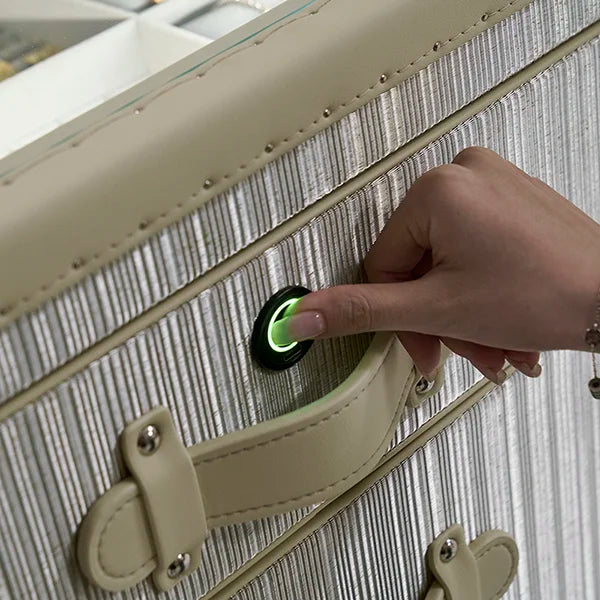
| Security lock on mass-market winder is single-point key tumbler only; inadequate for villa integration | Biometric + key dual-lock system: fingerprint scanner with fallback key; log of access events retained | Fingerprint enrolment test; access-log review after simulated unauthorised attempt |
| Integrated humidor or wine compartment in combined unit uses shared ambient air, introducing humidity fluctuation risk to watch movement | Climate-zone isolation: watch winding chamber independently sealed from humidor / cellar compartment | Measure RH in watch chamber independently over 48-hour period while humidor operates at target RH |
These parameters govern SIRAE's commissioned watch winder cabinet selection and specification process. Every unit verified by our master installation team before handover.
Wolf 1834's Structural Limitations: TPD Precision, Per-Station Programming & Cabinet Scalability
The TPD Constraint That Serious Multi-Brand Collections Expose
Wolf 1834 built its reputation on controlled winding cycles — the company's motor programmes operate across 50 possible cycle configurations, with TPD (turns per day) settings ranging from approximately 300 to 1,200 rotations daily, governed by a Japanese Mabuchi motor platform. For a homogeneous collection — say, six modern Rolex references sharing broadly similar mainspring geometry — the shared-programme architecture is adequate. Unremarkable, even.
The constraint emerges the moment a collection begins to mix makers with meaningfully different energy requirements. An F.P. Journe calibre running at a high beat rate requires a different daily rotation count and often a strictly unidirectional programme. A Patek Philippe perpetual calendar may require bidirectional winding at a different TPD threshold altogether. Wolf's multi-station cabinets, including the Axis Eight, apply a shared winding programme across grouped stations — there is no per-station individual programming of both rotation count and direction simultaneously.
For the collector with eight or more pieces spanning three or more brands, this is not a minor inconvenience. It is a structural mismatch between product architecture and collection reality.
Cabinet Scalability: The Expansion Problem
Wolf's cabinet range is designed around fixed station counts. A six-station unit remains a six-station unit — permanently.
When a collection grows, as collections reliably do, the owner faces a full unit replacement rather than a modular expansion. There is no chassis-level extension mechanism in the Wolf ecosystem that allows bolt-on winding modules to join an existing cabinet without full structural modification. For a collector who anticipates reaching twelve or sixteen stations within two to three years, this architecture demands a degree of forward-planning that Wolf's product range simply does not accommodate.
The Leather Pillow Contact Question
Wolf's most celebrated aesthetic signatures — hand-crafted leather exteriors, silk or anti-tarnish fabric interiors — are legitimate craft achievements, and their tactile quality is beyond question. The concern lies not in the exterior but in the watch cushion itself.
Leather pillow contact with watch cases over extended periods introduces a low but non-negligible chemical transfer risk. Chromate-tanned leathers, even those of demonstrably high quality, carry residual acid traces that can act on PVD coatings, DLC treatments, and rhodium-plated bezels over a 12-to-18-month contact horizon. Wolf does not publish third-party material safety certification for cushion contact surfaces — a gap that the collector of Patek grand complications or platinum-cased independents will note with some concern.
Buben&Zörweg, ORBITA, Underwood London & Rapport of London — A Lateral Evaluation
Buben&Zörweg: Austrian and German Engineering, Multi-Function Integration
Buben&Zörweg, founded in 1995 and manufactured to Austrian and German precision manufacturing standards, occupies a different stratum entirely from the Wolf ecosystem — by design, and by price. Their cabinets are fabricated in Austria and Germany using materials including brushed aluminium, carbon fibre, and Italian Nappa leather cushioning whose grain and hand-feel are unmistakably considered.
The Revolution series allows individual per-station programming via a built-in control panel, addressing the single most critical limitation in the Wolf architecture. Each of the eight watch positions in, for example, the Revolution 8 can be assigned its own rotation direction and count — directly answering the Patek/F.P. Journe mixed-collection scenario with precision rather than compromise.
The broader product range extends into multi-function cabinets that integrate watch winding with interior humidors, temperature-controlled wine and spirits storage, sound systems, and security safes — all within a single commissioned unit. For a collector whose Dubai private residence incorporates a dedicated cigar room, the possibility of a single architecturally resolved piece that handles watch conditioning, cigar cellaring, and controlled spirits storage within one security envelope is significant.
Key parameters for Buben&Zörweg consideration:
| Parameter | Detail |
|---|---|
| Manufacturing origin | Austria and Germany |
| Per-station TPD programming | Individual per station (control panel) |
| Cushion material | Italian Nappa leather (lining); carbon fibre / aluminium chassis |
| Security options | Security glass, soft-close mechanism, security lock |
| Multi-function integration | Humidor, wine/spirits cabinet, gun storage, sound system |
| Commissioned customisation | High — lead times vary; typically programme-dependent |
| Price orientation | Upper range; collector-grade commissioned investment |
The trade-off is customisation lead time. Buben&Zörweg's commissioned and configured multi-function pieces are not off-the-shelf acquisitions — they are programme-dependent, and the collector must plan accordingly. For a Dubai private residence with a $15,000 or higher programme budget, the customisation depth is unmatched. But proximity to the installation date is not a luxury the brand extends.
ORBITA Watchwinders: Precision Rotation Engineering, USA
ORBITA Watchwinders approaches the engineering problem from an entirely different angle. Their core technological distinction lies in the rotational delivery mechanism rather than the cabinet aesthetic — ORBITA uses a patented Programmable Electronic Rotation Technology (PERT) that allows very precise TPD control, station by station. Their platinum series cabinets support individual per-watch programming, with directional and bidirectional/unidirectional winding mode control at the station level.
ORBITA cushion materials are worth examining in the context of the material safety question. The brand uses Corfam-derived synthetic materials for watch pillows in several ranges — an inert, non-off-gassing synthetic that carries no chromate tanning risk by construction. This matters acutely for collections including rhodium-plated or PVD-coated cases, where the contact surface is not a decorative detail but a preservation decision.
ORBITA's cabinet aesthetic is more restrained and technical in character than Buben&Zörweg's. For the collector who prioritises engineering precision over integrated multi-function, ORBITA is the appropriate conversation. It is worth noting, however, that this technical restraint also means fewer options for the collector seeking a single piece of commissioned furniture.
Underwood London: British Cabinet Heritage, Scalable Station Counts
Underwood London brings a distinctly British cabinet-making sensibility to the watch winder category — dark wood veneers, piano lacquer finishes, the kind of considered joinery that reads immediately in a panelled London library or a Mayfair dressing room. Their larger cabinet formats accommodate station counts from eight through to twenty-four positions, addressing the scalability constraint that Wolf's fixed-count architecture cannot resolve.
Winding programmes across Underwood's upper range are individually settable per station — rotation direction and TPD targets can be assigned at the watch level. Interior lining uses soft microfibre, which is chemically inert and suitable for contact with sensitive case finishes. The brand's heritage is worth noting: Underwood has served the London jewellery trade for decades, and the cabinet-making quality reflects that provenance without overstating it.
Rapport of London: Modular Architecture and Interior Craft
Rapport of London occupies the middle register of the collector market with considerable competence. Their watch winder range extends to multi-station cabinets with glass-fronted display, individual station programming, and a modular approach to expansion that allows the collector to grow the installation without full unit replacement.
Interior lining in Rapport's collector cabinets uses leather and microfibre hybrids; the microfibre contact layer on watch cushions is the relevant material for chemical inertness. Rapport does not publish third-party material certification in the same depth as ORBITA, but the microfibre contact surface is structurally safer for coated cases than chromate-tanned leather pillows.
Rapport of London is the natural entry point into the collector tier at the lower end of the $500–$5,000 programme window, with Buben&Zörweg anchoring the upper ceiling.
Comparative Summary: Per-Station Programming and Material Safety
| Brand | Per-Station TPD Programming | Per-Station Direction Control | Contact Material | Scalability |
|---|---|---|---|---|
| Wolf 1834 | Shared across grouped stations | Shared programme | Leather / anti-tarnish fabric | Fixed station count |
| Buben&Zörweg | Individual per station | Individual per station | Italian Nappa leather | Commissioned configuration |
| ORBITA | Individual per station | Individual per station | Synthetic (Corfam-type) — inert | Multi-unit expansion |
| Underwood London | Individual per station | Individual per station | Microfibre / wood veneer | 8–24 station range |
| Rapport of London | Individual per station | Individual per station | Microfibre / leather hybrid | Modular options available |
Selecting a Watch Winder Cabinet by Collection Scale and Residential Context
Collections of Three to Eight Pieces: Defining the Programme
For a holding of three to eight watches spanning Rolex, Patek, and one or more independent makers, the primary selection criteria should be per-station programming depth and material safety — not brand heritage or exterior aesthetic alone.
At this scale, Rapport of London and Underwood London both serve well, with individually programmable stations and microfibre contact lining. The collector with two Patek Philippe references and an F.P. Journe — where the Journe's specific TPD requirement differs meaningfully from the Pateks — should confirm that the chosen cabinet allows each of the three positions to carry a distinct programme without affecting adjacent stations. That confirmation should come in writing, not in conversation.
The material question deserves direct attention at acquisition, not retrospectively. Ask the retailer or commissioner to confirm the contact-surface material specification and whether pH neutrality has been verified. This single question separates the informed collector from the uninformed one.
Collections of Eight to Sixteen Pieces: Scalability and Security Architecture
Beyond eight pieces, the scalability question becomes the dominant architectural decision.
A Buben&Zörweg commissioned multi-function cabinet — combining watch winding for twelve stations with an integrated humidor and a security-grade lock system incorporating fingerprint lock and key lock security systems — resolves multiple requirements within one unit. For a Dubai private residence with a dedicated study or cigar room, this level of integration means the watch collection, the cigars, and the access security are administered through a single commissioned installation rather than three separate units competing for wall space and visual coherence. The room reads differently as a result.
The lead time for a commissioned Buben&Zörweg piece is programme-dependent. For MENA delivery, allowing six to twelve months from specification to installation is prudent.
The Dubai Private Villa Context: Heat, Humidity, and Positioning
Dubai's ambient conditions — characterised by exterior temperatures reaching 45°C in summer, with significant humidity swings between the air-conditioned interior and transitional spaces — have a specific relevance to watch winder placement.
The watch movement itself is not directly threatened by a well-maintained villa environment. The concern is subtler: motor components in poorly isolated watch winder units can accumulate microscopic condensation residue when positioned near air-conditioning discharge zones, and movement lubricants in watches subjected to frequent temperature cycling benefit from stable ambient conditions during the rest phase. It is easy to overlook this — the cabinet looks correct in its position by the window, and the problem only reveals itself over time.
Position the winder cabinet away from direct air-conditioning outlets. Choose units with motor thermal management — Buben&Zörweg and ORBITA both build thermal considerations into their motor architectures. In the Gulf climate, this is not a trivial detail.
The SIRAE Commissioned Watch Winder Cabinet
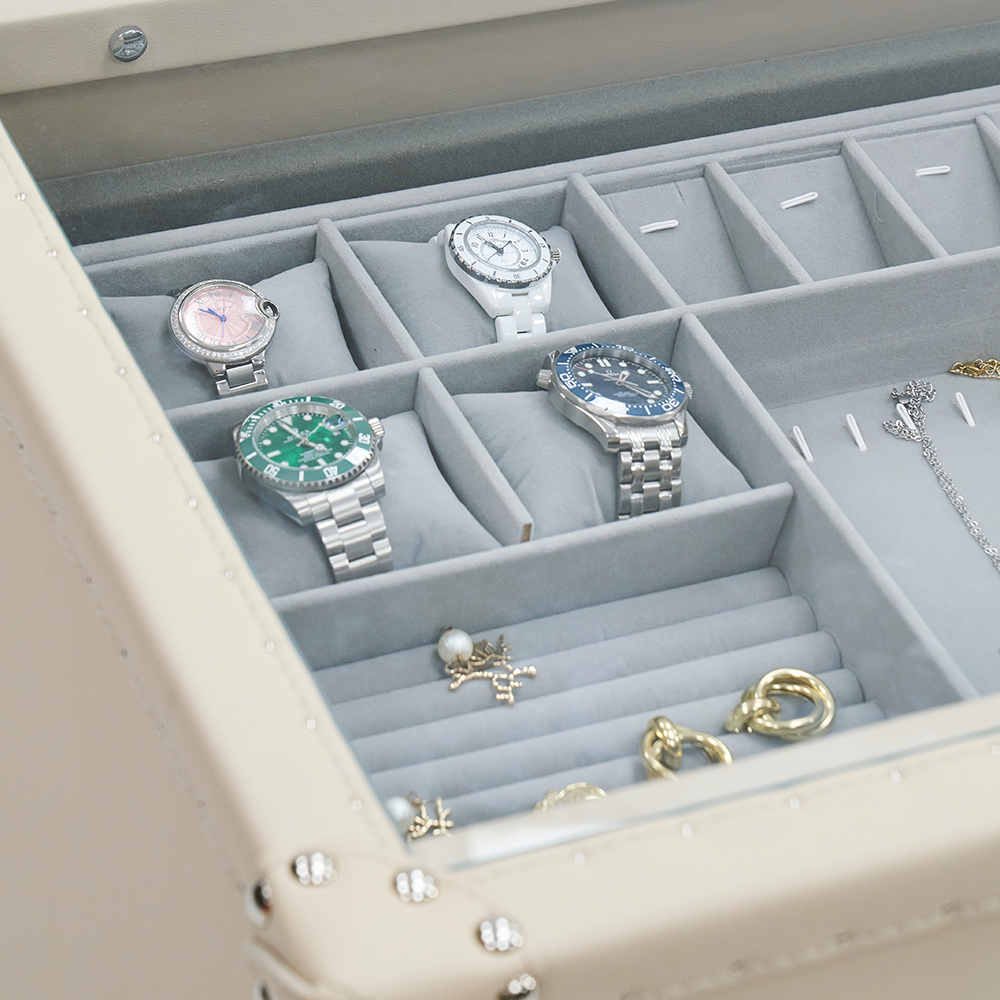
For clients seeking a commissioned watch winder cabinet that integrates the architectural demands of a private residence, SIRAE curates a standing Turntable Cabinet built on a solid wood veneer panel chassis with electroplated hardware, handcrafted copper wire fabric detailing, and microfibre leather edging — the interior lined in suede. The cabinet stands at 1,240 mm in height, with a footprint of 960 x 560 mm, providing the spatial presence appropriate to a principal study or dressing room without compromising the room's visual discipline. The copper wire detailing catches light with a warmth that lacquered surfaces do not.
A companion Watch Winder unit, dimensioned at 370 x 370 x 520 mm, provides a compact winding station for smaller collections or secondary display spaces, with the same material rigour applied at reduced scale.
Both pieces are verified by our master installation team and delivered through SIRAE's commissioned programme from our Dubai showroom, with white-glove fulfilment available across the UAE, the wider MENA region, and Saudi Arabia by appointment.
The Independent Maker Question: F.P. Journe, Richard Mille, and Non-Standard TPD Requirements
The collector who holds an F.P. Journe, a Richard Mille, or a comparable independent carries a responsibility that standard winder programmes do not always acknowledge.
These calibres are frequently wound to tighter specifications than Swiss lever escapement movements from the major maisons. F.P. Journe himself has, on various occasions, advised collectors on the precise winding requirements of his movements — guidance that deserves to be reflected in the programme, not approximated. Programming a Journe on a shared-station winder set to the median TPD for a Rolex sports reference is not a catastrophic error. But it is an imprecision that, over years, is entirely unnecessary.
The answer is individual station programming with confirmed TPD range support from 300 to 1,800 rotations, bidirectional and unidirectional mode selectable per station, and a rest-phase display position that holds the watch at 12-o'clock orientation. ORBITA's engineering approach specifically addresses this; Buben&Zörweg's upper range cabinets also support it. When commissioning, ask for written confirmation of the per-station programming range before proceeding.
There is a particular discipline to the care of great watches — not anxiety, but attentiveness. The right conditioning cabinet is not an accessory to the collection; it is a considered extension of the collector's judgement, made tangible in materials and mechanism.
To commission a private consultation at SIRAE's Dubai showroom — First floor, Al Shafar Complex, Jumeirah Beach Road, Umm Suqeim 1 — or to discuss a watch winder programme for your residence across the UAE, MENA, or Saudi Arabia, please reach our team on +971 55 886 6180, by post to info@siraecasa.com, or through https://www.siraecasa.com. Appointments are arranged with full discretion.
- A Ramadan Gift of Timeless Devotion: Selecting a Luxury Watch Winder for Your Husband in Qatar
- The Statement Luxury Bedroom: Selecting a Watch Winder and Jewellery Organiser Set That Earns Its Plac
- Integrated Jewelry Safes with Watch Winders for Qatar's Luxury Homes
- The Automatic Watch Winder Cabinet: Silent Motors, EMI Shielding, and Commissioned Multi-Watch Storage for the Discerning Collector
- The Collector's Sanctuary: Why a Safe with a Built-in Watch Winder is a Non-Negotiable Asset
- Watch Box vs Watch Winder vs Watch Case: Which Do You Need? (UAE Guide 2026)

Leave a comment
This site is protected by hCaptcha and the hCaptcha Privacy Policy and Terms of Service apply.