
The Complete Luxury Bar Cabinet Guide for UAE Homes (2026)
The Complete Luxury Bar Cabinet Guide for UAE Homes (2026)
A luxury bar cabinet is the most-handled statement piece in a UAE entertaining home — and the one most often bought wrong. Buy a piece engineered for a Milanese apartment, and within two Gulf summers the veneer lifts at the edges, the hinges sag, and the lacquer hazes. This 2026 guide covers the four formats of bar cabinet, the materials that survive Dubai's climate, sizing and circulation rules, interior zoning, and a buy-before checklist — so the drinks cabinet you choose this year still closes with a soft click in 2036.

Bar Cabinet, Bar Trunk, Drinks Trolley or Built-In: Which Format Fits Your Space?
Quick Answer: A freestanding bar cabinet suits most UAE villas and apartments: 40–80 bottle-and-glass capacity, no construction work, and it relocates when you move. Bar trunks serve studies and majlis corners, trolleys serve terraces and flexible hosting, and built-in bar units only make sense if you own the property and entertain weekly.
The four formats are not interchangeable — each solves a different hosting pattern. A built-in bar unit delivers the largest capacity but is fixed, slow to commission, and stays behind when a tenancy ends. A drinks trolley is the opposite extreme: mobile and charming, but open to dust and offering no security. The bar trunk — a vertical case that opens like a steamer wardrobe — is the connoisseur's compact option. The freestanding home bar cabinet sits in the practical centre, and it is where most buyers should start.
| Format | Typical capacity | Best space | Footprint | Indicative price band (AED) |
|---|---|---|---|---|
| Freestanding bar cabinet | 20–40 bottles + 30–50 glasses | Living room, formal majlis, dining room | 90–120 cm W × 45–55 cm D | 6,000–60,000 |
| Corner bar cabinet | 10–20 bottles + 15–25 glasses | Studies, apartments, awkward layouts | 65–85 cm per wall side | 4,000–25,000 |
| Bar trunk (vertical case) | 8–15 bottles + 10–20 glasses | Study, master suite, majlis corner | 60–75 cm W × 50 cm D | 8,000–45,000 |
| Drinks trolley | 6–10 bottles + 8–12 glasses | Terrace, flexible hosting, secondary serve point | 70–85 cm W × 40–45 cm D | 1,500–6,000 |
| Built-in bar unit | 60–150+ bottles | Owned villas, dedicated lounge | Wall-defined, typically 240 cm+ | 25,000–150,000+ |
If your hosting splits between an indoor majlis and a terrace, the proven pairing in Dubai homes is one closed liquor cabinet indoors plus a trolley that travels — never glassware stored outdoors permanently.
What Makes a Bar Cabinet "Luxury"?
The Bottom Line: A luxury-grade piece is defined by four measurable traits: hard-case construction that protects contents, fitted interior architecture (dedicated bottle, glass and accessory zones rather than bare shelves), solid brass hardware with soft-close mechanisms, and finishes rated for daily handling — not by price tag, brand stamp or mirror-and-gold styling alone.
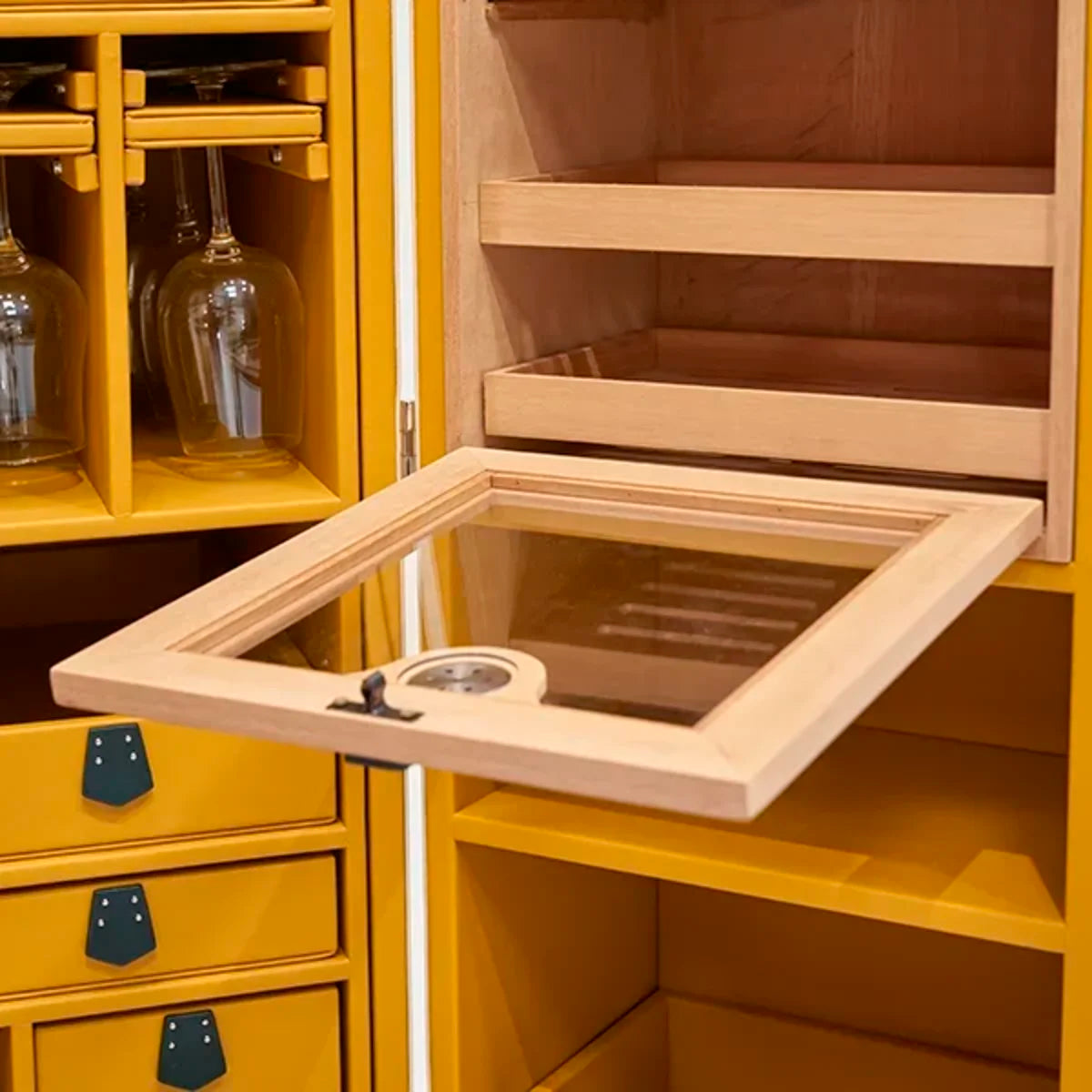
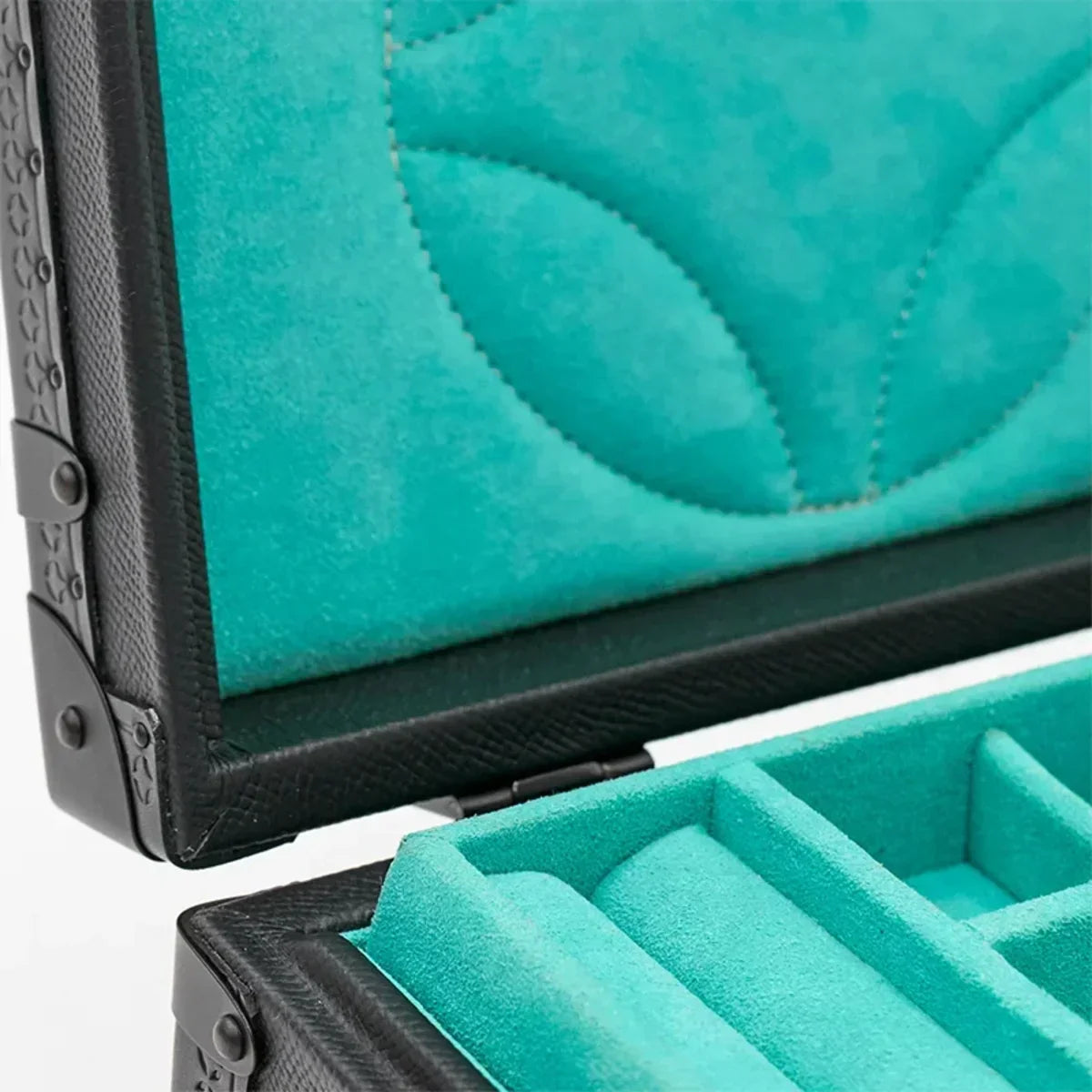
The fastest test is to open the doors and ignore the exterior entirely. A genuinely luxury bar cabinet is built like an instrument case inside: every bottle has a stationed position, stemware hangs or seats in cut cradles, and drawers run on dampened slides that close themselves from the last 4 cm. At SIRAE we describe this as custody-grade storage — the cabinet's first job is to protect what it holds, and the sculptural exterior is earned on top of that. Our woven copper-wire hard case construction, originally developed for jewellery cabinets, applies the same logic at bar scale: a rigid woven-metal facade that ventilates while it shields, paired with tarnish-resistant microfiber suede lining where glass and metal touch. You can see the construction at full height on the copper-wire bar cabinet in frosted silver.
The second trait is serviceability: soft-close hinges, removable trays and replaceable lining give the piece a decade-long service life, where glued felt and friction hinges have no path to repair.
Which Bar Cabinet Materials Survive the UAE Climate?
Technical Verdict: A luxury bar cabinet survives the UAE when its panel construction tolerates humidity cycling between roughly 25% RH indoors under air-conditioning and 80–90% RH outdoors in summer, its hardware is solid brass or stainless rather than plated zinc, and its facade sheds the fine Gulf dust without abrasive cleaning.
The symptoms appear in a known order. First the high-gloss lacquer develops micro-hazing where hands touch it. Then thin veneer lifts at door edges — the substrate beneath expands and contracts every time the front door of the villa opens and humid outdoor air meets 22–24°C conditioned interior air. By the second summer, plated hinges pit, and doors drop a few millimetres out of alignment. None of this is misuse; it is material selection that ignored the Gulf. The UAE's National Center of Meteorology records summer peaks above 45°C with coastal humidity routinely exceeding 80% RH (NCM), and air-conditioning pulls interiors down towards 25% RH — a swing wider than almost any furniture market on earth.
| Material / element | Risk in UAE conditions | What to specify in 2026 |
|---|---|---|
| Solid hardwood panels | Moderate — seasonal movement | Kiln-dried, engineered-core doors; oiled or low-sheen finish |
| Thin veneer on MDF | High — edge lift, blistering | Avoid for door fronts; acceptable only on interior fixed panels |
| Woven copper-wire facade | Low — metal is dimensionally stable | Woven hard case; ventilates contents, resists 45°C+ heat |
| Brass hardware (solid) | Low — develops patina, never fails | Solid brass hinges and pulls; soft-close mechanisms |
| Plated zinc hardware | High — pitting within 18–24 months | Avoid entirely |
| Glass shelving | Low — but check seating | 8–10 mm toughened, rubber-seated against vibration |
| Leather wrap (full-grain) | Moderate — dries under AC | Conditioned full-grain; keep 1 m+ from direct AC outflow |
| Microfiber suede lining | Low | Tarnish-resistant grade protects silverware and crystal |
Placement is the final variable: keep any drinks cabinet at least one metre from a supply-air outlet and out of direct afternoon glazing — west-facing Dubai windows can push surface temperatures of dark furniture well past 50°C.

How Big Should a Home Bar Cabinet Be — Majlis, Living Room or Study?
Quick Answer: Allow 90–100 cm of clear floor in front of any door swing, keep the serving surface at 90–105 cm height, and size capacity to your realistic hosting: 20–30 bottles covers a household that entertains fortnightly; only weekly hosts of 10+ guests need island-scale or built-in capacity.
Three placements dominate UAE homes, each with its own geometry:
- Formal majlis: the cabinet is part of the hospitality ritual, so it should be reachable without crossing seated guests — position it near the entry side of the room. A 100–120 cm wide cabinet reads correctly against majlis-scale seating; smaller pieces disappear.
- Living room: the cabinet doubles as display. An island format works here because it is finished on all four sides and can float behind a sofa as a room divider — see the proportions of the copper island display cabinet in blossom pink or the leather-wrapped display cabinets for how a 360° piece anchors an open plan.
- Study or den: a corner bar cabinet or bar trunk keeps the footprint under 0.5 m² while still presenting a complete serve. This is also where a combined media-and-bar wall earns its place — the copper-noir media cabinet format pairs closed bottle storage with display bays at the same depth.
Internal clearances matter too: spirits bottles run 30–33 cm tall, so specify at least one shelf bay with 35 cm clearance; wine bottles need 9 cm cradles; and stemware rails should give hanging glasses 2 cm of sway room.
Planning the Interior: Bottles, Glassware and Cigar Accessories
Zone the interior in four bands, and the cabinet stays presentable between gatherings rather than only after them:
- Display band (eye level): 6–10 hero bottles and decanters, front-facing, on suede so bases never scratch.
- Service band (90–105 cm): the pull-out or fold-down prep surface with bar tools — jigger, strainer, bar spoon — seated in fitted recesses.
- Glassware band: hanging stem rails plus flat seating for tumblers; never stack crystal.
- Reserve and accessories band (lowest): sealed drawers for backup bottles, napkins, and a dedicated humidor drawer if you keep cigars — cigars want 65–72% RH, and an air-conditioned room at ~25% RH will dry an unprotected cigar in days, so the sealed drawer is functional, not decorative.

The 2026 Buying Checklist
A luxury bar cabinet should outlast three apartment moves and a decade of summers, so audit each candidate against eight points before paying: panel construction rated for humidity cycling; solid brass or stainless hardware; soft-close doors and drawers; fitted interior zoning, not bare shelves; serviceable lining; 90 cm of door-swing clearance in your floor plan; a serve surface at 90–105 cm; and delivery with white-glove placement, because a 100+ kg hard-case cabinet is not a flat-pack item. If a seller cannot answer what the door substrate is, that is your answer.
Frequently Asked Questions
What is the difference between a bar cabinet and a liquor cabinet? A liquor cabinet prioritises closed, often lockable bottle storage; a bar cabinet adds a serve surface, glassware stations and tool storage so drinks are prepared at the piece. Most luxury formats in 2026 combine both: lockable lower storage with a presentation-and-service upper section.
Can I keep a drinks cabinet on a Dubai balcony or terrace? No — not a fine one. Outdoor summer conditions of 45°C+ heat, 80–90% humidity and fine dust will degrade any interior-grade finish within months. Keep the cabinet indoors, at least one metre from AC outflow, and use a trolley as the mobile outdoor serve point.
How many bottles should a home bar cabinet hold? For a household entertaining two to four times a month, 20–30 bottles plus 30–40 glasses covers a complete service with reserves. Size to your real hosting rhythm: oversized cabinets run half-empty and read as showroom props rather than a working bar.
Why use a copper-wire facade instead of wood doors in the UAE? Woven metal is dimensionally stable, so it does not swell, lift or blister through the Gulf's 25–90% RH swings the way veneer can. It also ventilates the interior, preventing trapped-humidity odour, while a hard-case frame still protects contents from dust and impact.
Private Viewing in Dubai
Specification tables only go so far — the soft-close weight of a solid brass hinge and the texture of a woven facade have to be felt. To experience a luxury bar cabinet at full scale, book a private appointment at the SIRAE showroom, Al Shafar Complex, Umm Suqeim 1, Dubai. Call +971 55 886 6180 or write to info@siraecasa.com, and our team will walk you through copper-wire and leather collections, interior zoning options, and placement planning for your majlis or living room.
- A Villa Owner's Guide to Commissioning a Climate-Controlled Wine Cabinet in the UAE
- Choosing a Luxury Bar Cabinet for Your Modern Dubai Majlis
- The Ultimate Guide to Designing a Home Coffee Bar Cabinet in Dubai
- Bar Trunk vs. Bar Cabinet: A Connoisseur's Guide to Luxury Spirit Storage
- Wine Cabinet & Wine Rack Ideas for UAE Homes (2026)
- Home Bar Counter & Island Ideas for Dubai Villas (2026)
%0AA%20luxury%20bar%20cabinet%20is%20the%20most-handled%20statement%20piece%20in...)
Leave a comment
This site is protected by hCaptcha and the hCaptcha Privacy Policy and Terms of Service apply.