
Sideboards & Buffet Cabinets for the Dubai Dining & Living Room (2026)
Sideboards & Buffet Cabinets for the Dubai Dining & Living Room (2026)
A sideboard is the most over-bought and under-specified piece in a Dubai dining room — chosen for its facade, then asked to do a job it was never sized for. The usual mistake is buying for the wall and not for the work: a piece that looks handsome against an empty wall but cannot actually hold a full set of dinner service, swallows the room when chairs pull out, or warps at the joins after one AC season. This 2026 guide is written for the dining and living room specifically — not the entryway — and covers how to size a buffet cabinet against your table and your circulation, how to plan storage for serveware, drinks and linens, and which finishes hold their geometry through the Gulf's humidity and west-light cycle.

Sideboard, Buffet, Credenza — What Is the Actual Difference?
Quick Answer: In a Dubai home the three terms describe the same category of low storage cabinet, but with useful distinctions: a sideboard is the general low piece used to store and serve in or near the dining room; a buffet cabinet sits slightly taller on longer legs and is built around active serving; a credenza is the sleeker, often legless variant that reads as a living-room or media-adjacent piece. Choose by the job, not the label.
The names matter less than the function they point at. A buffet cabinet earns its name at the table — it is the surface you plate from, lay a spread across, or keep a samovar and dates on during long majlis evenings, so it wants generous top depth and a comfortable serving height. A sideboard is the broader workhorse: the same low silhouette, but defined more by enclosed storage than by serving, equally at home holding table linen in the dining room or remotes and serveware along a living-room wall. A credenza trades feet for a plinth or floating base and a longer, lower line, which is why it migrates so naturally to the living room as a media-adjacent unit beneath a wall-mounted screen.
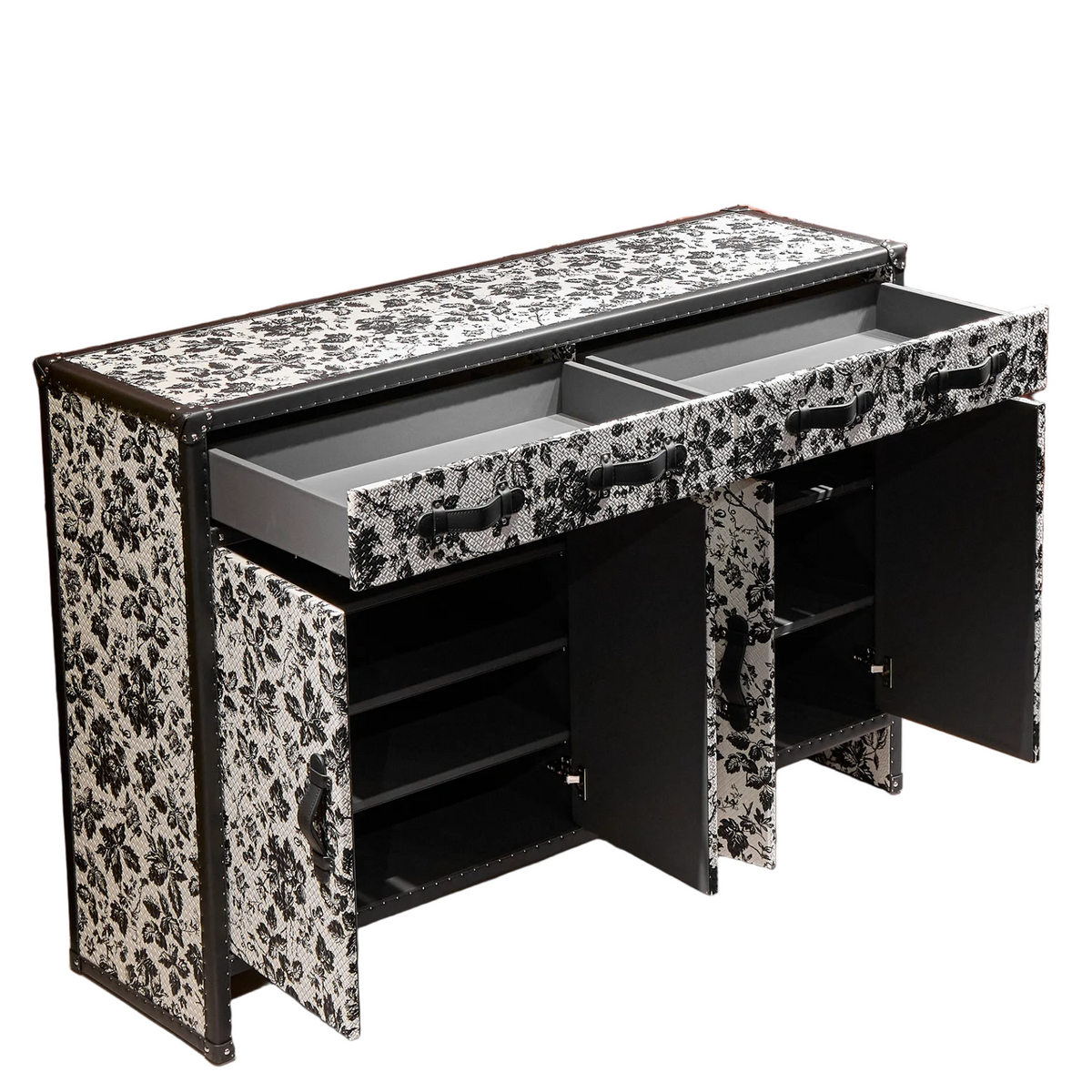
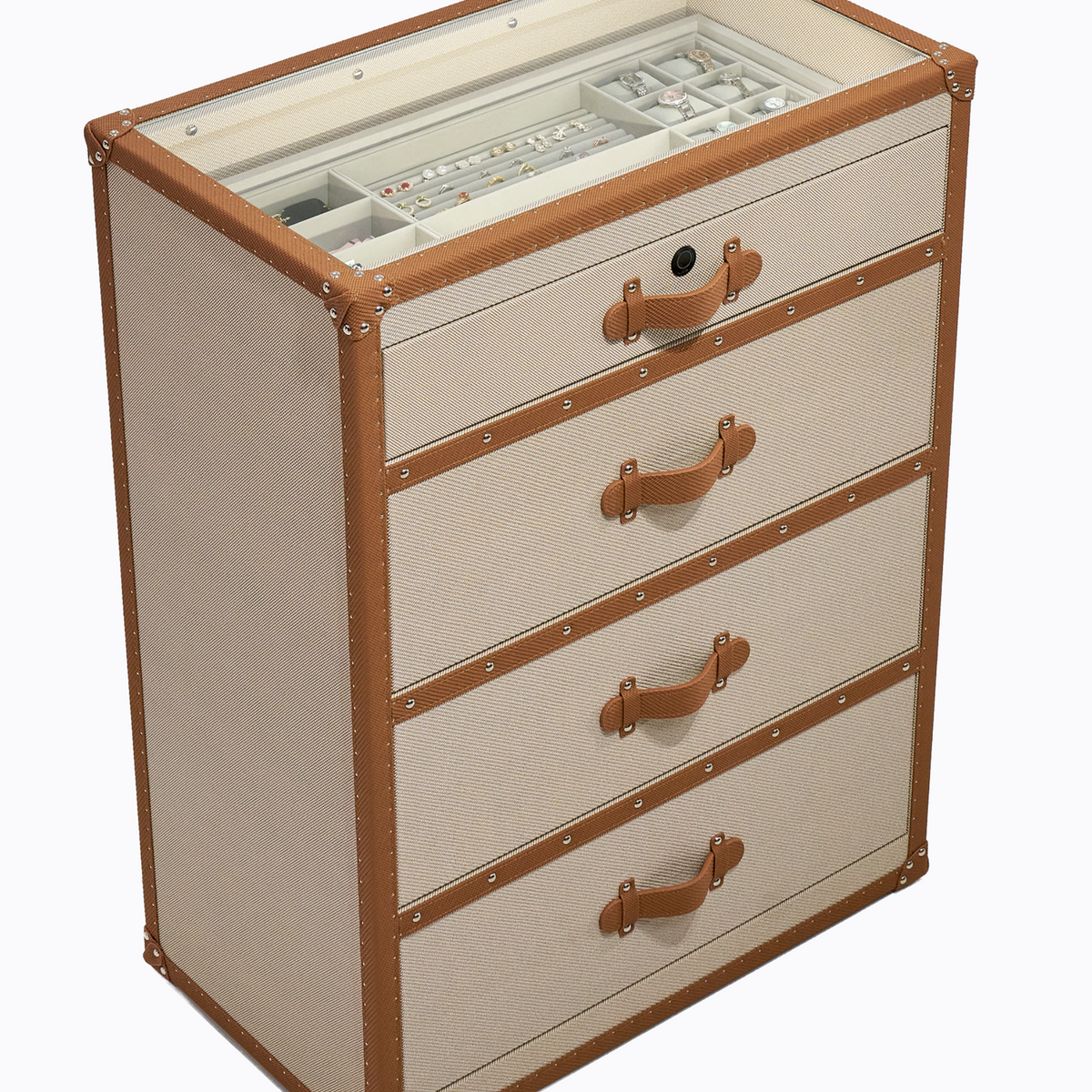
SIRAE's pieces are built on a single custody-grade chassis rather than disposable particle-board buffets — so the decision is about proportion and storage mix, not construction quality. The Heritage Print · The Avant Sideboard - Monochrome is the true sideboard in the range: a long, low, enclosed-storage line that reads as the classic dining-room piece against a wall. Around it, SIRAE's dressers do credenza and buffet-height duty — the Heritage Print · The Couture Dresser - Monochrome carries serveware and linen at serving height, while the Aurum Wire · The Sovereign Jewelry Dresser - Noir leans toward the credenza-and-display end of the same family with its vitrine top.
| Term | Typical role | Build cue | Best room |
|---|---|---|---|
| Buffet cabinet | Active serving + storage | Taller, longer legs, deep top | Dining room |
| Sideboard | Storage-led, occasional serving | Low body, short legs or skirt | Dining or living |
| Credenza | Display / media-adjacent | Legless plinth, long low line | Living room |
| Display island | Show + store collectibles | Vitrine top over closed base | Living or dining |
How Do You Size a Sideboard Against Your Dining Table?
Technical Verdict: A dining-room sideboard should sit at roughly your dining-table height — 75–80 cm is the standard band — and span about 60–75% of the wall it anchors, never wider than the table it serves. Leave a minimum of 90 cm (about 36 inches) of clear floor between the table edge and the cabinet face so chairs pull out and guests pass behind them without collision. Measure the run of clear wall and the pulled-out chair line before you choose anything.
Height is the quiet ergonomic decision. A buffet cabinet you plate from wants to land near table height so the transfer of a dish from cabinet to table is level and unstrained; too low and you stoop over a hot platter, too tall and a seated guest loses the surface entirely. The 60–75% width rule keeps the piece reading as intentional — a sideboard that fills the whole wall looks built-in by accident, while one that is too slim looks stranded. Anchor it to the table's centre line, not the wall's, when the cabinet faces the dining surface.
Depth is the measurement Dubai buyers most often get wrong, and it cuts both ways. Too shallow (under 40 cm) and a dinner plate sits proud of the shelf or a serving platter will not lie flat; too deep (over 50 cm) and the cabinet eats the circulation a Dubai dining room needs when six to twelve chairs are in play during hosting. The table below is a planning check, not a hard rule — measure your own table and chair-pull before committing.
| Dimension | Recommended range | Why it matters in a UAE dining room |
|---|---|---|
| Cabinet height | 75–80 cm | Level plating transfer to the dining table |
| Width vs wall | 60–75% of clear wall | Reads intentional, not built-in or stranded |
| Width vs table | ≤ table length | Sideboard should support, never outscale, the table |
| Depth | 40–48 cm | Holds dinner plates / platters without crowding chairs |
| Clearance to table | ≥ 90 cm (36 in) | Chairs pull out; guests pass during majlis hosting |
A second Dubai-specific note: many villa dining rooms are double-height or open-plan onto the living room, so a low sideboard that would look lost on a tall wall can be paired with art or a mirror above it to reclaim the vertical proportion — the cabinet stays at serving height, and the wall is finished separately.

What Should Go Inside a Dining-Room Buffet Cabinet?
The Bottom Line: Plan the interior of a buffet cabinet around four jobs before you plan its face — serveware and dinner service, table linen, glassware and a drinks station, and a display top — and match the mix of drawers to doors accordingly. Deep drawers carry the weight of dinner service better than door-and-shelf cabinets, and they belong in a Dubai dining room where deep swing doors collide with pulled-out chairs.
Each job has a different storage logic. Serveware and dinner service — chargers, platters, the second dinner set kept for hosting — is heavy and stacks best in deep, full-extension drawers; shelves behind doors force you to lift the front stack to reach the back. Table linen wants shallow, wide drawers that let a runner or a set of napkins lie flat without creasing. Glassware and a drinks station is the job most under-planned in UAE homes: a buffet top doubles as the surface where coffee, dates, juices and — for the household that entertains a mixed guest list — a discreet drinks tray are laid out, so it wants an easy-clean top and an enclosed lower section to keep spare glassware dust-free between occasions. A display top carries the room's character — a tray, a sculptural object, a pair of lamps — and should stay around half-empty so it reads composed rather than crowded.
Where the Heritage Print · The Avant Sideboard - Monochrome handles the long enclosed-storage run, a luxury dresser pressed into buffet-height service covers the drawer-led jobs: the Heritage Print · The Maison Dresser - Ivory stacks dinner service and linen in deep drawers, and its closed body keeps serveware and spare glassware away from settling dust — which matters more in Dubai than in temperate climates where windows stay shut and the air is filtered year-round. For collectors who want part of the dinner service or a crystal set on view, the Aurum Wire · The Sovereign Jewelry Dresser - Noir pairs a vitrine display section over a closed base, so the showpiece is seen and the everyday is hidden.
| Stored item | Best compartment | Note for UAE homes |
|---|---|---|
| Dinner service / chargers | Deep full-extension drawer | Weight-bearing; avoid back-of-shelf reach |
| Platters / serveware | Tall door section or deep drawer | Keep enclosed against dust |
| Table linen | Shallow wide drawer | Lay flat to avoid creasing |
| Glassware / crystal | Closed lower cabinet | Dust-free between hosting occasions |
| Drinks tray / decanters | Buffet top + enclosed shelf | Easy-clean top; discreet storage below |
| Display objects | Open top, half-empty | Reads composed, not cluttered |
Which Finishes Survive a Dubai Dining Room?
Technical Verdict: A sideboard in a Dubai dining room is cycled between roughly 25% RH indoors under air conditioning and 80–90% RH outdoor coastal humidity recorded by the UAE National Center of Meteorology (ncm.gov.ae) every time a door opens to the outside or the AC is off during travel. That swing is what splits joints, lifts veneer edges and warps door fronts. The finishes that survive are dimensionally stable: woven copper-wire construction, solid metal frames, sealed stone tops, toughened glass and properly built hardwood cases — not thin veneer over MDF.
Dining-room sideboards face a harder service life than bedroom storage because of what lands on them. Hot platters, condensation rings from chilled juices and the occasional spill mean the top finish has to be genuinely wipe-clean and heat-tolerant, not merely handsome. A sealed stone or toughened-glass top shrugs off both; a thin lacquer over veneer will ring and lift. Below the top, the case construction decides longevity — a woven hard case or a solid frame holds its geometry through the humidity cycle, while a glued veneer box telegraphs every season change at the joins within a year or two.
Placement is the free upgrade most people skip. Keep any timber or leather-fronted sideboard at least one metre from a direct AC supply outlet, which dries the front faster than the back and pulls the panel into a slow warp. And mind the west light: a dark sideboard sitting under a west-facing Dubai window absorbs afternoon heat that pushes dark surfaces past 50°C, fading and stressing the finish far faster than the same piece on a shaded wall.
| Finish / construction | UAE risk | What to verify |
|---|---|---|
| Woven copper-wire hard case (SIRAE) | Low — metal is dimensionally stable | No veneer to lift; sealed structure |
| Solid metal frame + stone top | Low | Stone sealed against oil/water rings |
| Toughened glass top | Low | 8 mm minimum, rubber-seated on frame |
| Quality kiln-dried hardwood case | Moderate | Low-sheen finish; avoid high gloss |
| Leather-fronted doors | Moderate — AC dries facade | Condition regularly; 1 m from AC outflow |
| Veneer over MDF | High — edge lift in humidity cycling | Avoid for a hard-working dining piece |

Sideboard or Buffet for the Living Room — Media-Adjacent Use
Quick Answer: A sideboard works beautifully in the Dubai living room as a low storage-and-display line, including beneath a wall-mounted screen, where it stores AV equipment, board games and serving pieces while presenting a finished top for objects and lamps. Choose a credenza-style low profile, prioritise ventilation if it houses electronics, and let it echo — not match — the room's other timber or metal tones.
The living-room sideboard does a quieter job than its dining counterpart, but a more visible one. Sitting low beneath a mounted television, it absorbs the cable clutter and the speaker, sets the screen at a comfortable seated eye line, and offers a long composed surface that the dining buffet rarely gets to be because it is always working. For households that serve in the living room as well — Arabic coffee and dates for guests who never make it to the dining table — the same enclosed storage that hides AV equipment doubles as discreet serveware storage, keeping a tray and small glasses within reach but out of sight.
For the living-room line itself, the Heritage Print · The Avant Sideboard - Monochrome gives the long, low credenza profile a media wall wants — a finished top for lamps and objects over enclosed storage for AV gear and serveware. Where a household wants more personality than the dining buffet allows, a jewelry dresser run at credenza height does the display-led job: the Aurum Wire · The Illustrious Jewelry Dresser - Frosted Silver brings a cool metallic facade that sits calmly under a screen. The rule that holds across both rooms: a low storage piece should share one material thread with its surroundings — a leg finish, a metal tone, a stone — and differ on everything else, so it reads as chosen rather than matched.
If the piece will hold a media unit, two practical checks matter more than looks: leave a venting gap or use a cabinet with an open or perforated back so the AV equipment does not cook itself, and confirm the cable run can reach a socket without bridging a walkway. A beautiful sideboard that traps heat or trails a cable across the floor has failed at the one job the living room asked of it.
Frequently Asked Questions
What is the difference between a sideboard and a buffet cabinet? In UAE homes the terms overlap, but the useful distinction is about height and intent. A buffet cabinet usually stands slightly taller on longer legs and is built around active serving — it is the surface you plate from at the dining table, so it favours a deep, generous top. A sideboard sits lower with short legs or a skirted base and is defined more by enclosed storage than by serving, which lets it live equally in the dining room or along a living-room wall. Choose by the job you need it to do.
What height should a dining-room sideboard be? Aim for roughly dining-table height, in the 75–80 cm band. At that height a buffet cabinet lets you transfer a dish to the table without stooping over a hot platter, and a seated guest can still reach the surface. Going taller turns the piece into a server you stand at; going shorter forces an uncomfortable bend for plating. If the cabinet is purely for living-room storage rather than dining-room serving, a lower credenza profile is fine — the table-height rule applies specifically to pieces you plate or serve from.
How much clearance do I need between a sideboard and the dining table? Leave at least 90 cm — about 36 inches — of clear floor between the table edge and the face of the sideboard. That gap lets a dining chair pull fully out and allows a guest to walk behind a seated person without turning sideways, which matters in UAE homes where hosting fills every chair. In tighter Dubai dining rooms, choose a sideboard with drawers rather than deep swing doors, since drawers open into the clearance you already have rather than demanding extra swing space.
Can a sideboard double as a TV unit in the living room? Yes, and it is one of the best uses for a low credenza-style sideboard. It sets a wall-mounted screen at a comfortable seated eye line, hides AV equipment and cables, and offers a finished top for lamps and objects. Two checks matter: make sure the cabinet vents — an open or perforated back stops electronics overheating in a warm climate — and confirm the cable run reaches a socket without crossing a walkway. Choose an enclosed lower section if you also want discreet serveware storage for living-room hosting.
Visit the SIRAE Showroom in Dubai
A sideboard's depth, height and finish only make sense once you stand a real platter on it and pull a dining chair out beside it. To test serving height against your own table, see how our woven copper-wire and closed-case constructions hold up to the Gulf's humidity, and plan the right drawer-to-door mix for your serveware and linen, book a private appointment at the SIRAE showroom, Al Shafar Complex, Umm Suqeim 1, Dubai. Call +971 55 886 6180 or write to info@siraecasa.com, and our team will help you specify a buffet cabinet sized to your dining and living room.
%0AA%20sideboard%20is%20the%20most%20over-bought%20and...)
Leave a comment
This site is protected by hCaptcha and the hCaptcha Privacy Policy and Terms of Service apply.