
Glass Display Cabinets & Curio Cabinets for Dubai Villas: Styling a Collection (2026)
Glass Display Cabinets & Curio Cabinets for Dubai Villas: Styling a Collection (2026)
A glass display cabinet is the only piece of furniture in a Dubai villa that is judged twice — once on how it looks, and once on whether it protects what is inside. Most are bought for the first reason and fail on the second: the collection fades under west-facing light, the crystal clouds with dust drawn through gaps in a loose-fitting door, and a row of watches sits behind ordinary glass that any visitor can read at a glance. A curio cabinet is not a bookshelf with doors; it is a small controlled environment. This 2026 guide covers how to choose, light, style and secure a display cabinet so that a collection of objets, crystal, watches or antiquities is shown at its best and held safely in Gulf conditions — UV-safe glazing, conservation-grade lighting, humidity stability against air-conditioning cycling, security-aware display, and the styling discipline that separates a curated cabinet from a cluttered one.

What Is the Difference Between a Display Cabinet, a Curio Cabinet and a Display Case?
Quick Answer: All three are glass-fronted furniture for showing a collection, but the intent differs. A display cabinet is the broad category — any cabinet with glass doors or panels used to present rather than hide its contents. A curio cabinet is a display cabinet specifically for small, varied "curiosities" — crystal, figurines, collected objets — usually with glass on multiple sides and internal lighting. A display case is the most protective form, often lockable, sealed and lit, used where the contents are valuable enough to need security as well as visibility.
The distinction matters because it determines specification. A curio cabinet prioritises visibility from several angles, so it wants glass on the sides as well as the front and lighting that reaches every shelf. A display case prioritises the contents — watches, fine jewellery, antiquities — so it wants a lock, a well-sealed door and glazing that protects against light damage. In UAE residential briefs the words are used interchangeably; what you actually need is defined by what you are displaying and how exposed it is. A useful test: if the contents would be a loss to replace, or a target to a visitor, you are specifying a display case, not a curio cabinet, even if it looks like furniture.
| Term | Primary intent | Typical glass | Lock | Best for |
|---|---|---|---|---|
| Display cabinet | Show, not hide | Front, sometimes sides | Optional | General collections, decorative objects |
| Curio cabinet | Multi-angle display | Front + two sides, glass shelves | Rarely | Crystal, figurines, varied objets |
| Display case / display island | Protect + present | All sides, often laminated | Usually | Watches, jewellery, antiquities, valuables |
| Tower case | Vertical statement display | Full-height glass front | Optional | Single hero piece or tall collection |
Does a Display Cabinet Need UV-Protective Glass in Dubai?
Technical Verdict: Yes — UV exposure is the single most damaging and least reversible thing that happens to a collection in a Dubai villa, and ordinary clear glass stops very little of it. UV radiation is the most aggressive form of light for organic and coloured materials: it fades dyed silk and paper, yellows ivory and bone, and degrades the binders in antiquities and artwork. A west-facing Dubai window pushes both intense direct sun and surface temperatures past 50°C on summer afternoons. A display cabinet placed anywhere that afternoon light can reach needs glazing that filters UV, not just glass that looks clear.
There are three practical routes. Laminated glass — two panes bonded with an interlayer — blocks the large majority of UV and is the standard used in museum display cases for this reason; it is also more secure, because it holds together when struck. UV-filtering film applied to standard toughened glass is a retrofit option that achieves much of the same protection. And placement does part of the work for free: light reflected off a pale wall carries a fraction of its original UV, so a cabinet positioned to receive indirect rather than direct light is already better protected than one in the path of the sun.
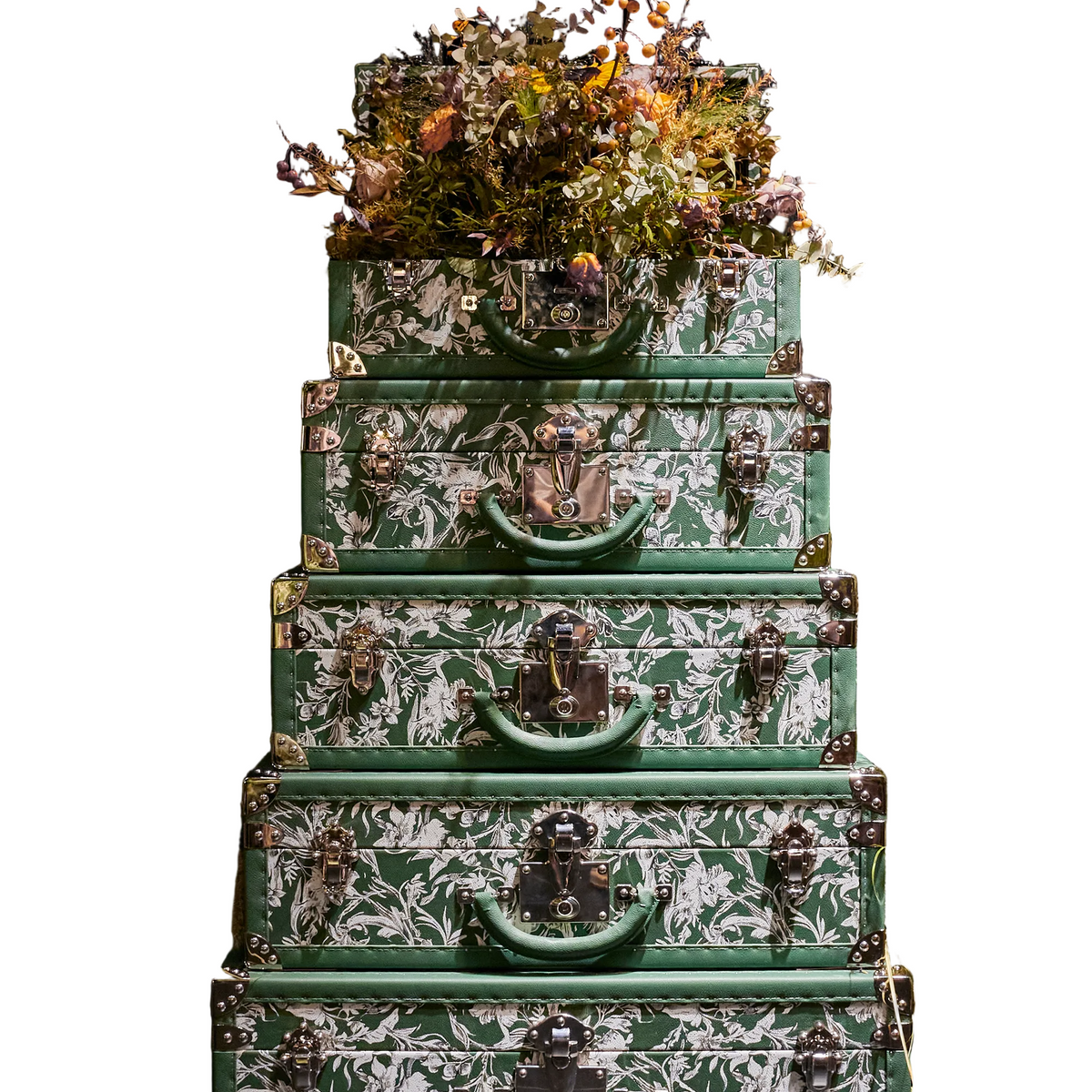
For SIRAE's enclosed glass pieces — the Heritage Print · The Veraison Tower Display Case - Emerald and the display islands — the glazing and the seal are specified together, because UV protection and dust exclusion are the same problem solved by the same well-fitted, properly glazed door. The cabinet that keeps light damage out also keeps Gulf dust out.
| Glazing type | UV protection | Security | Notes for UAE |
|---|---|---|---|
| Standard clear annealed glass | Minimal | Low — shatters | Avoid for any fading-prone or valuable contents |
| Toughened (tempered) glass | Minimal UV, high impact | Moderate | Strong but does not filter light; add UV film |
| Toughened + UV film | High | Moderate | Good retrofit; verify film rating |
| Laminated glass | High (interlayer blocks UV) | High — holds together | Best for valuables and west-facing rooms |
| Acrylic (UV-grade) | Varies by grade | Low — scratches | Lighter; only specify UV-stabilised grades |

How Should You Light a Display Cabinet Without Damaging the Collection?
Quick Answer: Use cool-running LED lighting kept low and even, never halogen. Conservation practice shows that only about 50 lux is needed to read the shape and colour of most objects, so flooding a cabinet with bright light damages contents without improving how they look. Position LED strips at the front edge of each shelf so light falls onto the objects rather than glaring off the glass, keep the fittings out of the sealed display volume where possible, and warm the colour temperature to flatter metal, crystal and gilt.
Lighting is where most display cabinets go wrong twice over. The first mistake is heat: older halogen and puck fittings run hot enough to warp delicate materials, dry out leather and timber, and — critically in a sealed case — drive humidity swings as the air inside heats and cools. LED solves this almost entirely; little heat, almost no UV, and years of life. The second mistake is quantity: a cabinet lit like a retail vitrine looks cheap and accelerates fading, while low, even, warm light reads as luxury and protects the contents — the museum logic of "enough to see, no more."
Direction is the detail that separates a good install from a bad one. Light entering from the top-front edge of each shelf rakes across the objects and lifts their texture; light buried at the back silhouettes them and glares back through the front glass into the viewer's eyes. Glass shelves help, because they let light pass down through the stack rather than trapping it on the top tier — one reason a true curio cabinet uses glass shelves rather than timber ones.
| Light source | Heat | UV emitted | Lifespan | Verdict for display |
|---|---|---|---|---|
| LED strip (warm 2700–3000K) | Very low | Negligible | 25,000+ hrs | Recommended — front-edge mounted |
| LED puck / spot | Low | Negligible | 25,000+ hrs | Good for a single hero object |
| Halogen | High | Low–moderate | ~2,000 hrs | Avoid — heat and humidity risk |
| Incandescent | High | Low | ~1,000 hrs | Avoid entirely |
| Direct daylight | N/A | High | N/A | Never use as display light |
How Do You Style a Display Cabinet So It Looks Curated, Not Cluttered?
The Bottom Line: Leave roughly a third of the cabinet empty, group objects by a single unifying thread — colour, material or form — and build each shelf with height at the back and smaller pieces forward and slightly off-centre. The defining mistake is treating a display cabinet as overflow storage: a curated cabinet tells one story, a cluttered one tells none. Edit hard, and the pieces you keep read as a collection rather than an accumulation.
The discipline is subtractive. Start by removing everything, then return only objects that share a thread — a palette of clear-and-amber crystal, a material story of brass and bone, a family of repeating forms. Repeating one shape across different materials is a quiet professional trick: five vessels of the same silhouette in glass, ceramic and metal read as intentional in a way that five unrelated objects never will. Then stage each shelf with depth: tall pieces at the back, mid-height in the middle ground, the smallest and finest forward where the eye lands first. Off-centre beats symmetrical for everything except a deliberately formal arrangement.
Negative space is not wasted space — it is what lets each object be seen. The most common failure in a UAE villa cabinet is the instinct to fill every shelf because the cabinet is large and the collection is larger; the result reads as a cupboard. Anchor heavier, darker objects low and keep lighter, more delicate pieces high, and let the gaps breathe.
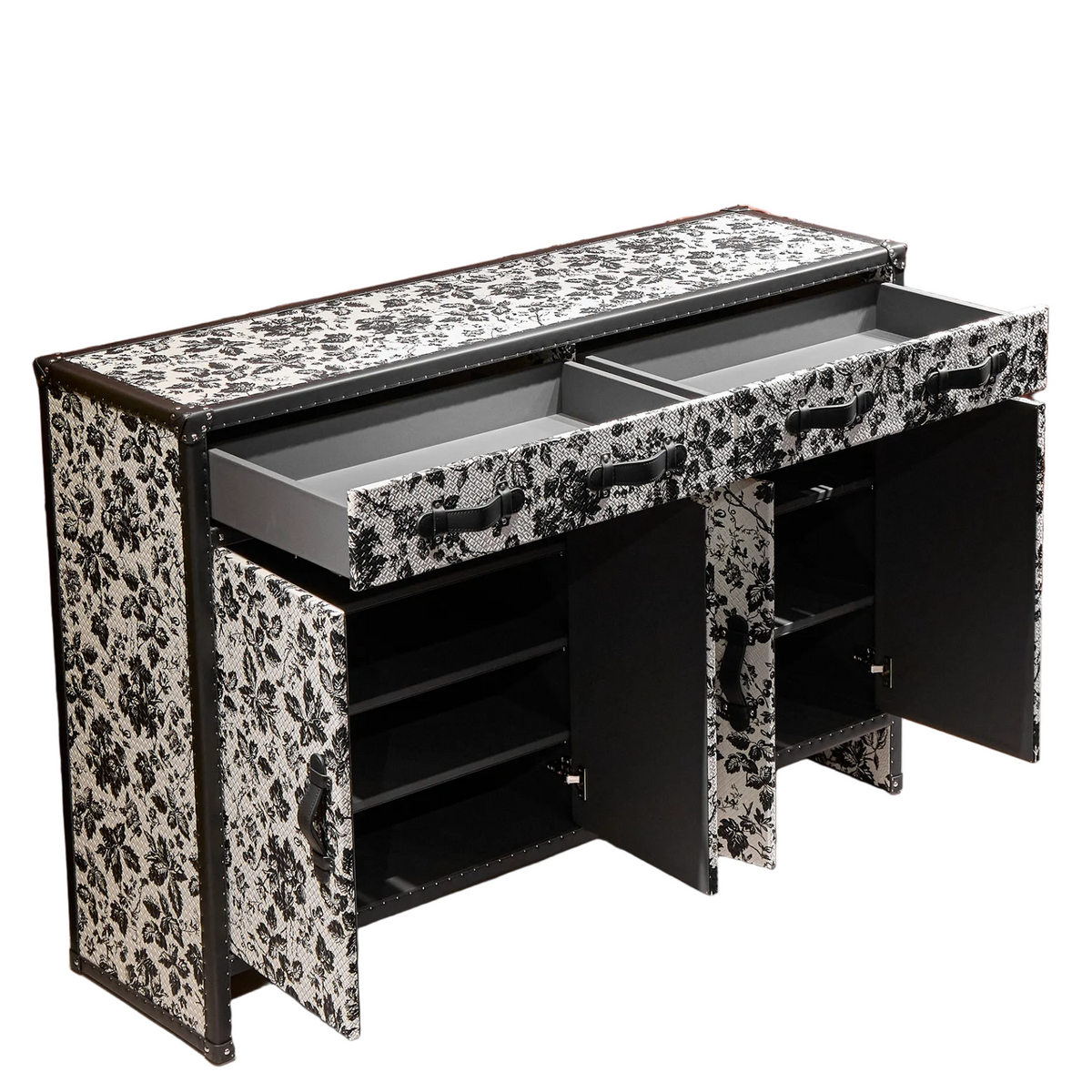
Display islands change this calculation by being viewable in the round. The Aurum Wire · The Sovereign Jewelry Dresser - Noir and the Aurum Wire · The Vivienne Display Island - Blossom Pink are designed to be approached from multiple sides, which means styling has no "back row" to hide weaker pieces in — every object earns its place. For a softer, warmer palette the Heritage Print · The Regent Jewelry Dresser - Sandstone anchors a collection in neutral tones that flatter crystal and gilt without competing with them. All three are listed under dressers and chests of drawers, where the drawer depth is sized for jewellery trays rather than folded linen. Style an island the way you would a sculpture: it must resolve from every angle.

How Do You Display Valuables Safely — Watches, Jewellery, Antiquities?
Technical Verdict: Display valuables behind a lock and laminated glass, position the case where it is visible to the household but not framed in a window or front-of-house to visitors, and treat "on display" and "secured" as two settings of the same piece rather than a choice between them. The point of a display case for watches or jewellery is to admire a collection without leaving it casually accessible — clear panels for viewing, a tamper-resistant lock and a glass grade that resists a quick strike.
Security-aware display is a discipline of placement as much as hardware. A locked case is undermined if it sits in the entrance hall where every guest and contractor sees the contents on arrival; the same case in a private study or dressing room, lit and lockable, gives the owner daily pleasure of the collection without advertising it. For genuinely high-value pieces, the considered UAE approach is layered: a lockable, laminated display case for pieces in rotation, and a biometric safe or trunk for the rest — display what you wear, secure what you store.
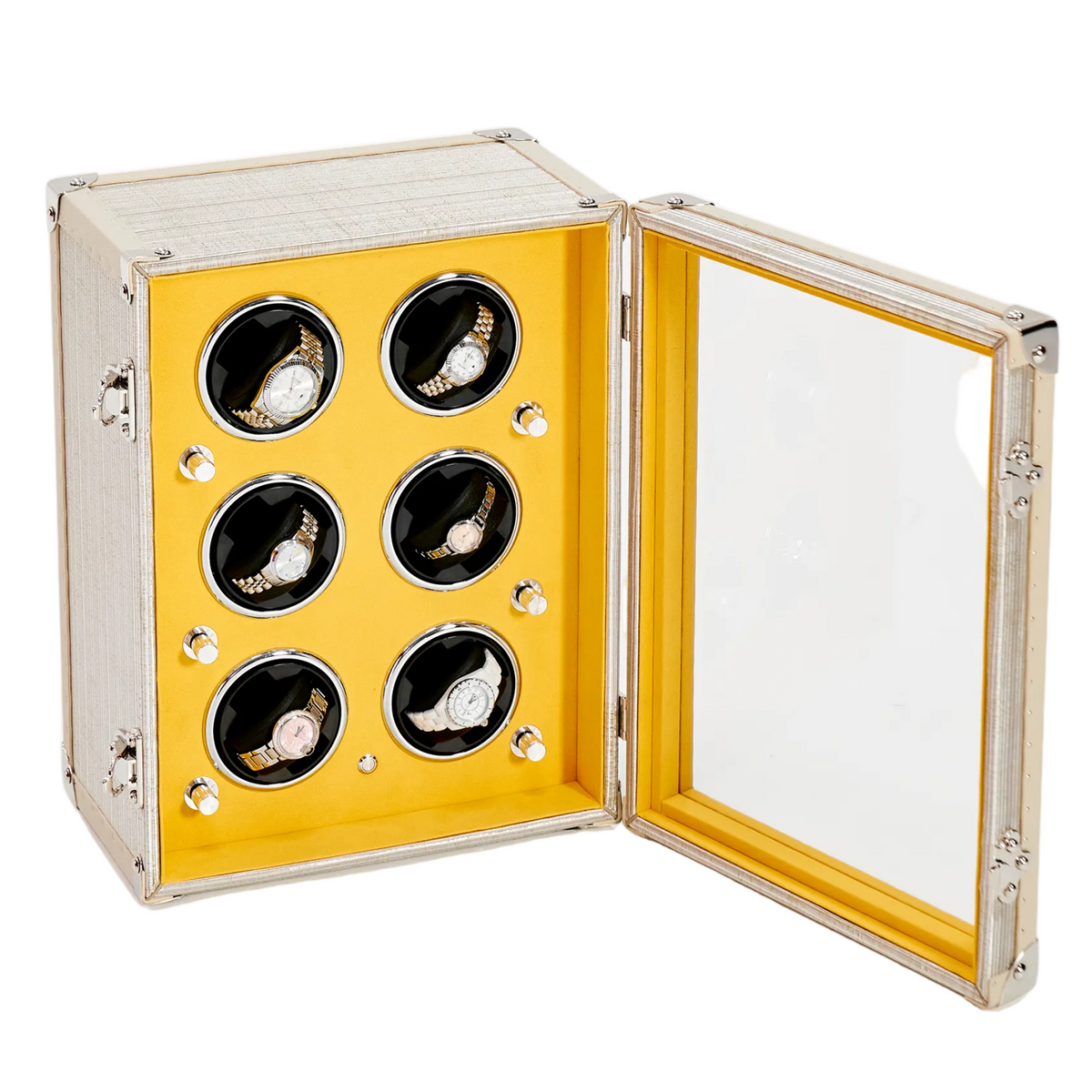
Jewellery and watches also have a presentation-specific need: a display case sized and fitted for them. The Aurum Wire · The Refined Necklace Trunk - Frosted Silver is built to hold and present pieces rather than pile them, which protects them from the abrasion and tangling that loose storage causes and keeps each piece readable behind glass. For watches, a glazed case with soft cushioning and a lock lets a collection be enjoyed daily while staying protected from dust, handling and casual sight. The principle holds across all of it: visibility and security are not opposites — the right case delivers both.
How Do You Keep a Sealed Display Cabinet Stable in the Gulf Climate?
The Bottom Line: A well-sealed glass cabinet is an advantage in Dubai, not a problem, because a sealed volume holds a steadier humidity than the room around it — but only if you avoid heat sources inside and place the cabinet away from AC outflow and west windows. The Gulf indoor environment cycles hard: air-conditioning pulls interior humidity down toward 25% RH while summer coastal air outside runs 80–90% RH, recorded by the UAE National Center of Meteorology (ncm.gov.ae). That swing is what cracks ivory, lifts veneers and clouds the inside of poorly sealed glass with dust and condensation.
The sealed cabinet works in your favour because it buffers that swing — the air inside changes more slowly than the room. To keep that buffer working, three rules apply. First, no heat inside the case: LED only, because a hot halogen fitting turns a stable sealed volume into a humidity pump. Second, placement away from the two Gulf aggressors — keep the cabinet at least a metre from any supply-air outlet, whose dry blast dehydrates contents and draws dust, and out of the direct path of west-facing afternoon sun. Third, for sensitive antiquities, a small conservation-grade silica gel pack inside a sealed case stabilises humidity further, the same technique museums use for their own display cases.
Dust is the everyday version of this problem. Fine Gulf dust settles continuously and is the reason a glass-front cabinet beats open shelving for any collection in the UAE: the door that excludes UV and buffers humidity also keeps the crystal clear and the watches clean. A loose or warped door defeats all three functions at once, which is why door fit and seal quality are worth more in this climate than any decorative feature. For books and sculptural objects that can take a weekly dusting, open shelving still earns its place — the Aurum Wire · The Belvedere Open Display Cabinet - Blossom Pink keeps all three tiers in full view.

Frequently Asked Questions
What should you put in a glass display cabinet? A glass display cabinet suits any collection that gains from being seen and protected at once: crystal and cut glass, decorative objets and sculpture, fine ceramics, watches, jewellery, antiquities and collected travel pieces. The unifying rule is that the contents should reward being looked at and benefit from a dust-free, UV-protected, lit environment. Avoid using a display cabinet as overflow storage for everyday items — it dilutes the collection and turns a feature piece into a cupboard. If something does not deserve a light on it, it does not belong behind the glass.
Is a curio cabinet outdated, or still in style in 2026? The curio cabinet is firmly back in 2026, but in a refined form. The heavy, ornate, brass-handled cabinet of decades past has been replaced by cleaner glass-and-metal or glass-and-craft constructions with integrated LED lighting and multi-angle visibility. The renewed interest tracks the wider move toward displaying collections rather than hiding them — a curated curio cabinet or display island now reads as considered and personal rather than dated. What has changed is the discipline: fewer objects, better lighting, and far more negative space than the crowded curio of the past.
How much UV-protective glass matters depends on what you display — when is it essential? UV protection becomes essential the moment a collection includes anything that can fade or degrade — coloured glass, silk, paper, ivory, painted antiquities, photographs — or whenever the cabinet sits where Dubai daylight can reach it. Pure crystal and solid metal are relatively light-stable, so a cabinet of clear crystal in a windowless room is lower risk. But because most villa rooms carry strong indirect light and most collections mix materials, UV-filtering laminated glass or UV film is the safe default in the UAE rather than the exception. Reversing light damage is effectively impossible, so prevention is the only strategy.
Where should a display cabinet be placed in a villa? Place a display cabinet against a solid interior wall where soft, indirect light reaches the front glass at an angle — not sandwiched between two windows, which silhouettes and darkens the contents, and not in the direct path of west-facing afternoon sun. Keep it at least a metre from air-conditioning outflow to avoid the dry blast that dehydrates contents and draws dust. For valuables, favour a private room over the entrance hall so the collection is enjoyed daily without being advertised to every arriving visitor. Allow clearance for doors to open fully and for the piece to be viewed comfortably.
Visit the SIRAE Showroom in Dubai
A display cabinet only proves itself when you see how it holds light, seals against dust and frames a collection in person. To compare glass grades, internal lighting and the difference a properly sealed display case makes for crystal, watches and antiquities in Gulf conditions, book a private appointment at the SIRAE showroom, Al Shafar Complex, Umm Suqeim 1, Dubai. Call +971 55 886 6180 or write to info@siraecasa.com, and our team will walk you through styling and protecting your specific collection.
%0AA%20glass%20display%20cabinet%20is%20t...)
Leave a comment
This site is protected by hCaptcha and the hCaptcha Privacy Policy and Terms of Service apply.