

How to Store Gold Jewellery in the UAE: Anti-Tarnish (2026)
How to Store Gold Jewellery in the UAE So It Never Tarnishes (2026)
If you store gold jewellery in the UAE, you have probably seen the symptoms: a 22K bangle that has lost its warm glow, dark patches along the links of an 18K chain, a clasp leaving a faint grey mark on the skin, a bridal set that came out of its box duller than it went in. None of this means "fake gold". These are predictable reactions between alloy metals and one of the most aggressive storage climates on earth — and all of them are preventable.
This guide covers the tarnish mechanism, the exact jewellery storage humidity and temperature thresholds, a material-by-material risk table, and a storage system that keeps 22K bridal sets and 18K daily pieces showroom-fresh through 2026. (Searching "how to store gold jewelry" in the American spelling? Every threshold below applies identically.)

Why Does Gold Jewellery Tarnish in the UAE?
Quick Answer: Pure 24K gold does not oxidise, but almost no wearable jewellery is pure gold. The silver and copper that make up 8.4% of a 22K piece and 25% of an 18K piece react with sulphur compounds, salt aerosols and moisture in Gulf air, forming dark sulphide films.
The chemistry is straightforward. Gold itself does not combine with oxygen or sulphur at any natural humidity level, but jewellers alloy it with silver, copper and zinc for hardness and colour — and those base metals are the weak point:
- Silver reacts with trace hydrogen sulphide (H₂S) in the air to form black silver sulphide (Ag₂S). This is the classic silver tarnish humidity problem, and it happens inside gold alloys too.
- Copper oxidises and sulphidises, producing brown-to-dark films and, in chronic damp, greenish corrosion at solder joints.
- Sweat accelerates everything: perspiration carries chlorides and sulphur compounds, so a piece boxed unwiped after a Dubai summer afternoon is stored in its own corrosive electrolyte.
The UAE multiplies each reaction. Coastal air along Jumeirah and the Palm carries corrosion-catalysing salt aerosols; summer mornings reach 80–90% RH outdoors; desert dust holds a moisture film against metal. Heat compounds it all — tarnish chemistry roughly doubles per 10°C rise, and the Gulf spends months above 40°C.
What Humidity Level Should You Store Gold Jewellery At?
Technical Verdict: To store gold jewellery safely in the Gulf, hold the storage micro-climate below 50% relative humidity, ideally in the 35–45% RH band, at a stable 18–24°C, away from direct sunlight. Below 40% RH, silver sulphide formation slows dramatically; above 60% RH, tarnish and corrosion accelerate sharply.
Here is the paradox most UAE residents miss: an air-conditioned villa is not automatically safe storage. AC pulls midday indoor humidity down to around 25% RH — but when the system cycles off overnight or balcony doors open, indoor RH can spike past 65% within the hour. Jewellery in an open tray rides that swing daily, and repeated condensation-evaporation cycles damage metal more than steady moderate humidity does. The UAE's National Center of Meteorology (ncm.gov.ae) records coastal humidity moving from below 20% to above 90% within a single summer day.
The practical conclusion: do not rely on room climate. Build a sealed micro-climate inside the storage unit itself.
Target Storage Environment Parameters
| Parameter | Ideal | Acceptable | Danger zone | Notes |
|---|---|---|---|---|
| Relative humidity | 35–45% RH | <50% RH | >60% RH | Sealed compartment + desiccant beats room AC |
| Temperature | 18–24°C | 15–28°C | >30°C sustained | Avoid garages, cars, window-side cabinets |
| Daily RH swing | <10% | <20% | >30% | Swings cause condensation cycles |
| Light | Dark storage | Indirect ambient | Direct sunlight | UV degrades lacquers, heats compartments |
| Air exchange | Sealed / gasketed | Closed drawer | Open tray | Limits sulphur and salt aerosol ingress |
Tarnish Risk by Metal: From 22K Bridal Gold to Plated Pieces
The lower the gold content — or the thinner the protective plating — the more aggressive your storage protocol needs to be.
| Material | Composition | Tarnish risk in Gulf climate | Primary countermeasure |
|---|---|---|---|
| 24K gold | 99.9% Au | Minimal — surface dulling from dust/oils only | Soft-cloth wipe; standard dry storage |
| 22K gold (bridal sets) | 91.6% Au + Ag/Cu | Low–moderate; slow darkening at joints and clasps | <50% RH, anti-tarnish lining, wipe before boxing |
| 18K gold | 75% Au + Ag/Cu/Zn | Moderate; visible dulling within months if stored damp | Sealed compartment + desiccant, individual slots |
| White gold (rhodium-plated) | 75% Au, Rh surface | Low while plating intact; yellows as rhodium wears (typically 1–3 years) | Scratch-free individual slots; re-plate when warm tone shows |
| Sterling silver | 92.5% Ag | High; visible tarnish in weeks at >60% RH | Anti-tarnish strips, sealed storage, store apart from gold |
| Gold-plated / vermeil | Base metal + ≤2.5µm Au | High; plating is porous, base metal corrodes beneath | Strict dry sealed storage; never store touching other pieces |
One rule above all: treat plated and vermeil pieces as the most fragile items you own — not the cheapest.

How Do You Build a Tarnish-Proof Storage System at Home?
The Bottom Line: A tarnish-proof system has four layers — a clean piece, an anti-tarnish lining, an individual sealed compartment, and a managed desiccant — inside a dedicated cabinet kept away from windows and bathrooms. Each layer removes one tarnish driver: residue, contact chemistry, humid air, and accumulated moisture respectively.
This is the core of a serious gold jewellery storage UAE protocol — each layer exists to prevent tarnish at a different stage of the reaction:
- Clean before storing. Wipe every piece with a dry microfiber cloth after wearing to remove sweat chlorides and skin oils — the highest-impact ten-second habit on this list.
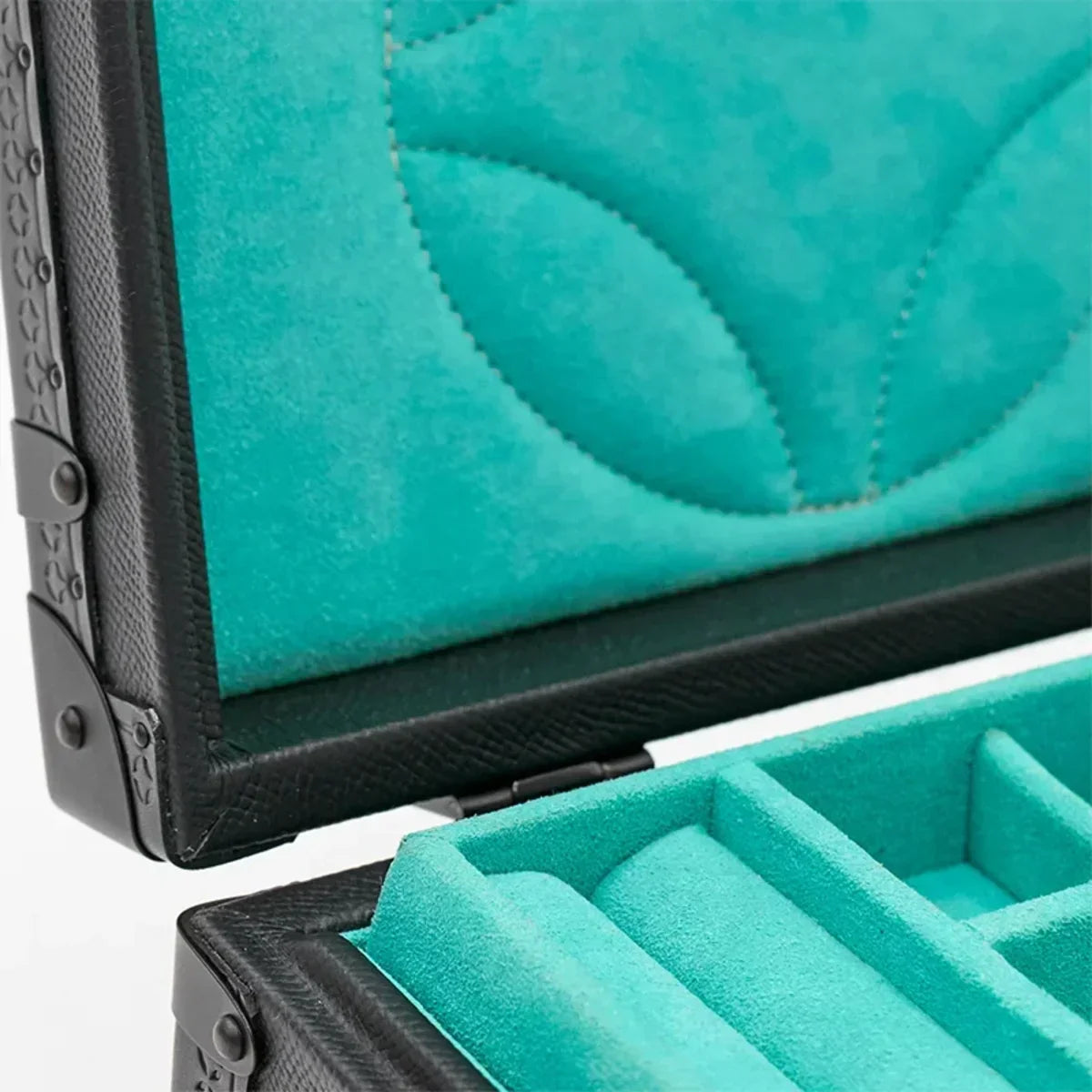
- Line with anti-tarnish material. Anti-tarnish microfiber suede actively limits sulphide formation at the contact surface — the reason SIRAE cabinets use tarnish-resistant microfiber suede rather than ordinary velvet.
- Give every piece its own slot. Metal-on-metal contact causes scratching (fatal for rhodium plating) and galvanic micro-corrosion between dissimilar alloys; chains should lie clasped and straight in individual channels.
- Seal the micro-climate and add desiccant. A gasketed drawer or closed hard case with a 10–20g silica gel sachet holds 35–45% RH whatever the villa's air is doing; recharge the sachet every 2–3 months.
Just as important is what to keep out of the storage box:
- Rubber bands and rubber-backed liners — vulcanised rubber releases sulphur compounds, the exact chemical that blackens silver and copper alloys, and can tarnish a chain through the air without touching it.
- Newspaper and ordinary cardboard — acidic, lignin-rich papers off-gas sulphur and peroxides; never wrap bridal gold in newspaper for "safekeeping".
- Cosmetics and perfume — alcohol and sulphate residues; keep the vanity's spray zone away from open trays, which is why a leather jewellery cabinet with closed drawers outperforms an open dresser-top organiser in a UAE bedroom.
- Bathroom adjacency — the highest-humidity room in the house; a walk-in wardrobe is ideal, an en-suite shelf the worst common choice.
For travellers, the same logic applies in miniature: a copper-wire petite jewellery box built with woven copper-wire hard case construction holds its protective micro-climate in transit far better than a soft pouch.
Bridal Sets and Eid Gold: Long-Term Storage in the Gulf
Two distinctly GCC scenarios are long-duration — which makes them high-risk.
Bridal gold sets. A 22K bridal set may be worn a handful of times a decade, spending years in continuous storage. For multi-year archiving: clean professionally first, wrap each component in acid-free tissue or anti-tarnish cloth (never cling film, which traps condensation), seal with fresh desiccant, and inspect every 6 months. A set archived correctly in 2026 should open in 2031 needing only a soft wipe.
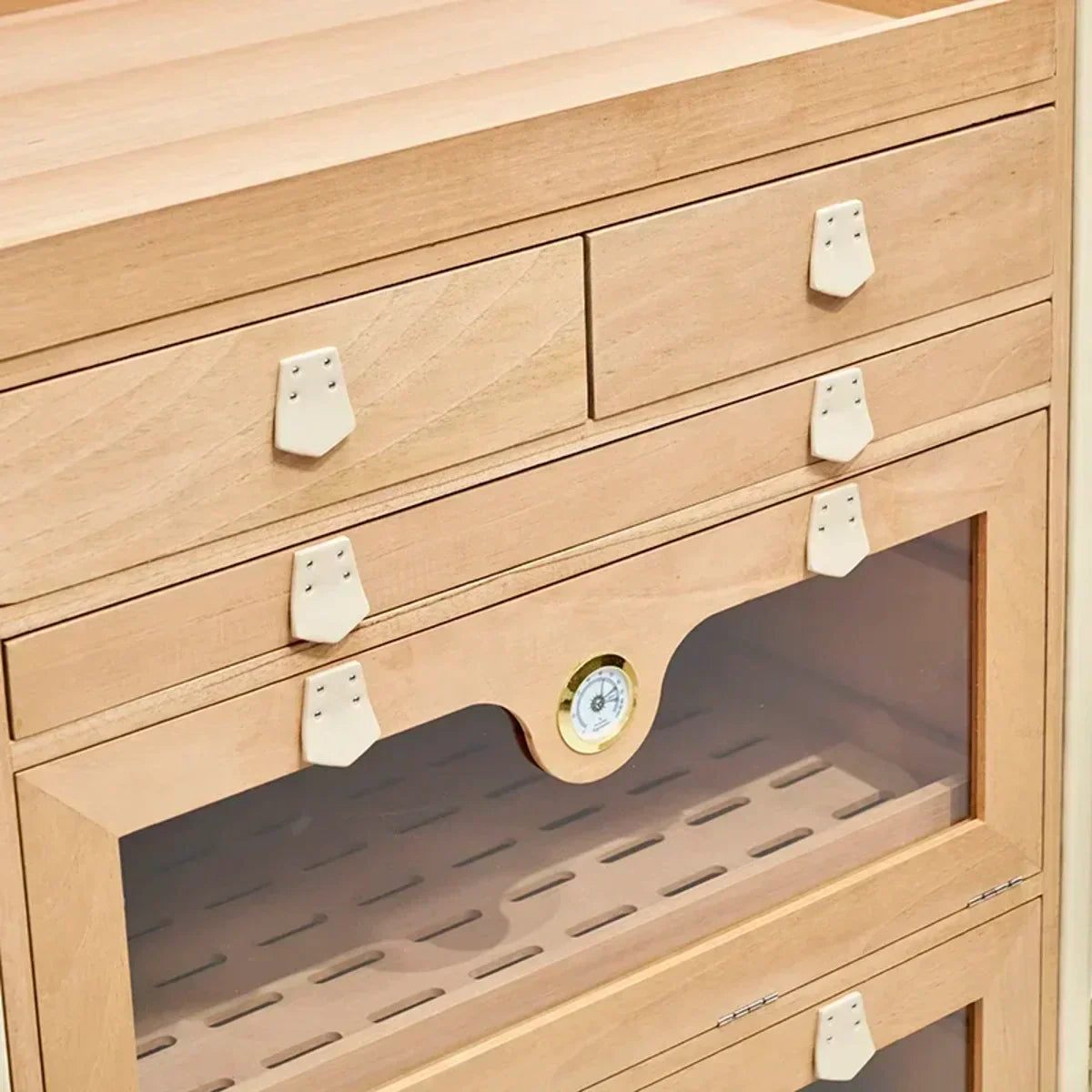
Post-Eid archiving. Pieces worn intensively across Eid Al Fitr and Eid Al Adha go into storage carrying a season of sweat residue at peak summer humidity. Build a simple ritual: the week after Eid, wipe every worn piece, check clasps and prongs, refresh the silica gel, and log what is stored where. Families managing inherited collections often dedicate a full-height leather jewellery cabinet to this seasonal rotation — daily pieces in the upper drawers, archived sets sealed below, behind soft-close drawers with solid brass hardware that itself resists Gulf corrosion.
The pattern is the same in both scenarios: Gulf tarnish damage concentrates in careless long-term storage, not in wearing. How you store gold jewellery between occasions matters more than how often you wear it.

FAQ: Storing Gold Jewellery in UAE Humidity
Does pure 24K gold tarnish in UAE humidity?
No. Pure gold is chemically inert to oxygen and sulphur at any natural humidity level. What looks like tarnish on high-karat pieces is usually surface residue (oils, dust, cosmetics) or reaction of the small silver/copper fraction in 22K alloys. A gentle clean restores 24K instantly; lower karats need preventive storage.
Can I store gold and silver jewellery in the same box?
Only in separate sealed compartments. Sterling silver tarnishes fastest, and its sulphide chemistry accelerates darkening of neighbouring gold alloys in a shared airspace. If one cabinet holds both, dedicate separate anti-tarnish-lined drawers and give the silver drawer its own anti-tarnish strips, replaced every 2–3 months.
How often should I replace silica gel in a jewellery box in the UAE?
Every 2–3 months under Gulf conditions, versus 6 months in temperate climates. Use an RH indicator card inside the compartment: when it reads above 50%, recharge the silica gel (2–3 hours in a 120°C oven for rechargeable beads) or replace the sachet. After humid-season door-opening spikes, check monthly.
Is air conditioning enough to protect jewellery from tarnish?
No. AC lowers midday indoor humidity to roughly 25% RH, but overnight cycling and opened doors push it back past 60–65%, and that daily swing drives condensation cycles on metal. Protection must come from a sealed storage micro-climate — gasketed drawers or hard cases with desiccant — not from room air.
Where is the worst place in a UAE home to keep jewellery?
The en-suite bathroom shelf, followed by sunny window-side dressers and car glove boxes. Bathrooms hit 80%+ RH daily; direct sun heats compartments past 35°C and accelerates every tarnish reaction. The best location is an internal walk-in wardrobe wall — stable temperature, no plumbing moisture, no UV.
To see how a custody-grade cabinet helps you store gold jewellery at a stable 35–45% RH — tarnish-resistant microfiber suede lining, sealed soft-close drawers, woven copper-wire and leather construction proven against Gulf humidity — book a private viewing at the SIRAE showroom, Al Shafar Complex, Umm Suqeim 1, Dubai. Call +971 55 886 6180 or write to info@siraecasa.com.
%0AIf%20you%20store%20gold%20jewellery%20in%20the%20UAE,%20you%20have%20p...)
Leave a comment
This site is protected by hCaptcha and the hCaptcha Privacy Policy and Terms of Service apply.