
Patek Philippe Box: Original vs. Bespoke Storage for Collectors
The Patek Philippe Box: Safeguarding Provenance Beyond Original Packaging
For the discerning collector, the ritual of acquiring a Patek Philippe is a profound experience, and its original box is a tangible part of that narrative. Yet, as a collection of grand complications grows, the lacquered wood and leatherette cases present a paradox: they are integral to the watch's history but often impractical and, in some cases, detrimental to its long-term preservation, especially within the demanding climate of Dubai and the wider MENA region.
This guide navigates the collector’s path from original packaging to commissioned, climate-controlled storage solutions. We will explore the balance between retaining complete provenance and adopting superior methods of care that protect both the timepiece and its future value.
Guide to This Commission
- The SIRAE Standard: A Technical Comparison
- The Original Patek Philippe Box: An Asset or an Afterthought?
- Beyond the Box: The Collector's Dilemma of Space, Materials, and Practicality
- Curating a Legacy: Integrating Commissioned Storage with Original Provenance
The SIRAE Standard
Technical Verdict: Original manufacturer packaging from certain eras utilises petroleum-based synthetics and adhesives prone to degradation, especially under >50% RH and fluctuating temperatures typical of the Gulf. Commissioned cabinetry mitigates this with inert, archival-grade materials and active climate control, ensuring asset stability while optimising vault space.
| Symptom / Observable Failure | Root Cause (Material & Environment) | SIRAE Engineering & Verification |
|---|---|---|
| Flaking interior lining ("snowstorm effect") | Polyurethane (PU) leatherette & unstable adhesives degrading over time. | Inert, non-reactive microfiber suede and leather lining. Verified stable in climate-cycle testing. |
| Warped wood or peeling veneer | High humidity swings causing material expansion/contraction. | Solid wood core with furniture-grade veneer panels. Assessed for dimensional stability pre-fabrication. |
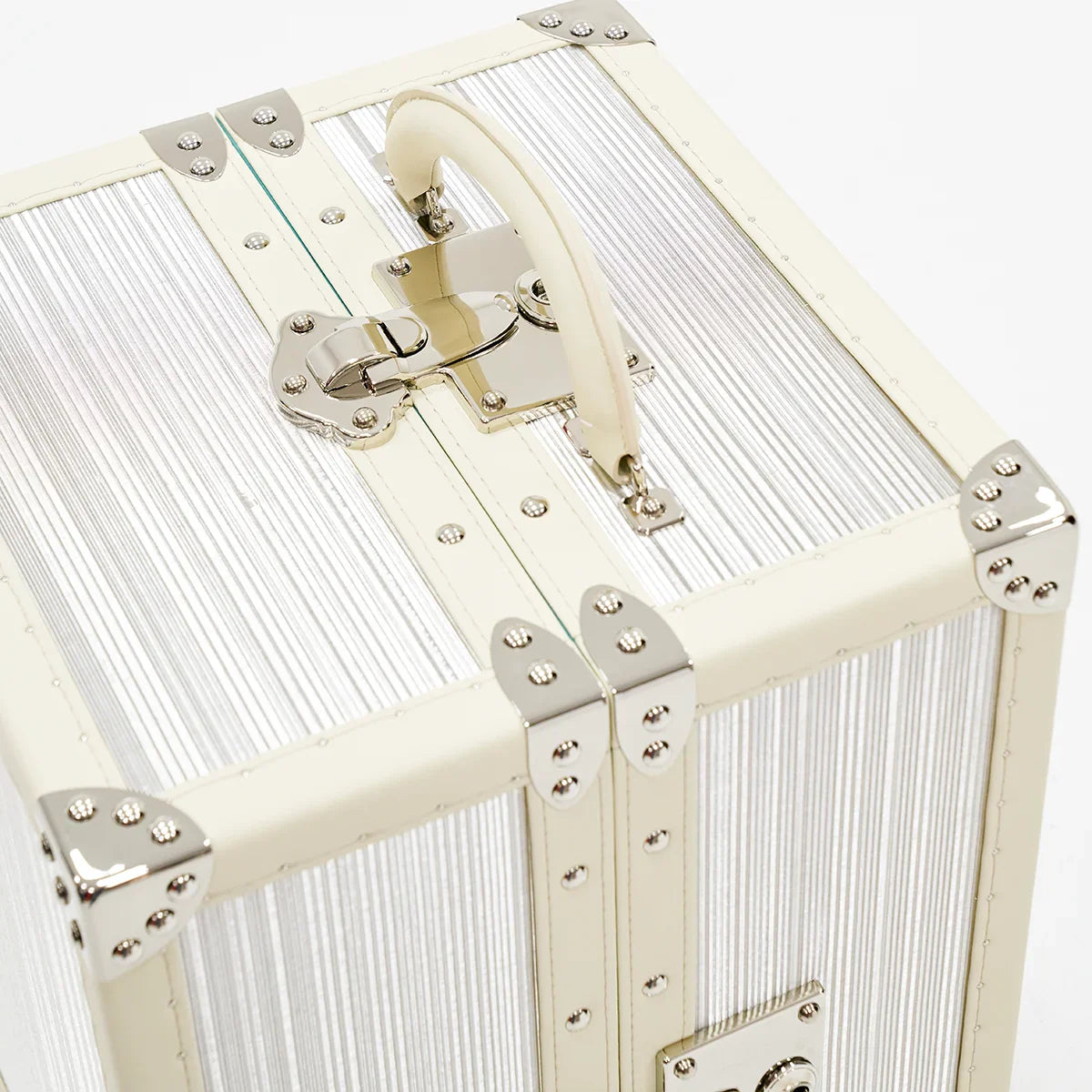
| Inefficient vault footprint | Oversized, non-stackable presentation box design. | Space-optimised modular cabinetry, such as the Aurum Wire Watch Case - Frosted Silver. |
| Lack of mechanical upkeep | Static storage for automatic movements. | Integrated, low-noise watch winder modules. TPD & directional settings verified for specific calibres. |
SIRAE cabinetry is engineered to provide a chemically stable micro-environment, moving beyond passive storage to active, long-term preservation. This approach addresses the inherent material science limitations of mass-produced presentation packaging.
The Original Patek Philippe Box: An Asset or an Afterthought?
The Bottom Line: The original box is a critical component of a watch's full set, essential for maximising auction value and authenticating its history. However, its primary function is presentational, not archival preservation, with materials that were not specified for multi-decade stability.
There is an undeniable romance to the original Patek Philippe box. For generations of collectors, it has been the ceremonial vessel for some of horology's greatest achievements. This connection was understood by leaders like Philippe Stern, who famously became one of the first clients of the Italian artisan case-maker Scatola del Tempo, signalling an early appreciation for dedicated, high-quality storage beyond the point of sale.
Yet, collectors' forums are replete with cautionary tales. The elegant boxes of the 1990s and early 2000s are now known for their deteriorating inner linings, a fine powder of degrading material that can potentially infiltrate a timepiece. This contrasts sharply with the experience of owning, for example, a modern Glashutte Original, which thoughtfully includes a detachable leather travel pouch, or the notoriously oversized case for the Omega Speedmaster Moonwatch, which presents its own significant storage challenges.
The consensus among seasoned collectors is clear: while the box and papers are non-negotiable for establishing provenance, relying on the box for daily or long-term storage is a risk. It is an accessory to the asset, not its permanent home.
Beyond the Box: The Collector's Dilemma of Space, Materials, and Practicality
Technical Verdict: Standard-issue watch boxes are susceptible to accelerated decay in high-humidity environments. Commissioned solutions counter this with archival-grade materials like our hand-sewn microfiber suede and proprietary woven copper-wire facades, preventing off-gassing and material breakdown.
The practical challenges of a growing collection quickly become apparent. Private vaults in Dubai villas have finite space, and the bulky, decorative nature of modern watch boxes makes them profoundly inefficient. A closet filled with empty packaging is a common reality for enthusiasts who must separate the watch from its impractical housing to make storage manageable.
The more pressing concern, however, is material science. The "flaking" phenomenon is a result of chemical decomposition. The synthetic leathers and foams used in many boxes from past decades are breaking down, releasing volatile organic compounds and fine particles. This process is expedited by the heat and humidity characteristic of the Gulf climate, posing a direct threat to the delicate dials, oils, and polished surfaces of the timepieces they are meant to protect.
This material vulnerability stands in stark contrast to the principles of fine cabinet making. Purpose-built storage, founded on our proprietary copper-wire hard case craft, utilises stable, proven materials—solid wood structures, tarnish-resistant microfiber linings, and precision-engineered solid brass fittings—to create a sanctuary for the collection, isolating it from environmental threats.
Curating a Legacy: Integrating Commissioned Storage with Original Provenance
Technical Verdict: A commissioned multi-unit watch winder cabinet or storage vault offers a functionally superior solution that enhances, rather than replaces, original provenance. It provides calibrated mechanical maintenance, environmental stability, and sophisticated security while allowing original boxes to be archived separately in ideal conditions.
The most sophisticated solution is not a choice between the original box and a new one, but an integration of both into a comprehensive preservation strategy. A commissioned piece, such as the SIRAE Aurum Wire Watch Box - Noir & Crème, is not merely a box; it is a piece of precision furniture engineered for collectors. It maintains the collection in a state of perfect readiness, with programmable winders ensuring that complex movements are kept in optimal condition.
(/blogs/news/choosing-leather-jewellery-box-dubai), showing the Aurum Wire collection with its distinct woven copper-wire facade.]
This approach allows the collector to honour the watch's history while protecting its future. The original boxes, papers, and tags—the complete set that defines its provenance—can be stored separately in a cool, dry, and dark environment, preserving their own condition. Meanwhile, the timepieces themselves reside in a secure, accessible, and environmentally controlled cabinet that celebrates the collection as a whole.
This is the ultimate expression of stewardship. It acknowledges that a collection of this calibre is a legacy, an asset that requires a level of care and foresight far beyond what standard packaging can provide. By investing in a dedicated storage solution, the collector is not discarding history, but ensuring it endures for the next generation.
To explore a commissioned storage programme tailored to the specific demands of your collection and residence, we invite you to arrange a private consultation at our Dubai showroom on Jumeirah Beach Road. Our specialists are available to demonstrate how precision engineering and fine craftsmanship can provide the ultimate security and preservation for your most treasured assets. Please contact our private client line at +971 55 886 6180, email info@siraecasa.com, or visit us at First floor, Al Shafar Complex, Umm Suqeim 1, Dubai. Further details can be found at https://www.siraecasa.com.
Collectors weighing this balance can see both philosophies side by side in our watch boxes and winders collection.
- The Best Watch Box for Men: A UAE Gentleman's Guide
- The Best Watch Box for Your Rolex Collection: A Connoisseur's Guide
- The Cartier Watch Box: From Iconic Red Case to Collector's Vault
- Watch Box vs Watch Winder vs Watch Case: Which Do You Need? (UAE Guide 2026)
- Choosing the Perfect Luxury Watch Box: A UAE Collector's Guide

Leave a comment
This site is protected by hCaptcha and the hCaptcha Privacy Policy and Terms of Service apply.