
Home Safe vs Bank Vault in the UAE: Where Should You Keep Fine Jewellery? (2026)
Home Safe vs Bank Vault in the UAE: Where Should You Keep Fine Jewellery? (2026)
A home safe is the default answer most people reach for when a jewellery collection outgrows a dresser drawer — but in the UAE the real decision is a three-way trade-off between a home safe, a bank safe deposit box, and a private vault, and the right answer is rarely all of one. Most of the ranking advice on this question is written for the United States, where bank-box rules, deposit insurance and access culture are completely different from the Gulf. This 2026 guide reframes the decision for a UAE resident: where each option genuinely protects you, where it quietly fails, what UAE-specific realities about bank lockers and insurance change the maths, and how custody-grade home storage closes the gap between convenience and security.

Should You Keep Fine Jewellery at Home or in a Bank in the UAE?
Quick Answer: Keep the jewellery you actually wear at home in a quality home safe or custody-grade locked trunk, and reserve a bank safe deposit box or private vault for irreplaceable, rarely-worn or investment-grade pieces. For most UAE residents the practical split is roughly 70% at home for access and 30% in a vault for the pieces you would never be able to replace. A single location is almost always the wrong answer.
The reason the binary "home or bank" framing fails is that the two options optimise for opposite things. A home safe optimises for access and control — you can open it at midnight before a flight, you decide who knows it exists, and there is no third party between you and your property. A bank or private vault optimises for hardened security and removal of the piece from the place burglars actually target: your home. Fine jewellery is not one category. The diamond riviere worn three times a year and the everyday gold bangles have completely different access profiles, and forcing both into one location guarantees that one of them is stored wrong.
The UAE adds a layer that US-oriented guides miss entirely. Bank safe deposit lockers here are genuinely scarce — residents and the local press have long described them as "rare and expensive," with some branches running multi-year waiting lists, so the bank-box option may simply not be available to you on demand (Gulf News). That scarcity, combined with the access and insurance realities below, is why a serious home storage solution is not a fallback in the UAE — for many collectors it is the primary layer.

Home Safe vs Bank Safe Deposit Box vs Private Vault: The Comparison
The Bottom Line: A home safe wins on access and control but depends entirely on your villa's own security; a bank safe deposit box wins on hardened security but loses on access hours, availability and — critically in the UAE — on the bank's near-total disclaimer of liability for the contents; a private vault sits between the two, often offering 24/7 access with vault-grade security at a price. Match the tier to the piece, not the piece to one tier.
The table below maps the three options against the factors that actually decide where a piece should live. Read it by piece, not by collection: a single watch you wear weekly and a inherited diamond set you wear once a year belong in different rows of the answer.
| Factor | Home safe / custody-grade storage | Bank safe deposit box | Private vault (e.g. specialist providers) |
|---|---|---|---|
| Access hours | 24/7, instant | Branch business hours only | Often 24/7 at automated providers |
| Availability in UAE | Immediate — you own it | Scarce; waiting lists reported up to years | Generally available to rent |
| Contents insured by provider | No — you arrange cover | No — bank disclaims liability for contents | No — you arrange cover |
| Security level | Depends on safe rating + villa security | Vault-grade, monitored | Vault-grade, monitored |
| Privacy / control | Full — you decide who knows | Bank holds access log | Provider holds access log |
| Best for | Everyday and frequently-worn pieces | Irreplaceable, rarely-worn, investment pieces | Overflow / high-value with access needs |
| Recurring cost | One-time purchase | Annual rental + VAT | Annual rental + VAT |
| Climate control | You control room AC/humidity | Generally climate-stable | Generally climate-stable |
Two columns deserve emphasis because they overturn the US-style advice. First, the "contents insured by provider" row reads No across all three. The UAE has no deposit-insurance scheme that extends to safe deposit box contents, and UAE banks typically disclaim liability for what is inside the locker — guidance for Dubai is explicit that contents are not insured by the bank and you must arrange cover with your own insurer (Arnifi). A bank box is a stronger box; it is not a guarantee. Second, the access row is not a minor inconvenience in a hosting culture where jewellery is worn for evening events that are planned at short notice — a piece locked in a branch that opens at 9am is unavailable for tonight.
What the UAE Gets Wrong vs the US Model (No FDIC, No Bank Liability)
Technical Verdict: In the United States, a safe deposit box sits inside an FDIC-insured institution, but even there the FDIC does not insure the contents of the box — and in the UAE there is no equivalent deposit-insurance backstop for the institution either. The practical takeaway is identical in both countries and stronger here: never assume a bank box insures your jewellery. Your own scheduled jewellery policy is the only thing that does.
This is the single most consequential misunderstanding among people relocating to the Gulf. They assume a bank vault transfers risk to the bank. It does not. Across jurisdictions, banks limit their liability for locker contents and do not verify or record what you store; in the event of loss your recourse can be very limited. In the UAE specifically, the disclaimer is standard and the regulatory framework around lockers focuses on access control and procedures for deceased or unresponsive customers rather than on indemnifying contents. The vault protects the jewellery physically. The insurance protects you financially. They are two separate purchases and you need both regardless of where the piece sits.
There is also a supply reality. Because bank lockers are scarce, an entire private-vault sector has grown in Dubai and across the Emirates — automated facilities offering round-the-clock access, and rental boxes starting at modest annual fees. These are a legitimate middle tier. But they carry the same insurance truth: the provider secures the box, not the value inside it. Whichever external option you choose, the home layer remains the one you control completely — which is why the quality of your home storage, not just the existence of a bank box, determines how well your collection is actually protected.

What Is "Custody-Grade" Home Storage — and Why It Matters in a Villa
Quick Answer: "Custody-grade storage" is SIRAE's category for home jewellery storage built to a higher standard than a decorative box but to a different brief than a steel bolt-down safe: lockable, biometric where appropriate, climate-considered for Gulf conditions, and designed to live openly in a dressing room rather than be hidden in a cupboard. It is the layer that makes keeping jewellery at home a deliberate security decision instead of a default one.
A standard jewellery box solves organisation, not security — it is, as security guidance everywhere notes, the first place an intruder looks. A heavy fire-rated floor safe solves security but is an industrial object you hide, and it does nothing for the daily ritual of getting ready. Custody-grade storage is the middle path that suits how UAE villas are actually lived in: a piece you open with a fingerprint, that keeps a collection organised and visible to you, that resists casual and opportunistic theft, and that you are happy to have on display because it is also beautiful furniture.
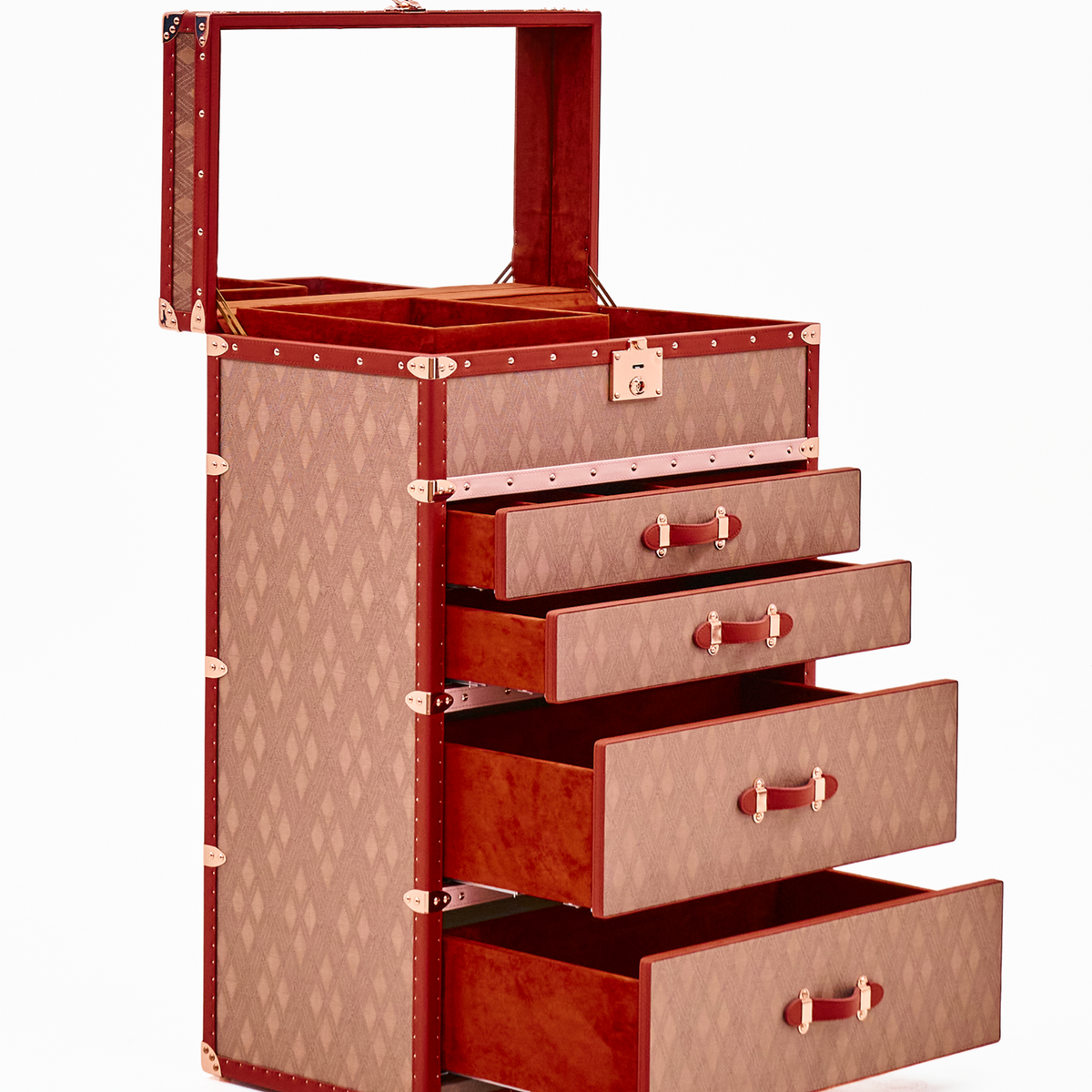
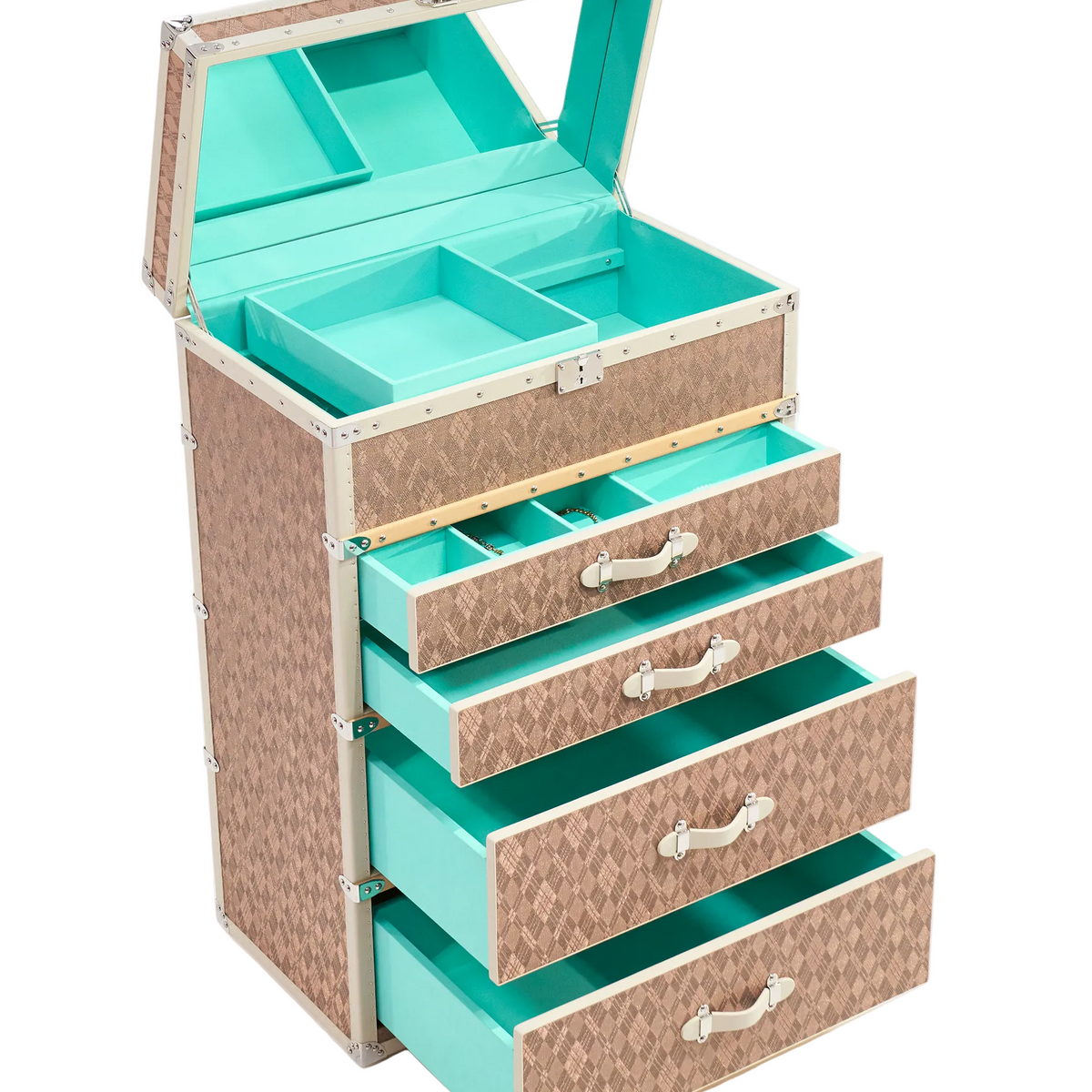
Three features define the category. Access control: a genuine lock, and increasingly a biometric one, so the contents are secured against household staff, guests and contractors — a real exposure in serviced villas — without a key that can be copied. The Aurum Wire · The Amber Jewelry Cabinet - Dune Gold is built precisely around this: fingerprint access on a woven copper-wire trunk that reads as a furniture piece, not a safe. Organisation under lock: tiered trays, ring rolls and necklace bars so the collection is laid out and inventoried the moment you open it — the Aurum Wire · The Celeste Jewelry Cabinet - Diamond Mist Blue carries this into a standing cabinet format for larger collections. Climate consideration: construction that is dimensionally stable through the UAE's indoor humidity swing, with interiors that protect against the tarnish that Gulf coastal air accelerates on silver and white metals.
How to Split a Collection: A Practical UAE Storage Map
The Bottom Line: Sort every piece by two axes — how often you wear it and how irreplaceable it is — and the storage location follows almost automatically. Frequently worn goes home; rarely worn and irreplaceable goes to a vault; the large middle group of valuable-but-worn pieces lives in custody-grade home storage where access and security are balanced. Then insure the whole collection on a scheduled policy regardless of location.
The map below is the working version of that logic. It is informational, not financial advice — your insurer's specific thresholds and your own risk tolerance set the final lines.
| Piece profile | Worn how often | Recommended location | Why |
|---|---|---|---|
| Everyday gold, watch you wear weekly | Often | Home — custody-grade locked storage | Access daily; security against casual/staff theft |
| Statement pieces worn to events | Monthly | Home — biometric trunk or cabinet | Short-notice access for evenings; locked when not worn |
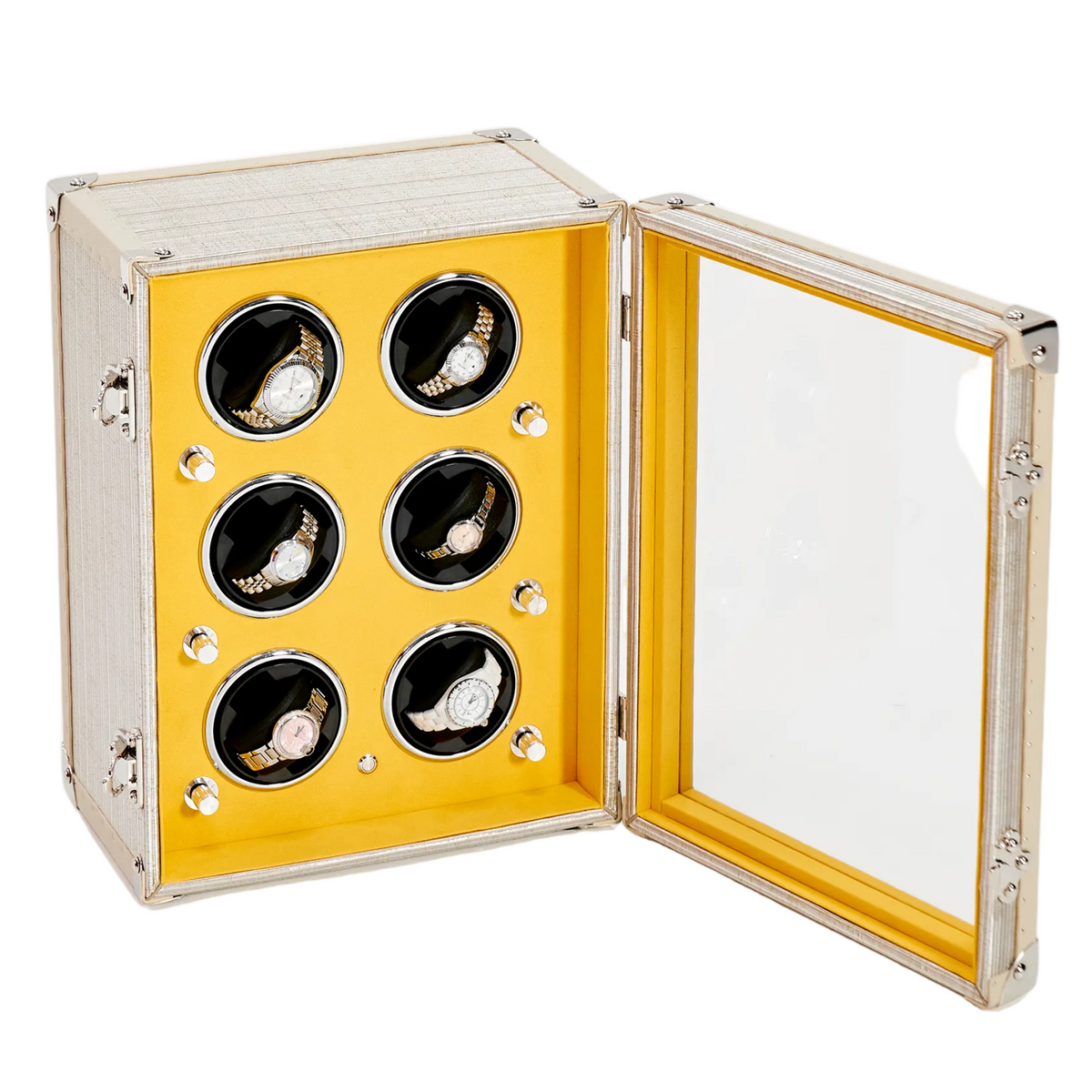
| High-value sets, fine watches | Few times a year | Home (custody-grade) or private vault | Balance of access and hardened security |
| Irreplaceable heirlooms, investment stones | Rarely / never | Bank safe deposit box or private vault | Removed from the home, the actual theft target |
| Documents: appraisals, certificates | N/A | Copies home, originals in vault or digital | Needed to prove value for any claim |
A few UAE-specific notes sit underneath the table. Keep digital photographs and appraisal certificates for every significant piece — they are what an insurer needs to settle a claim, and they belong with you, not solely in the locked box. Be deliberate about who in the household knows where the home storage is and how it opens; biometric access removes the copied-key problem that plagues serviced villas. And remember the access asymmetry one more time: anything you might wear at short notice should never be the piece sitting in a branch that closes at 4pm. For collectors building toward a larger holding, the Aurum Wire · The Pearl Jewelry Cabinet - Pearl White offers the same custody-grade construction in a lighter palette suited to a bright Gulf dressing room.

Insurance: The Layer That Decides the Real Answer
Quick Answer: Where you store jewellery in the UAE affects your insurance premium and sometimes your eligibility — many home contents policies cover jewellery at a lower rate when it is stored in a safe than when it is worn, and high-value items above a threshold typically must be individually scheduled. Storing pieces in custody-grade locked storage is not just safer; it can be the condition on which cover is offered or priced.
UAE home contents policies generally include jewellery, but with structure. High-value items — commonly those above roughly AED 40,000–50,000 — usually need to be specified individually under a personal-possessions or scheduled section rather than absorbed into a general contents limit, and the premium can reflect whether a piece is typically locked away or routinely worn. This is where the home-safe decision and the insurance decision converge: a quality locked or biometric storage solution can be the difference between a piece being insurable on reasonable terms and being effectively uncovered. Always confirm the exact thresholds, security requirements and documentation your insurer asks for — this article is general information, not personalised insurance advice, and policies differ. The constant across every scenario is that the storage and the schedule work together: the vault or trunk protects the object, the scheduled policy protects its value.
Frequently Asked Questions
Is it better to keep jewellery at home or in a bank in the UAE? For most UAE residents the right answer is both, split by how a piece is used. Keep frequently-worn jewellery and watches at home in a quality locked or biometric storage piece for instant access and control, and reserve a bank safe deposit box or private vault for irreplaceable, rarely-worn or investment-grade items. Bank lockers in the UAE are scarce and access is limited to branch hours, so anything you might wear on short notice should stay home. Whichever location you choose, insure the pieces separately — no provider insures the contents for you.
Are the contents of a bank safe deposit box insured in the UAE? No. UAE banks typically disclaim liability for the contents of a safe deposit box and there is no deposit-insurance scheme covering box contents. The bank secures the vault and the access process; it does not indemnify what is inside. The same is true of private vault providers. To protect the financial value of jewellery in any vault, you need your own scheduled jewellery or home contents insurance policy. Treat the box as a stronger physical container, never as a transfer of financial risk to the institution.
What should you never keep in a bank safe deposit box? Anything you may need urgently or outside banking hours — passports you travel with at short notice, original wills, and jewellery you might wear to an event planned the same week. Because UAE branch access is limited to business hours and lockers can be scarce, time-sensitive items are poorly suited to a bank box. Keep those at home in custody-grade storage. Reserve the bank box for items whose value is high, whose loss would be irreplaceable, and whose access is genuinely rare.
Is a home safe secure enough for fine jewellery in a Dubai villa? A custody-grade home storage piece is secure enough for everyday and frequently-worn fine jewellery, provided it is properly locked or biometric and your villa has its own alarm and access discipline. It protects against opportunistic and household-staff theft — the most common real-world risk in serviced villas — and gives you 24/7 access. For the small subset of pieces that are irreplaceable or rarely worn, add an external vault layer. The home safe is the primary layer for what you use; the vault is the deep layer for what you cannot replace.
Visit the SIRAE Showroom in Dubai
Choosing between a home safe and a bank vault is ultimately a question of how a collection is lived with, and that is easier to resolve in person than on paper. To see how custody-grade storage — biometric jewellery trunks and locking cabinets built for Gulf conditions — fits the access and security split your collection needs, book a private appointment at the SIRAE showroom, Al Shafar Complex, Umm Suqeim 1, Dubai. Call +971 55 886 6180 or write to info@siraecasa.com, and our team will help you map which pieces belong at home and how to store them well.
- Gold Bar Safes in Saudi Arabia: A Private Commissioning Guide
- Jewellery Safe vs. Jewellery Box: A Collector's Guide to Asset Protection
- The Biometric Jewellery Armoire: Blending Instant Access with Fortress-Grade Security
- Beyond the Vault: Securing Valuables from Internal Threats with Biometric Alerts
%0AA%20home%20safe%20is%20the%20default%20answer%20mos...)
Leave a comment
This site is protected by hCaptcha and the hCaptcha Privacy Policy and Terms of Service apply.